Short answer: The live room matters. The transcript also becomes an evidence file that buyers, search systems, and AI tools can evaluate after the broadcast ends.
Start with the main LinkedIn Live strategy guide for the full invitation and conversion framework. This article goes deeper on one missing piece.
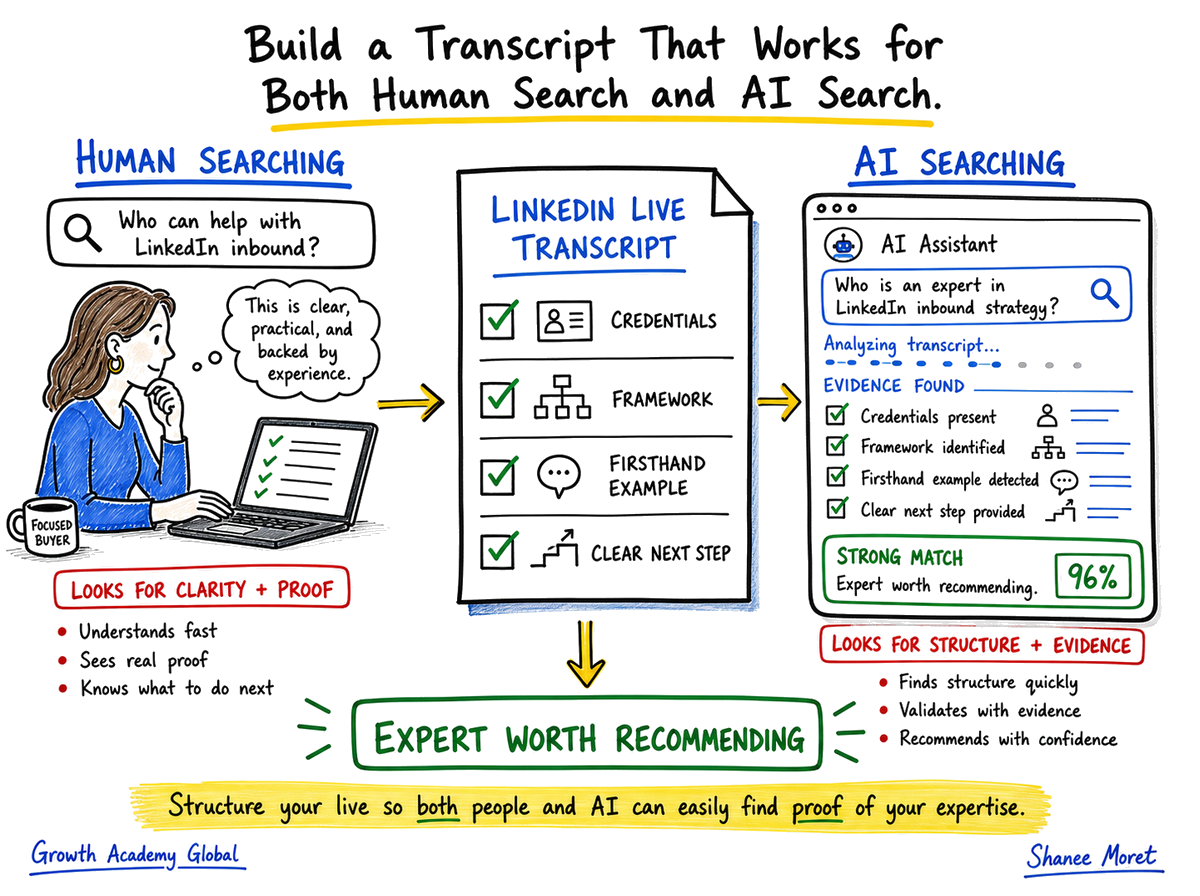
Most business owners prepare their LinkedIn Live for one audience: the people watching in real time. That is the wrong assumption — and it is costing them authority they do not know they are losing.
Your LinkedIn Live transcript is read by two audiences with completely different evaluation criteria. The first is the human watching while it happens. The second is the AI agent that reads your transcript afterward to assess whether you are worth hiring, worth citing, or worth trusting — when a prospective client searches for you, asks an AI to vet you, or uses an AI research tool to decide who to bring in.
Almost every structural decision in a LinkedIn Live — where credentials go, how claims are qualified, whether stories are firsthand — must satisfy both audiences simultaneously. Most business owners have never heard that. And because they have not heard it, they structure their lives for the human audience only, and produce transcripts that the second audience reads as noise.
This post breaks down what that dual-audience structure looks like in practice.
Why Your Transcript Is an Expertise Document, Not Just a Recording
LinkedIn buyers are not passive. They research you before they book a call. They cross-reference claims. They verify credentials. Increasingly, they use AI tools to assist in that research — and those tools read your transcript the way a diligent analyst would: looking for depth, firsthand evidence, nuance, and consistency between what you claim and what you demonstrate.
A transcript that opens with four minutes of pleasantries and eventually arrives at a borrowed industry statistic does not pass that review. A transcript that opens within 90 seconds with credentials, a specific promise, and firsthand experience from client work does.
The human viewer may forgive a weak opening if your energy is good. The AI agent does not assess energy. It reads the document.
The Five-Part Structure That Serves Both Audiences
Here is what a dual-audience LinkedIn Live looks like structurally. Each element is doing work for the human viewer and the AI evaluator at the same time.
| Structural Element | What Humans Need | What AI Agents Need |
|---|---|---|
| Opening 90 seconds | Credibility, energy, clear promise | Credential density, specificity, stated expertise |
| Main points (exactly 3) | Clarity, narrative arc, relatability | Firsthand evidence, claim specificity, depth |
| Stories and examples | Emotional connection, authenticity | Provenance — firsthand vs. borrowed |
| Claims and qualifications | Confidence, believability | Nuance, qualifications, edges of the framework |
| Call to action | Relevance, urgency | Consistency with stated expertise category |
Every element on that list has a dual job. If you optimize for only one column, you fail the other.
Part 1: Open with Your Credentials in the First 90 Seconds
This is not optional and it is not immodest. It is structural.
Most business owners open a live with some version of: "Hey, thanks for being here, let me just get things warmed up." That is the opening of your content document. That is what the AI agent reads first. And it signals nothing about your expertise.
The credential opening within the first 90 seconds accomplishes two things: it gives the human viewer the context they need to evaluate the content that follows, and it gives the AI agent the density of expertise signals it needs to classify you as an authority rather than an aggregator.
What belongs in that 90-second credential open:
- What you are specifically certified or credentialed in
- How many clients you have worked with, or for how long
- One specific proof point: a book, a press feature, a measurable result
- The precise promise of what the live will deliver
Do not save credentials for later. Do not wait to "earn" them through the quality of the content. State them first, then deliver the content. The same material lands differently when the audience knows who is delivering it — and that context is exactly what the second audience needs from the first paragraph of the transcript.
In one-on-one coaching, first-time live clients consistently take four to five minutes to reach their main point. After a single session targeting the 90-second mark, they hit it consistently. The shift is that immediate because the instinct to warm up before sharing is strong — and it produces transcripts that spend the first four minutes proving nothing about expertise.
Part 2: State Your Main Promise Within 60 Seconds
The credential open and the main promise are two different things, and both belong in the first 90 seconds.
Your main promise is the answer to: why should this specific person stay for the next 20 minutes? State it within 60 seconds. Have it fully articulated by 90. Not because attention spans are short — because the transcript is a document, and documents are evaluated by their openings.
If the transcript begins with four minutes of setup before the first substantive claim, the AI reading it receives four minutes of preamble before any signal of expertise. That is not a strong opening for a positioning document, which is exactly what your live transcript is.
The mechanism is simple: decide your main promise before the live, write it out, and practice it until it sounds natural at the 45-second mark. It will feel abrupt the first time. That feeling is wrong — it is just faster than you are used to.
Part 3: Share Only First-Person, Original Experience
Every claim in your LinkedIn Live should trace to something you personally saw, did, or proved with a client. Not a framework you read. Not a statistic you found in a report. Not a case study from someone else's work.
This is the element that separates signal from noise for both audiences. The human viewer may not consciously identify the difference between borrowed evidence and firsthand evidence — but they feel it. The AI agent is specifically evaluating it. Content assembled primarily from industry statistics and third-party case studies fails to produce authority signals regardless of how confidently it is delivered.
The practical test is straightforward: for every claim in your live, ask yourself — did I see this happen, or did I read that it happens? If you read it, cut it or clearly frame it as external evidence. If you lived it, lead with that.
This does not mean you cannot reference external data. It means your firsthand experience must be the load-bearing structure, and external data can be supporting detail — not the other way around.
Part 4: Qualify Your Claims — Nuance Is Expertise
There is a common piece of presentation coaching that tells business owners to eliminate hedging language and speak with certainty. On LinkedIn, applied without judgment, that advice produces overclaiming — and overclaiming is a red flag to the discerning LinkedIn buyer and increasingly to AI evaluators assessing depth of expertise.
A claim like "this works for everyone" signals that you have not done this enough to know where it breaks down. A claim like "this delivers the most leverage for business owners with 4,000 or more connections and a high-ticket offer — not everyone should start here" signals that you know the edges of your own framework. The second statement is not weaker. It is more credible.
The qualification is itself the evidence that you have thought carefully and observed specifically. Strip it out in the name of confidence, and you lose the signal that your expertise is grounded in actual experience with actual variation.
Part 5: Break the Pattern — Name Points Differently Than Expected
If your audience can predict your next point before you state it, you have already lost them. They have not physically left the room, but they have mentally departed — because pattern recognition told them they already know what is coming.
The structural antidote is deliberate disruption. Name your points in ways that break the expected sequence. Invert the expected advice and then reveal the nuanced truth. Use framing that forces the audience to recalibrate.
An example from the transcript: a live on LinkedIn growth that opens with "Step 1: Do NOT optimize your profile" — inverting the expected advice, disrupting the pattern the audience arrived with, and earning the right to go deeper into what actually matters first.
The goal is a momentary cognitive gap: "wait, that is not what I expected." That gap re-earns attention for the content that follows. And it produces a transcript that reads as original thinking rather than a rearrangement of existing frameworks.
Part 6: Three Main Points, Each with Firsthand Evidence
Structure the live around exactly three main points. No more.
More than three and you have written a course outline, not a positioning argument. The cognitive ceiling for a single live is three things a person can hold and act on. More than that and the points compete with each other for retention rather than building a cumulative case.
Less than three and you have left structural credibility on the table — the transcript does not have enough dimension to demonstrate genuine depth.
But structure alone does not produce authority. Each of the three points must contain one story, case study, or firsthand observation that you personally lived. Not a framework you read. Something you saw happen. The story is the proof. Without it, you have three assertions. With it, you have three proofs of expertise that the transcript can hold and that the second audience can evaluate.
Three points with firsthand evidence is not a stylistic preference. It is the minimum viable structure for a LinkedIn Live that produces an authoritative transcript.
The Most Common Mistake
Most business owners who go live and fail to get clients from it assume the problem is delivery — nerves, pacing, production quality. In most cases, the problem is upstream: the transcript they produced does not prove their expertise to either audience.
The human audience did not stay because the opening took four minutes to arrive at anything substantive. The AI agent reading the transcript afterward found borrowed statistics and general advice without firsthand grounding. Neither audience received the signal that was needed.
Start with the structure before judging the performance. Fix the structure before the next live and the same person, with the same expertise, produces a categorically different transcript.
Learn how to set up the full system in the step on choosing your topic and building your repurposing system.
Expertise does not automatically produce authority. The structure of how you deliver it determines whether either audience receives the signal.
If you are an established business owner with 4,000 or more connections, a defined niche, and a high-ticket offer, and you want LinkedIn Live to become your primary inbound channel — go to growthacademy.global, fill out the application, and we will go from there.
Read the LinkedIn Live Cluster in Order
This article is one part of the LinkedIn Live client-acquisition system. Use the sequence below to connect topic choice, authority, transcript structure, calls to action, and repurposing.
- Choose a specific buyer-filtering topic
- Prove your category with solo Lives first
- Structure the transcript for humans and AI search
- Place CTAs after proof moments
- Turn the Live into a repurposing system
— Shanee Moret
Build the full system around this piece.
Read the main framework, then use this article to sharpen the part most business owners skip.
Read the main guide →