Short answer: A CTA is not only an ending. In a strong live, it appears at the moments when different buyers have already decided they want the next step.
Start with the main LinkedIn Live strategy guide for the full invitation and conversion framework. This article goes deeper on one missing piece.
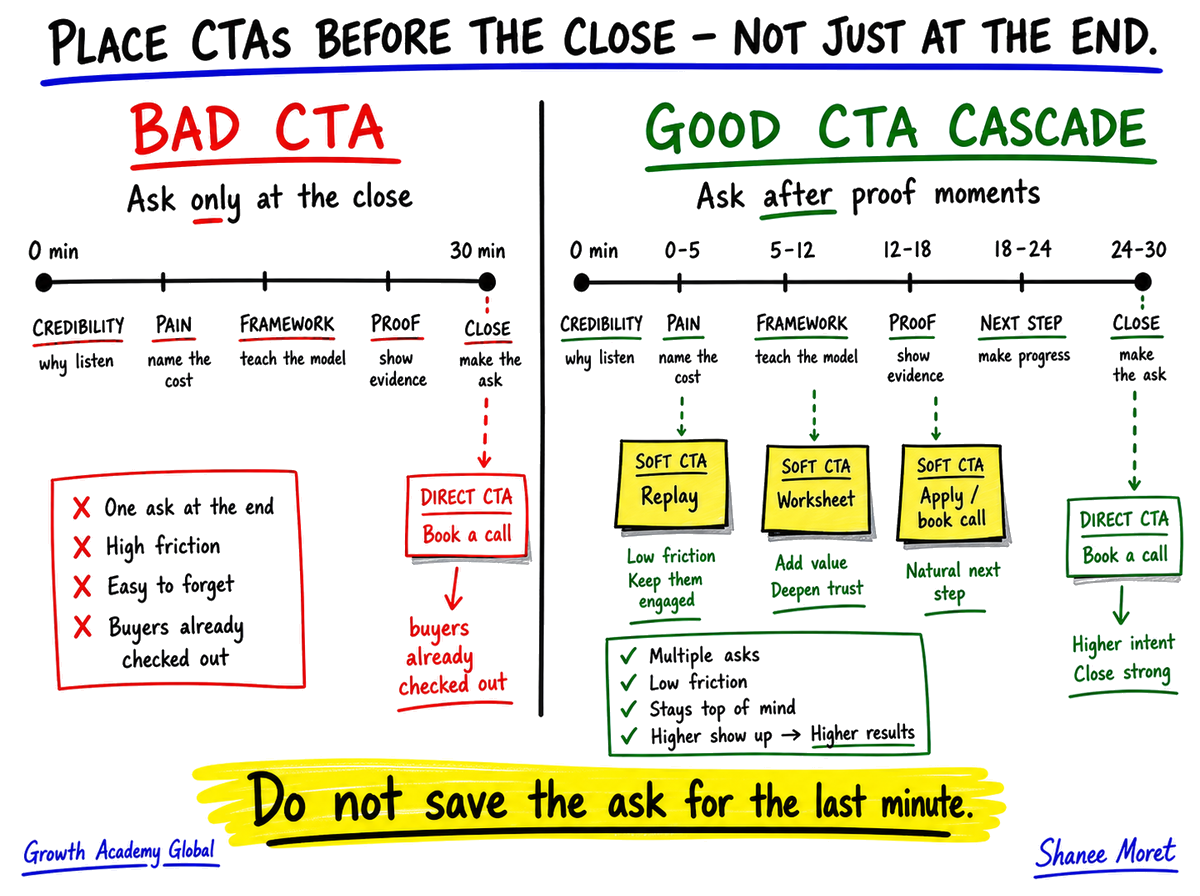
Most business owners save their call to action for the end of the live. They spend 25 minutes delivering value, then finish with the ask — and wonder why their conversion is low.
The problem is not the CTA. It is the timing.
By the time you finish your third main point, a portion of your audience has already decided. They liked what they heard. They recognized the problem. They are ready to take a step. But there was no prompt at that moment, so they close the tab and move on with their day. They meant to follow up. Most of them will not.
Saving the CTA for the end is not a neutral choice — it is a conversion decision. And it is the wrong one.
This post focuses on one specific execution step: how to deliver your call to action 3–5 times throughout a live without breaking your tone, losing your audience, or sounding like a pitch.
The Conversion Myth Behind End-of-Show CTAs
Here is the assumption most business owners are working from: audiences need to hear everything before they decide, so the CTA belongs at the end.
That assumption is wrong.
Buyers do not all decide at the same moment. Some decide on credentials — they hear your background in the first two minutes and mentally say "this person knows what they're talking about." Some decide on mechanism — your explanation of how something works clicks for them and they think "that's exactly my problem." Some decide on proof — a specific case study lands and they see themselves in it.
Each of those is a distinct decision window. Each one closes when the moment passes. A single end-of-show CTA reaches only the buyers who are still undecided after all three windows have already opened and closed.
The CTA Cascade solves this. Instead of one CTA at the end, you place one after each of your three main points — after the credentials, after the mechanism, after the proof. Three placements. Three different buyers, each caught at their actual peak decision moment.
You are not repeating yourself. You are targeting different buyers with the same offer.
The Mechanics: What the CTA Cascade Looks Like in Practice
The structure is simple. A typical LinkedIn Live has three main points. You place a CTA after each one. You end with a final CTA after the FAQ section. That is four placements total — well within the recommended 3–5 range.
| Live Segment | CTA Placement | Buyer Type It Catches |
|---|---|---|
| After credentials / opening | Optional, light | Buyers who decide on authority |
| After Point 1 | Yes | Buyers who decide on expertise signal |
| After Point 2 | Yes | Buyers who decide on logic and mechanism |
| After Point 3 | Yes | Buyers who decide on proof and evidence |
| After FAQ | Yes | Late deciders, still on the fence |
Each placement should be short enough to feel like direction, not a commercial break. Keep the action consistent every time.
Here is what a natural, non-disruptive CTA sounds like in practice — this is the version I demonstrated live: "If you're interested in getting to the next level on LinkedIn, go to growthacademy.global, fill out the form, and do so today because I only have the bandwidth to handle three more one-on-one clients this quarter."
That is the standard: short, direct, and delivered in the same voice as the teaching.
The Two Rules That Make the CTA Land
Rule one: under 10 seconds.
The CTA is not a commercial break. It is not a recap of your offer, a breakdown of what's included, or a justification for the price. It is a directional prompt for people who are already ready to move. Give them the action and move on. The moment you extend it past 10 seconds, it stops feeling like guidance and starts feeling like pressure.
Rule two: no change in tone or pace.
This is where most business owners fail. They deliver their content with confidence and then — the moment they pivot to the CTA — they slow down, soften their voice, and signal with their entire body that something different and slightly uncomfortable is happening. The audience reads that shift instantly. The CTA becomes awkward.
Treat the CTA as the next sentence after the content. Same speed. Same register. Same level of directness. If you are teaching with authority, carry that authority into the ask. It is not a different mode. It is the same one.
Common Mistakes Business Owners Make With CTAs on LinkedIn Live
Burying the CTA in a run-on sentence. "So if you're interested and want to learn more about how I work and what that looks like for people in your situation, you can head over to my website and find the application form there, or feel free to DM me." That CTA will produce nothing. It is too long, too vague, and signals that the speaker is not sure they should be making the ask at all. Every word past 10 seconds costs you a click.
Changing the offer between placements. If you say "fill out the application" after point one and "send me a DM" after point two, you have created two competing actions for someone who is ready to move. Pick one. Keep it identical across all placements. Consistency is not repetition — it is commitment.
Apologizing for it. "I don't want to be too salesy, but if you're interested..." is worse than no CTA at all. You have just told your audience that you are uncomfortable asking for their business. That discomfort transfers. State the ask directly and return to the content. The apology is the problem, not the ask.
Waiting for the right moment. Some business owners insert CTAs only when the conversation "feels right." This produces one CTA or none. The discipline is placing the CTA after each main point regardless of how the session is going — whether chat is active or dead, whether your point landed cleanly or not. The structure does not depend on the feel of the room.
What to Do If Chat Is Dead
Low engagement during a live is common, especially in early sessions. It does not change the CTA strategy.
If you are concerned about the FAQ section feeling flat with no live questions, prepare questions in advance from your real DMs or from known concerns your ICP has raised. State them as you would state any incoming question: "A question I get asked often is..." and answer it directly. This produces a more useful FAQ segment than dead air, and it keeps the live substantive through to the final CTA.
The FAQ section matters because it gives you one more natural placement for the close — and because buyers who were still undecided through your three points often make the decision when they hear a question that matches their exact hesitation answered clearly.
For more on structuring your live content so there is substance throughout, read how to structure your live for humans and AI agents.
The One CTA: Pick It Before You Go Live
Before your live begins, you need one answer to this question: what is the single action I want someone to take if they are ready to move forward?
Not two options. One.
For business owners selling high-ticket consulting or coaching, that action is almost always: fill out an application at a specific URL. State the URL in full every time. Do not say "link in bio" or "check the comments." Say the URL.
Every placement should point to the same action. This is not laziness — it is how the cascade works. The buyer who heard it after point one and was not ready yet hears it again after point two and the recognition accelerates the decision. Familiarity with the action reduces the friction of taking it.
Three to five short repetitions of the same prompt, each placed at a natural break after substantive content. That is the whole system.
Key Takeaways
- Buyers decide at different moments in a live — after the credentials, after the mechanism, after the proof. One end-of-show CTA captures only those who are still undecided at the end.
- Place the same CTA after each of your three main points, and again after the FAQ. That is four placements — within the recommended 3–5 range.
- Keep every CTA under 10 seconds and maintain the same tone and pace as your content. No shift in register, no apology for the ask.
- Choose one action before the live begins. Keep it identical across every placement. Inconsistency creates friction; consistency reduces it.
- If chat is low, prepare FAQ questions in advance from real DMs or known ICP concerns. Use the FAQ section to land one more substantive point before the final CTA.
For the full LinkedIn Live framework, read the main LinkedIn Live strategy guide.
Read the LinkedIn Live Cluster in Order
This article is one part of the LinkedIn Live client-acquisition system. Use the sequence below to connect topic choice, authority, transcript structure, calls to action, and repurposing.
- Choose a specific buyer-filtering topic
- Prove your category with solo Lives first
- Structure the transcript for humans and AI search
- Place CTAs after proof moments
- Turn the Live into a repurposing system
— Shanee Moret
Build the full system around this piece.
Read the main framework, then use this article to sharpen the part most business owners skip.
Read the main guide →