Short answer: Repurposing is not something you rescue after the broadcast. It is an upstream design decision that determines whether the live creates one asset or many.
Start with the main LinkedIn Live strategy guide for the full invitation and conversion framework. This article goes deeper on one missing piece.
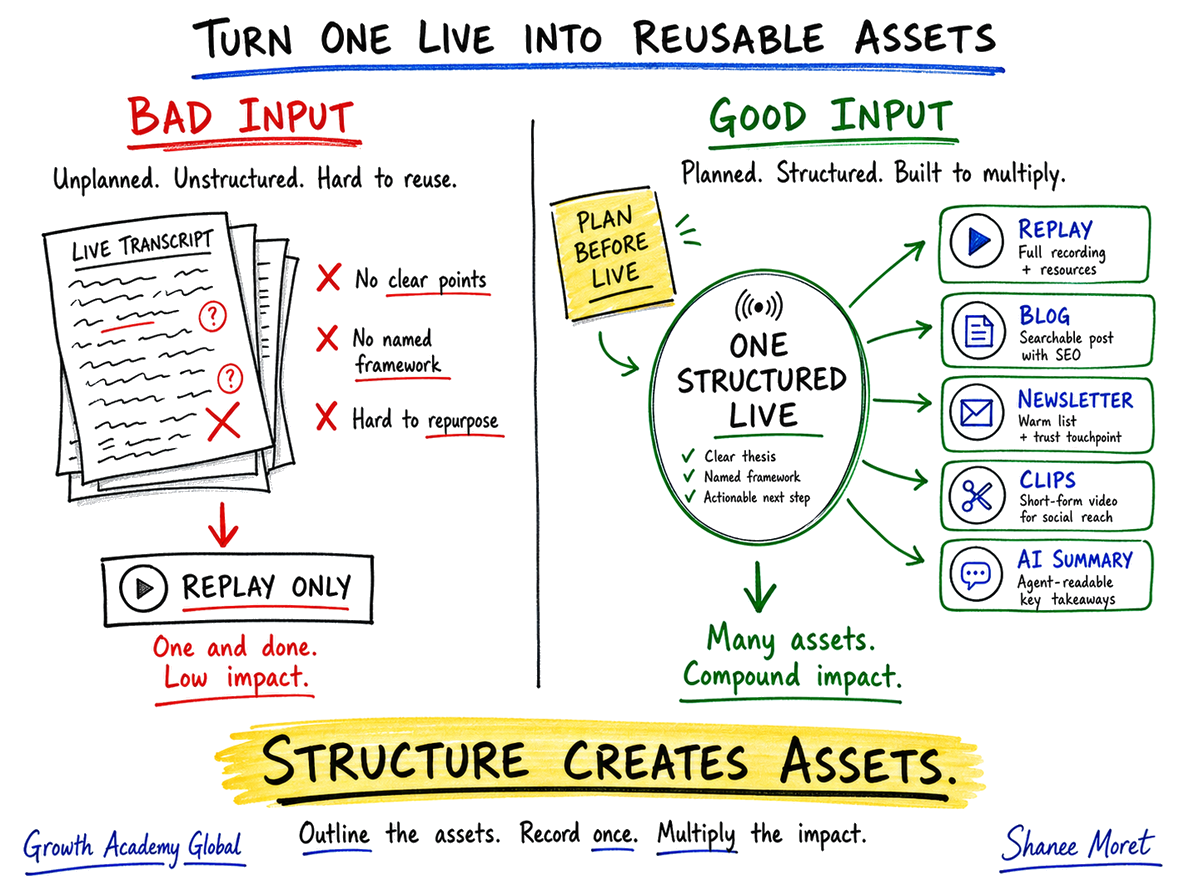
Most business owners plan what to say on their LinkedIn Live. Almost none plan what happens to the content after they stop broadcasting. That oversight is not a minor gap in the workflow — it is the reason most lives produce one asset instead of many, and why the content equity from a 60-minute session disappears within 48 hours.
The repurposing system does not come after the live. It comes before it.
Why "I'll Figure It Out After" Doesn't Work
Here is what the default outcome of an unplanned live looks like: a replay that sits on LinkedIn, perhaps embedded in one post, watched by a fraction of the people who registered, and forgotten by the following week.
That is one asset from one session. And for most business owners, that is the entire return on the preparation, the setup, the invite campaign, and the hour they spent delivering it.
The planned outcome is structurally different. A single LinkedIn Live, built correctly and processed through a repurposing system, produces:
- A replay embedded in your LinkedIn newsletter for every registrant who didn't attend live
- Three to five newsletter articles pulled from distinct sections of the transcript
- One long-form blog post anchored to the central framework you taught
- Short-form video clips from the highest-signal moments
- AI-indexed written content distributed across LinkedIn and YouTube
The reason most business owners don't get that output is not a tool problem or a time problem. It is a structure problem, and it starts before the live runs.
The Repurposing Factory Model
Think of your LinkedIn Live as a factory input. The transcript, the video, the structure of what you taught — these are the raw materials. A repurposing system is the factory that converts raw materials into finished goods across multiple channels.
The factory only runs on clean input.
A live built around three clear points, each anchored in one firsthand story, with credentials stated upfront and a consistent call to action — that live produces clean input. Every section has a clear beginning and end. Every point is standalone enough to extract. Every story is specific enough to hold up in written form.
A disorganized live — no clear structure, no firsthand evidence, no distinct points — produces transcript material that cannot be edited into anything coherent. You cannot repurpose a live where the main points are buried, the stories are vague, and the framework is undefined. You are left with scrap.
This is why the repurposing decision must be made before the live, not after. When you sit down to plan your live, you are not only planning a presentation — you are designing a production run.
What Each Output Requires From the Live
The repurposing system only works if the live is built to produce extractable material. Here is what each output channel needs from the live itself:
| Output | What It Needs From the Live |
|---|---|
| LinkedIn newsletter (replay embed) | A clean recording and a clear session description with the main points named |
| Newsletter articles (3–5) | Distinct sections in the transcript with a clear point, a personal story, and a specific takeaway each |
| Long-form blog post | A named framework with three or more steps, stated explicitly during the live |
| Short-form video clips | 45–90 second segments where a single idea is stated completely, without needing surrounding context |
| AI-indexed written content | Firsthand evidence, qualified claims, credential density — material that reads as expertise when extracted |
Notice what each of these requires upstream: structure. Not production quality. Not a professional studio. Not a co-host. Structure — the kind that comes from planning your three points and their supporting stories before you ever go live.
Where the System Breaks Down
The most common mistake I see is business owners attempting to repurpose a live that was not designed for it. They export the transcript, hand it to an AI tool, and get back a newsletter article that reads as generic advice — because the live itself was built from generic advice. The tool cannot invent the firsthand stories that weren't in the transcript. It cannot extract the nuanced case study that was never stated. It can only reflect back the quality of the input.
Three patterns I see consistently:
No clear points. The live meandered across several topics without ever fully landing on a main point. The transcript has no extractable sections because there are no sections — just continuous conversation. Nothing can be repurposed because nothing was ever completed.
Borrowed evidence. The live was built around industry statistics and third-party research rather than firsthand experience. That material does not hold up as standalone content. Readers can find it anywhere. It does not differentiate the business owner as an expert.
No named framework. The live taught a process but never named it or structured it with numbered steps. Without a named framework, there is no hook for a blog post, no organizing spine for a newsletter series, and no phrase for AI search to associate with the business owner's expertise.
All three of these are structure decisions made — or avoided — before the live runs. If you wait until after the live to realize the transcript is unusable, the session cannot be recovered.
How to Design the Live for Repurposing
Before your next live, answer these four questions in writing:
1. What are my three main points, stated in one sentence each? If you cannot state each point in one sentence before the live, you will not be able to state them clearly during it — and the transcript will not have extractable sections.
2. What firsthand story or case study am I using for each point? If the answer is "I'll figure it out in the moment," the transcript will not contain the firsthand evidence that makes each section repurposable. Plan the story in advance.
3. Which 60–90 second moment in each section is designed as a standalone clip? Identify in advance where the highest-density statement in each section lands. That is the segment you will clip. If you cannot predict it, the density is not there yet.
4. What newsletter articles will I pull from this transcript? Map the sections in advance. If you are planning three points and each produces one article, you have a three-article newsletter series planned before the live begins. If you are going deeper on the framework, plan a fourth article that covers the framework as a whole.
This planning takes 20–30 minutes before the live. It changes the downstream output from a single replay to a multi-channel content run.
Priority Distribution Channels
Not all distribution channels are equal for long-term authority building. LinkedIn and YouTube are the priority channels because of how AI search indexes content. Transcripts, articles, and video descriptions published to these platforms are read by the systems that evaluate expertise when a buyer searches for a solution or asks an AI to vet a consultant.
Short-form clips on LinkedIn perform well for reach. Long-form written content — blog posts, newsletter articles — builds the deeper indexed record that AI agents read. Both matter. The short-form clips bring new connections into your world. The long-form written content is what stays readable and citable over time.
Embed the replay in your LinkedIn newsletter within 48 hours of the live. That is the first repurposing action, and it serves the registrants who accepted the invite but did not attend live — which, based on typical acceptance-to-attendance conversion, is most of them.
The Six-Month Evidence Base
One live does not produce a positioning library. Six monthly lives does.
After six structured lives, each processed through a repurposing system, you have six transcripts proving expertise across distinct angles, six newsletter-embedded replays, a growing library of short-form clips, and real data on which title formats generate the highest-quality registrant pools. You have touched your full network twice through the invite system. You have a pattern of showing up — which is the thing that builds trust faster than any single piece of content.
The compound asset is not the video. It is the cumulative evidence base. And the evidence base does not exist at live number one. It exists at live number six, because you committed to a system and ran it consistently.
For the full framework that this step fits into, read the full guide.
If you want to understand how the live itself should be structured before you build the repurposing system around it, read about structuring your live for both human and AI audiences. And if you are still planning your timeline and invite strategy, the setup guide covers that in full.
Before Your Next Live
Build the repurposing plan first. That means:
- Name the three points and the story for each before you write the presentation
- Map which sections will become newsletter articles
- Identify the one 60–90 second segment per section that will become a short-form clip
- Schedule the newsletter embed for within 48 hours of going live
- Commit to one live per month for six months and track whether the evidence base is compounding
The live is the factory input. Design the factory before you run the machine.
Read the LinkedIn Live Cluster in Order
This article is one part of the LinkedIn Live client-acquisition system. Use the sequence below to connect topic choice, authority, transcript structure, calls to action, and repurposing.
- Choose a specific buyer-filtering topic
- Prove your category with solo Lives first
- Structure the transcript for humans and AI search
- Place CTAs after proof moments
- Turn the Live into a repurposing system
— Shanee Moret
Build the full system around this piece.
Read the main framework, then use this article to sharpen the part most business owners skip.
Read the main guide →