Short answer: Guest interviews can build activity while quietly starving the one signal your brand needs most: proof that you are the expert.
Start with the main LinkedIn Live strategy guide for the full invitation and conversion framework. This article goes deeper on one missing piece.
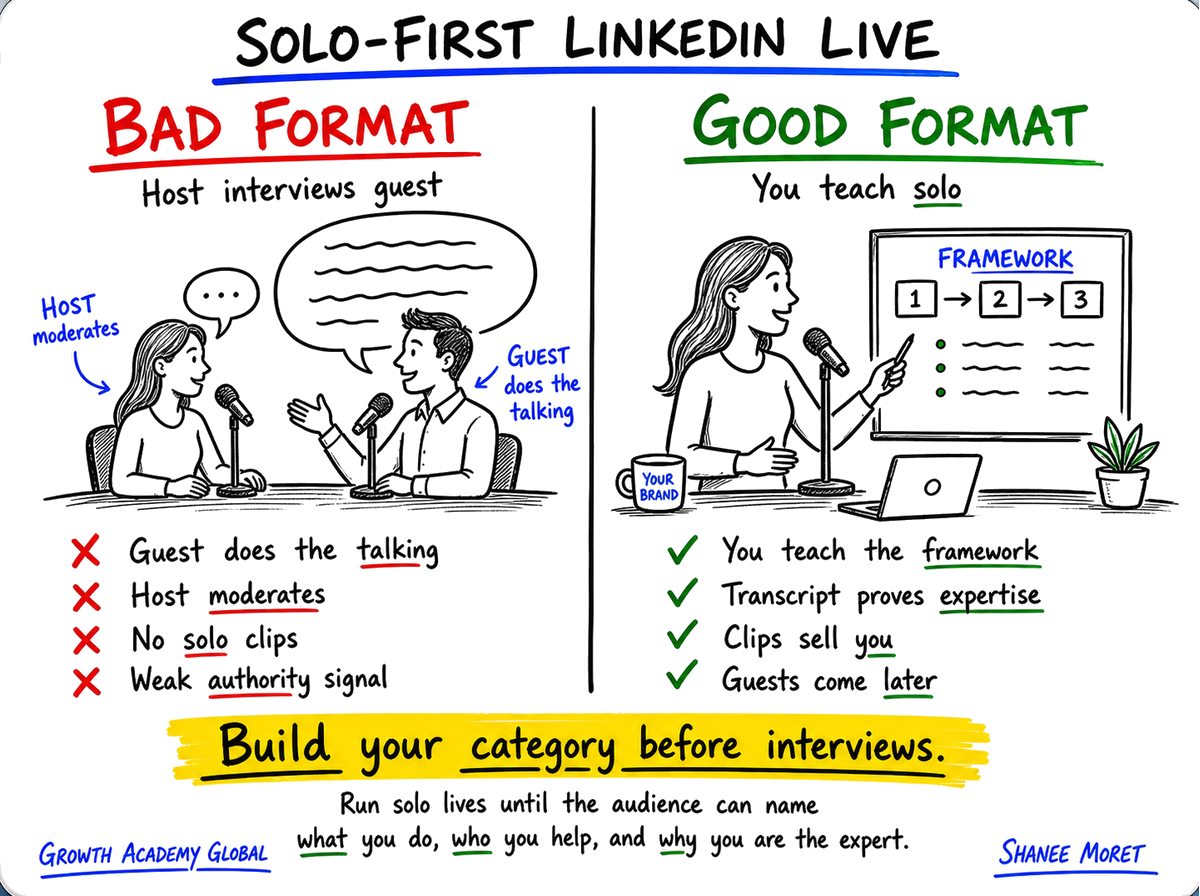
The most common mistake I see from business owners who have been doing LinkedIn Lives for six months and still have no clients: every single live in their library features a guest.
I have reviewed libraries like this more than once. The host has done 6 to 12 lives. They were consistent. They showed up. And they have nothing to show for it — no inbound calls, no usable clips, no clear signal anywhere in their content of what they specifically do.
When I dig into why, the answer is always the same. The guests did the talking. The host moderated. And the audience — along with every AI agent that will ever read that transcript — came away understanding the guest's expertise, not the host's.
This is the Solo-First Rule, and it is the most counterintuitive thing I teach about LinkedIn Live.
This post goes deep on this specific step.
What Interview Format Actually Does to Your Brand
The mainstream advice for growing on LinkedIn is collaborate. Bring on guests. Cross-promote with other experts. Borrow their audience.
That logic makes surface-level sense. And it breaks down completely when applied to LinkedIn Live in the early stages of building a brand.
Here is what actually happens when you interview a guest:
The guest usually does most of the talking. That is the structural reality of an interview. Your questions are a few seconds each. Their answers are several minutes each. You are the host. Hosting means facilitating, not demonstrating.
When the live ends, you have produced a transcript that proves your guest is an expert. You have no usable solo clips. You have no section of the recording that shows what you know, how you think, or why someone should hire you specifically. The audience spent 30 to 60 minutes learning from your guest — and they can name the guest's expertise far more clearly than yours.
That is the hidden cost of interview-format lives before you own a clear category. The collaboration that was supposed to grow your brand is quietly erasing it.
The Solo-First Brand Rule: The Correct Sequence
The Solo-First Rule has a specific sequence that works:
- Build your category through solo lives until you have direct evidence that your live content has generated business
- Build until your audience can answer — without prompting — what you specifically do, who you help, and why you are the expert
- Only then introduce guest format, from a position of established authority, where a guest adds dimension to something you already own
Before step three, a guest replaces something you have not yet built. That sequencing error costs most business owners months of live content that produces no inbound pipeline.
What the Transcript Looks Like — and Why It Matters
Your LinkedIn Live transcript functions as a positioning document. AI agents read your transcripts to evaluate your expertise when someone searches for you, asks an AI to vet you, or uses a research tool to decide who to hire. LinkedIn buyers are discerning. They research before they DM. An AI reading a library of interview-format lives will surface your guest's expertise, not yours.
| Transcript Element | Solo Live | Interview-Format Live |
|---|---|---|
| Primary speaker | You | Your guest |
| Expertise signals | Your frameworks, your case studies, your conclusions | Guest's frameworks, guest's case studies, guest's conclusions |
| Usable clips | Every strong moment belongs to you | Strong moments belong to the guest |
| Brand clarity | Audience can name your specific category | Audience can name the guest's category |
| AI agent reading | Identifies you as a category expert | Identifies you as a moderator |
| Business attribution | Inbound leads can trace to this content | Inbound leads trace to the guest, not the host |
A solo live transcript builds a case file for your expertise. An interview-format live transcript builds a case file for your guest's. When a prospective buyer's AI assistant surfaces your library of content, the pattern matters — and a library of interviews does not establish category ownership.
For a full breakdown of how to structure your live for both human and AI audiences, read Structuring Your Live for Humans and AI Agents.
Three Objections — and What They Actually Signal
"But interviews grow my network. The guest brings their audience."
Borrowed audience attention does not transfer cleanly. The guest's followers showed up for the guest. The percentage who convert to your followers — and then to your buyers — is significantly lower than the percentage of your own warm connections who would have attended a well-titled solo live and come away with a clear understanding of why you are worth hiring. You traded your invitation capacity and your talking time for someone else's audience attention, temporarily.
"But I don't have enough content to fill a solo live."
Worth sitting with honestly. If you cannot fill 20 minutes with your own firsthand experience, your own frameworks, and your own case studies, two things could be true: the scope of the live is too broad (narrow it until you can fill 20 minutes from direct experience alone), or you are leaning on borrowed content as a substitute for depth you have not yet developed in public. Solo live content should come entirely from what you personally saw, did, or proved with a client. Fewer things, deeper — not more guests to fill the gaps.
"My industry does interviews. It's the expected format."
Expected format is precisely the problem. A hundred interview-format lives have already come from your industry. Another one does not differentiate you. A solo live where you teach three things from direct experience, with a clear category and a clear call to action, does. Being the person in your industry who shows up solo, states a point of view, and defends it with firsthand evidence is a positioning advantage.
The Exception Condition
Guest format becomes appropriate under one specific condition: your category is already owned.
Bring guests in once you have a clear category that your audience can name without prompting, direct evidence that solo live content has generated inbound business, and a position established enough that a guest adds dimension to it rather than replacing it.
At that stage, the dynamic shifts entirely. You are the established expert inviting someone in. The audience is yours. The category is yours. The guest is a guest in your house — which is a fundamentally different thing from interviewing someone else's experts before your own house exists.
How to Audit Your Existing Library
Pull your last six to twelve lives. For each one, answer these questions:
- Was this a solo live or an interview?
- If an interview — what percentage of talking time was yours?
- Does a two-minute segment of this live exist that demonstrates only your expertise, suitable for a standalone clip?
- Could someone who watched only this live tell clearly what you do, who you serve, and why you are the expert to hire?
- Has any inbound inquiry or client directly referenced this live?
If the pattern is mostly interviews, low talking time, no usable solo clips, no client attribution — you have the diagnosis. Return to solo format until category ownership is established. Better guests will not solve that problem.
What to Do Next
Your next LinkedIn Live should be solo. One point. Teach it entirely from your own direct experience. Structure it around something you have personally seen, done, or proved with a client — no borrowed case studies, no recycled statistics, no frameworks that originated with someone else.
State your credentials in the first 90 seconds. Get to the main point before 60 seconds are up. Make a clear call to action after you have made your case.
Do that six times before you think about guests. Six solo lives gives you six transcripts proving your expertise from six distinct angles, a real data set on which titles generate the highest-quality registrant pools, and an audience that has seen a pattern of you — which is the thing that builds trust faster than any single piece of content ever could.
For the invitation system that determines how many people see any of this, read Setting Up Your LinkedIn Live Event 4 Weeks Out. For how to choose a topic that self-selects the right audience, read Choosing Your LinkedIn Live Topic.
The spotlight on your live belongs to you.
Collaboration that costs you the one asset brand building requires — a body of evidence that proves, clearly and repeatedly, that you are the expert — is not growth. Build the evidence base first. Guests can come after.
Read the LinkedIn Live Cluster in Order
This article is one part of the LinkedIn Live client-acquisition system. Use the sequence below to connect topic choice, authority, transcript structure, calls to action, and repurposing.
- Choose a specific buyer-filtering topic
- Prove your category with solo Lives first
- Structure the transcript for humans and AI search
- Place CTAs after proof moments
- Turn the Live into a repurposing system
— Shanee Moret
Build the full system around this piece.
Read the main framework, then use this article to sharpen the part most business owners skip.
Read the main guide →