Short answer: The title is not a headline. It is the first filter on the quality of the room, the replay audience, and the follow-up list.
Start with the main LinkedIn Live strategy guide for the full invitation and conversion framework. This article goes deeper on one missing piece.
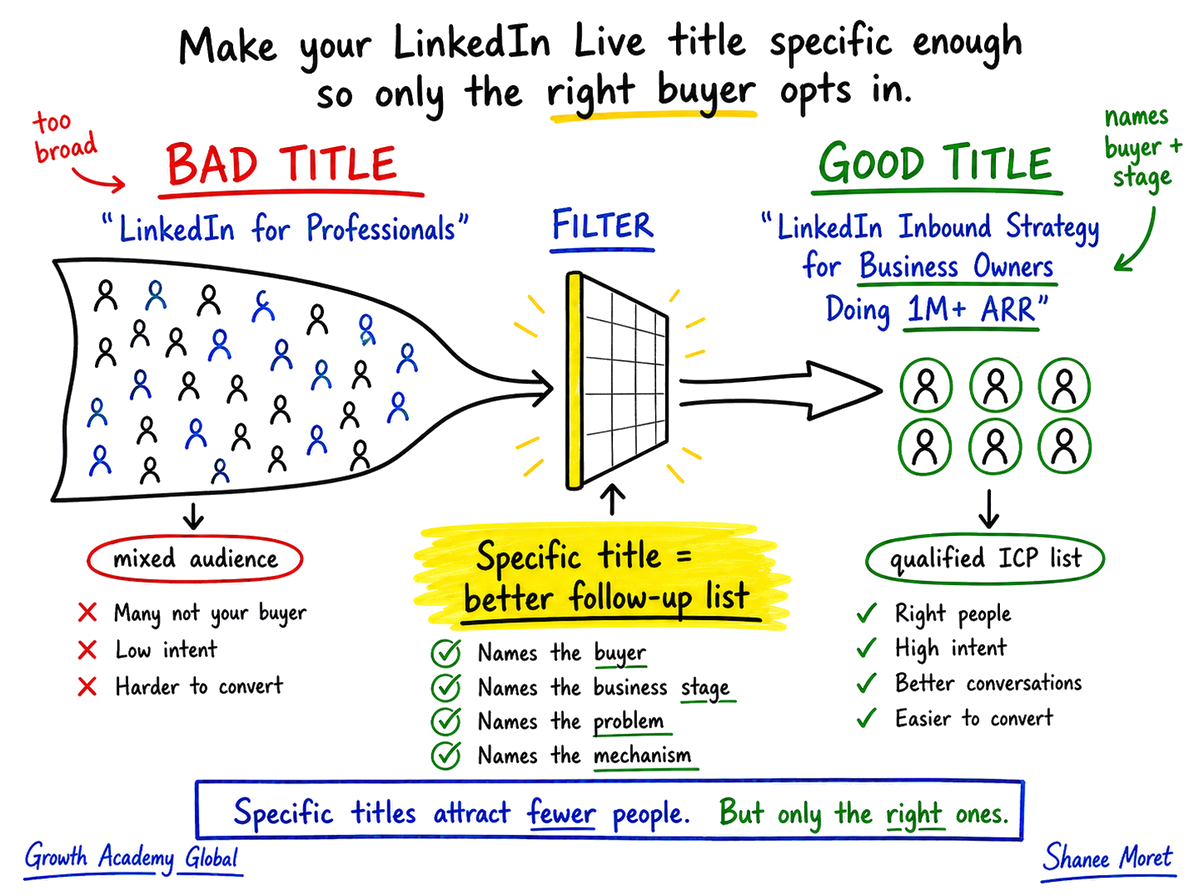
Most business owners pick their LinkedIn Live topic the wrong way. They think about what will get the most registrants. They gravitate toward broad, accessible subjects — personal development, productivity, general business growth — because those topics feel safer and more universally appealing.
That instinct is backwards. And it is quietly why so many LinkedIn Lives produce a full room and an empty pipeline.
The Real Function of a LinkedIn Live Title
Your topic title is not a headline. It is a filter.
When you send out your 4,000 invitations — 1,000 per week across four weeks — the title and description are the only information a connection uses to decide whether to accept or ignore. Nothing else. They have not heard you speak. They have not read your description carefully. They scanned the title, made a judgment in two seconds, and either raised their hand or kept scrolling.
That moment of self-selection determines the quality of every conversation that follows.
Here is the part most business owners miss: everyone who accepts that invitation is stored in a list on LinkedIn. That list exists whether or not they show up live. It is a warm lead asset you can message after the event — not a cold prospect list, not a paid list, not people who vaguely follow you. These are people who saw your specific topic, decided it was relevant to them, and opted in.
If the topic was broad, that list is full of people who are casually interested. If the topic was specific, that list is full of people who have the exact problem you solve.
Same invite volume. Categorically different list.
The Specificity Self-Selection Principle
The pattern that holds across live events is consistent: the more specific the title, the higher the quality of the registrants who accept.
Specificity functions as a filter applied at the invitation stage, before you have said a single word. A broad title maximizes volume and minimizes conversion quality. A hyper-specific title reduces the raw number of registrants and dramatically increases the percentage of actual buyers in that pool.
This feels counterintuitive because most marketing logic pushes toward reach. The LinkedIn Live system rewards the opposite logic.
Here is what the data looks like in practice. Lives titled directly around the core offer — the specific problem you solve for a specific type of person — outperform off-topic lives in client acquisition consistently in my client work. The conversion differential between on-topic and off-topic registrant pools is significant: offer-aligned registrants are far more likely to need the offer than people who registered for a broad or trend-driven topic. Same platform, same invite volume, same presenter. Dramatically different pipeline quality.
What "Specific Enough" Actually Means
Most business owners think their topics are specific. They are usually not.
Here is the difference:
| Too Broad | Specific Enough |
|---|---|
| "Growing Your Business in 2026" | "How Consultants With High-Ticket Offers Generate Inbound Leads on LinkedIn" |
| "LinkedIn Strategy for Entrepreneurs" | "The LinkedIn Live System That Replaces In-Person Networking for B2B Coaches" |
| "Productivity and Mindset for Business Owners" | "How to Structure 20 Minutes on LinkedIn Live to Book High-Ticket Discovery Calls" |
| "Using AI in Your Business" | "How Established Consultants Use LinkedIn Live to Close $10K+ Clients Without Outreach" |
The broad version reaches everyone. The specific version reaches the right person and repels everyone else.
Repelling the wrong people is not a failure — it is the mechanism working correctly.
The Three Mistakes That Produce Weak Registrant Pools
Mistake 1: Titling around a trend instead of around your offer.
When a topic is trending — AI, productivity, personal development — it feels like the smart move to attach your live to that topic. The issue is that trend-chasers and casual learners dominate the registrant pool. These people registered because the topic was interesting, not because they have the problem you solve. A trend-driven registrant pool is usually much less likely to contain buyers who need the offer right now.
Mistake 2: Using your language instead of your buyer's language.
Your ICP does not describe their problem using your framework names or industry terminology. They describe it in plain language. "Lead generation for service businesses" is your framing. "How to stop relying on referrals and get clients to come to you" is your buyer's framing. The second version makes the right person feel immediately seen. The first version sounds like a course catalog description.
Mistake 3: Titling for the widest possible audience to compensate for uncertainty about the ICP.
If you are not sure who your ICP is, the instinct is to go broad so you do not accidentally exclude a buyer. This is the wrong direction. Uncertain about your ICP is a positioning problem, not a topic problem — and LinkedIn Live will not solve it. Going broad delays the diagnosis and produces a warm lead list that cannot tell you anything useful. Going specific, even if the first attempt is imperfect, produces data: who accepted, who showed up, who messaged after.
How to Write a Title That Filters for Buyers
A LinkedIn Live title that works as a lead filter contains three elements:
- The buyer type — who specifically this is for (not "entrepreneurs," but "B2B consultants" or "established coaches" or "business owners with a high-ticket offer")
- The specific problem or outcome — what they are trying to do or what pain they are trying to escape
- The mechanism or context — LinkedIn Live, a framework name, a time constraint, a specific method
You do not need all three in the title. But if you can fit them clearly into five to eight words, the filter works. If the title requires the description to clarify who it is for, the filter is broken — most people will not read the description before deciding.
Test your title with a single question: if someone who is clearly outside your ICP read this, would they register? If yes, make it more specific.
The Warm Lead List Nobody Talks About
The step that most business owners skip entirely: after the live, message the acceptors.
Every person on that list raised their hand for your specific topic. They signaled intent before you said a word. Whether or not they showed up live, they are warmer than any cold prospect you will ever reach through outbound. They know who you are. They said the topic was relevant to them. They are now waiting for a reason to continue the conversation.
The message does not need to be complicated. Offer the replay. Share the slides. Ask what they are working on. The list is the asset — the live is how the list gets built.
Learn how the invite math works at scale
What On-Topic Registration Actually Looks Like
In the live events that work, the quality of the registrant pool matters more than the raw count. A smaller room built from a specific title is a different sales environment than a larger room built from a general business topic.
From a qualified room, the commercial outcome depends on the strength of the offer and the follow-up, not the attendance number alone. Those numbers do not work if the registrant pool was built on a trending topic that appealed to everyone.
Specificity is not a constraint on growth. It is the variable that determines whether the invite system produces a warm lead list or a curiosity list.
The instinct is always to go broader. The evidence consistently points the other direction. Pick the topic that makes your exact buyer think "this is for me" — and makes everyone else scroll past. That self-selection is the point.
Read the LinkedIn Live Cluster in Order
This article is one part of the LinkedIn Live client-acquisition system. Use the sequence below to connect topic choice, authority, transcript structure, calls to action, and repurposing.
- Choose a specific buyer-filtering topic
- Prove your category with solo Lives first
- Structure the transcript for humans and AI search
- Place CTAs after proof moments
- Turn the Live into a repurposing system
— Shanee Moret
Build the full system around this piece.
Read the main framework, then use this article to sharpen the part most business owners skip.
Read the main guide →