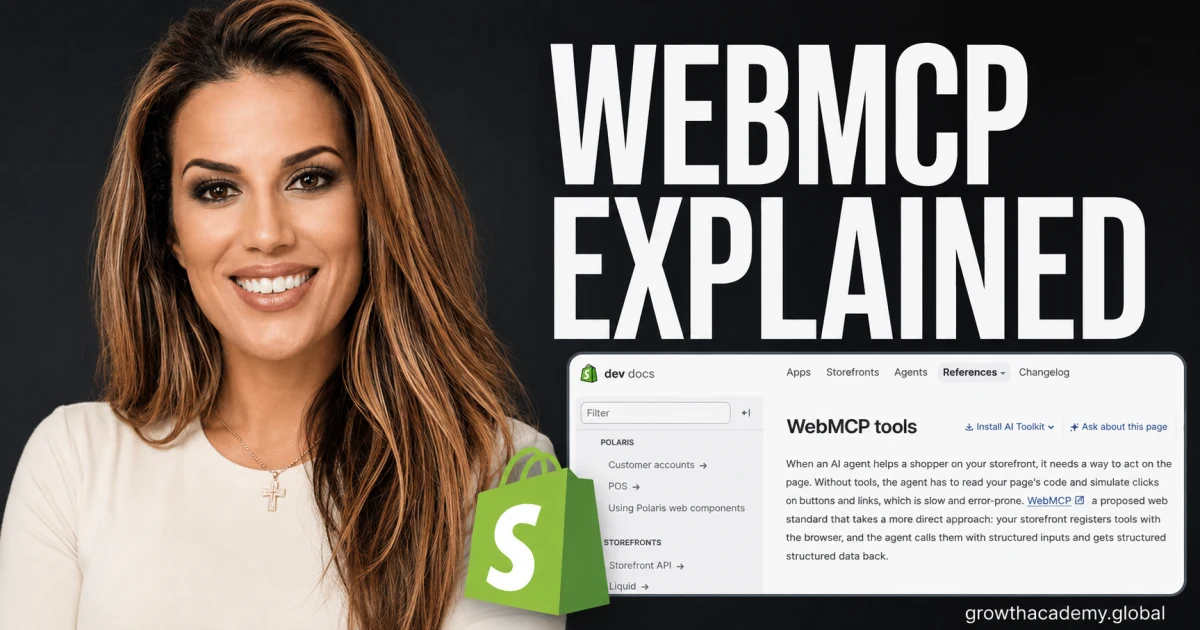
If you have watched an AI agent work through a website, you have seen the awkward part. It scrolls, it pauses, it clicks something, and sometimes it clicks the wrong thing and the whole errand falls apart.
That awkwardness has a specific cause. The agent is browsing like a fast human: reading the page, guessing which button does what, and simulating mouse clicks. When the page changes, the guesses go stale.
On August 25, 2026, Gigazine reported that OpenAI shipped a feature called Site tools in ChatGPT's built-in desktop browser. No first-party OpenAI announcement was located as of September 2, 2026, so treat the OpenAI rollout detail as independently reported rather than officially confirmed. The underlying WebMCP specification defines the site-to-agent tool pattern.
WebMCP lets a website declare named, callable functions that an AI agent can use directly, like an API built into the site itself. Independent coverage says OpenAI's Site tools call those functions instead of simulating clicks, and Shopify documents WebMCP support for Liquid storefronts. On supported sites, agent web tasks can become more reliable without owner-side setup.
The Clerk and the Menu
Picture sending an assistant into an unfamiliar store. In the old model, the assistant wanders the aisles, reads every shelf label, and hopes the store is laid out the way stores usually are.
Now picture a clerk meeting the assistant at the door and handing over a short menu: here is what you can ask me for. Check a price. Check stock. Add an item to a basket. The assistant stops wandering and starts asking.
That menu is what the WebMCP specification standardizes. A WebMCP-enabled site publishes a set of named functions, chosen by the site itself, that compatible agents can call directly.
Scraping and clicking becomes calling a declared function. Everything else in this article follows from that one change.
What Shipped, and Who Supports It
The reporting and available documentation establish three parts of the rollout, with different evidence strength.
Gigazine reports that OpenAI shipped Site tools in ChatGPT's built-in desktop browser. Because no first-party OpenAI announcement was located, the rollout remains independently reported.
Shopify's current developer documentation confirms WebMCP support for Liquid storefronts. The documentation does not establish the August 25 date or prove universal compatibility with every agent, so test the current storefront and agent combination.
And according to Search Engine Journal's reporting, Expedia, Instacart, and Target are experimenting with the standard as well. Gigazine covered the same launch from the ChatGPT side.
The Shopify Worked Example
Here is what the change looks like on a real errand.
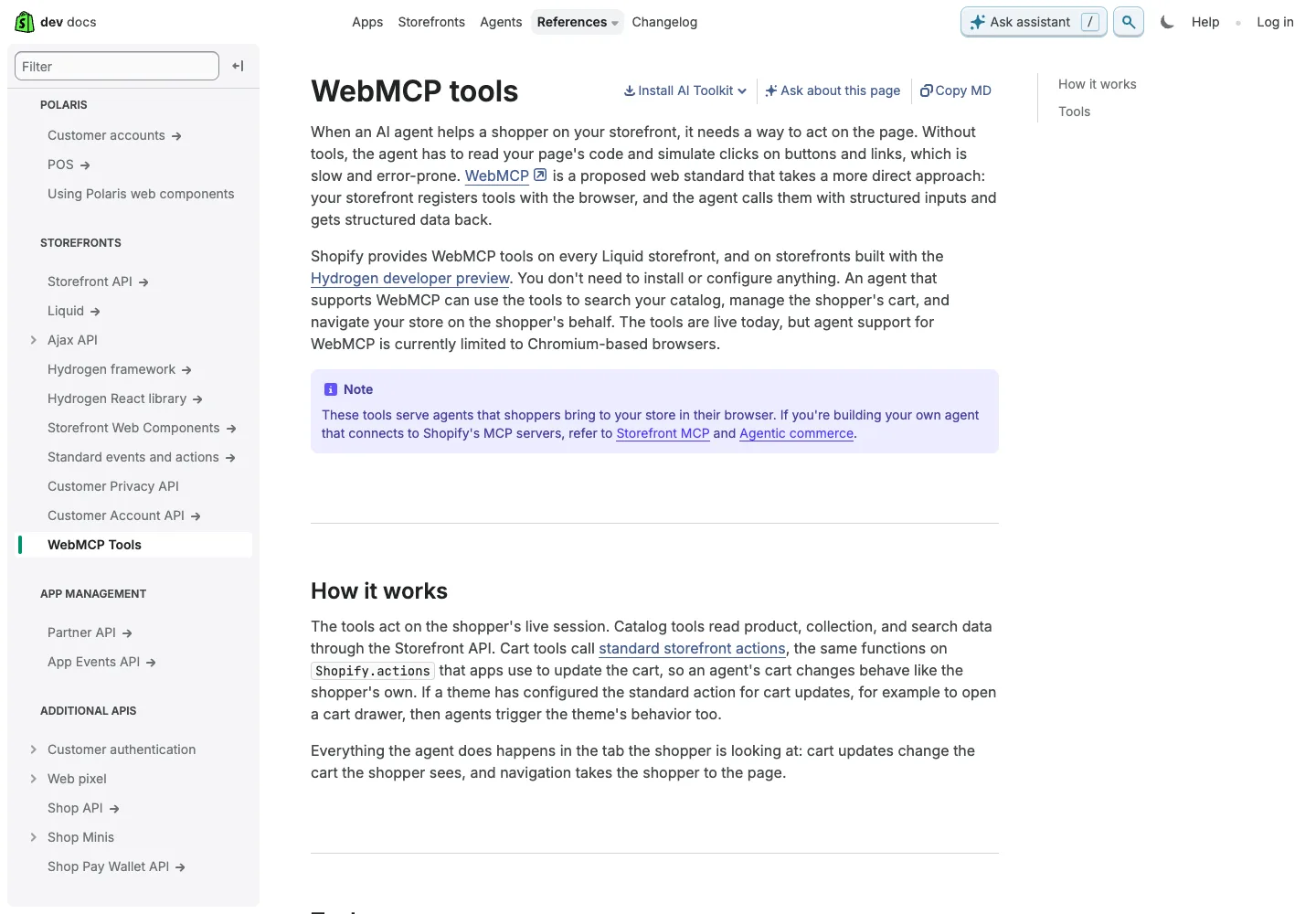
Before, an agent shopping a Shopify store had to interpret the page: find the search box, guess the right product tile, locate the add-to-cart button, and repeat that fragile dance on every page. A theme update could break the whole run.
On a WebMCP-enabled store, the agent can reliably browse the product catalog, assemble a cart, and check inventory by calling the store's declared functions. The store said what it can be asked for, so the agent asks for exactly that.
If you sell on Shopify, read that again from the merchant's chair. You did nothing, and your storefront became one of the places an agent can transact with reliably.
What This Means on Both Sides of the Counter
You probably stand on both sides of this counter, so take them one at a time.
As an agent operator. When you send Codex or ChatGPT Work to do web tasks, those tasks get more reliable on supported sites, and the improvement costs you nothing. There is no setting to flip and no configuration to maintain. The reliability arrives from the site's side of the connection.
As a business with a website. Agent-readiness is becoming a property of a storefront, the way mobile-readiness became one. If agents increasingly do the buying, research, and comparison work, sites that expose tools get transacted with more reliably than sites that resist. If you sell on Shopify, you got that property without lifting a finger. If you run a custom site, the standard belongs on your watchlist.
The Honest Limits
Adoption is early. Most of the web is not WebMCP-enabled yet, and a handful of named companies experimenting tells you the direction more than the timing.
Normal browsing still handles everything else. Agents fall back to reading pages and clicking on the sites that have not declared tools, with all the fragility that comes with that.
So treat this as a direction with one large proof point already live, which is Shopify. Directions with proof points are worth planning around.
What to Do With This
- If you sell on Shopify, see what an agent experiences. Ask your own agent to browse your catalog and assemble a cart, then watch where it succeeds. Shopify documents WebMCP support for Liquid storefronts, but current agent compatibility should be tested.
- Re-try the web tasks that used to break. If you gave up on agent errands like price checks or catalog research because runs kept failing, run them again against supported sites and note the difference.
- If your site is custom, put WebMCP on the watchlist. Ask whoever maintains your site to follow the standard. You are not behind today, and you want to know your options before agent traffic matters to your revenue.
- Keep a short list of which vendor sites your agent handles reliably. That list will quietly start shaping where your recurring purchasing errands go.
Frequently Asked Questions
What is WebMCP in plain language?
WebMCP is an open standard that lets a website declare named functions an AI agent can call directly, instead of the agent scraping the page and simulating clicks. Think of it as an API built into the website itself.
Did OpenAI officially confirm Site tools support?
Gigazine reported the OpenAI rollout. No first-party OpenAI announcement was located as of September 2, 2026, so this article labels that detail as independently reported.
My store runs on Shopify. Am I already covered?
Shopify's documentation confirms WebMCP support for Liquid storefronts. Availability and agent compatibility can vary.
What happens on sites that have not adopted WebMCP?
Agents browse them the old way, by reading the page and clicking, which still works and still carries the old fragility. WebMCP shrinks the reliability gap only where it is deployed, and most of the web has not deployed it yet.
Sources
Official / Primary Sources
Independent Coverage / Analysis
- Search Engine Journal: WebMCP connects AI agents to actions inside websites
- Gigazine: ChatGPT adds WebMCP support
Where This Points
Every era of the web had a moment when a site property went from optional to expected. Search-readiness had one. Mobile-readiness had one.
Agent-readiness just produced its first mass rollout, and it happened on the platform side, where one decision covered millions of stores at once.
You do not need to predict the pace. Watch whether your agent's errands succeed, watch where your buyers' agents show up, and know which side of the counter you are standing on when they do.