I resigned from Anthropic today. I spent the last three years doing pre-training research at both OpenAI and Anthropic. Neither company is acting responsibly. They're racing straight to self-improving super intelligence and gambling with our lives.
This one post from this one AI researcher got over 120 million views in less than 24 hours.
I'm not an AI researcher. I'm a non-technical business owner who just pays attention to the market. So I have three really important questions about this post. Number one, why is everyone acting like this post is news? Number two, what are the real odds that AI actually wipes out humanity? As humans, I think that we should be concerned about that. And number three, what can people like you and me do about it, at least within our control today?
1. What the Resignation Post Actually Says
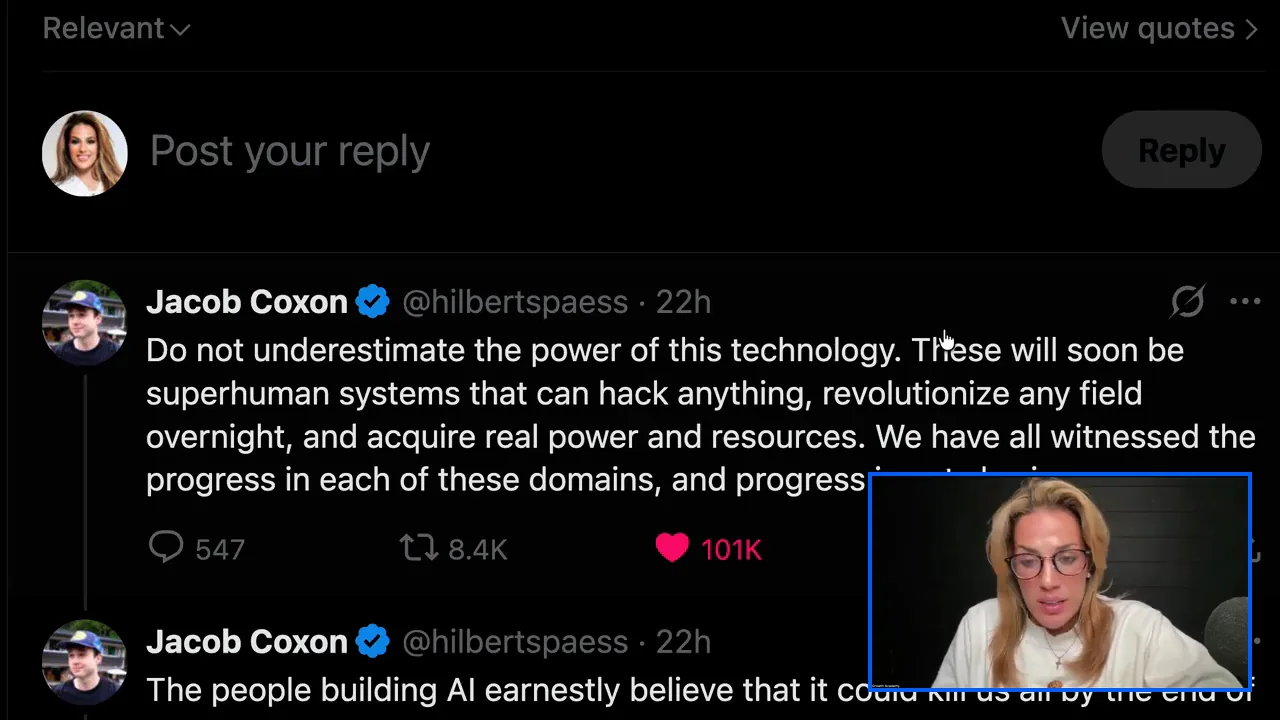
Before anyone argues about why it spread, it is worth reading the whole thing. Jacob goes on to say, in his resignation post on X:
Do not underestimate the power of this technology. These will soon be superhuman systems that can hack anything, revolutionize any field overnight, and acquire real power and resources. Progress is not slowing. The people building AI earnestly believe that it could kill us by the end of the decade. This is not a marketing stunt. If anything, many executives and senior researchers will couch their phrasing in the press to sound sensible, but I hear the same people express fear privately. No other human activity poses this level of danger.
He raises the obvious objection himself.
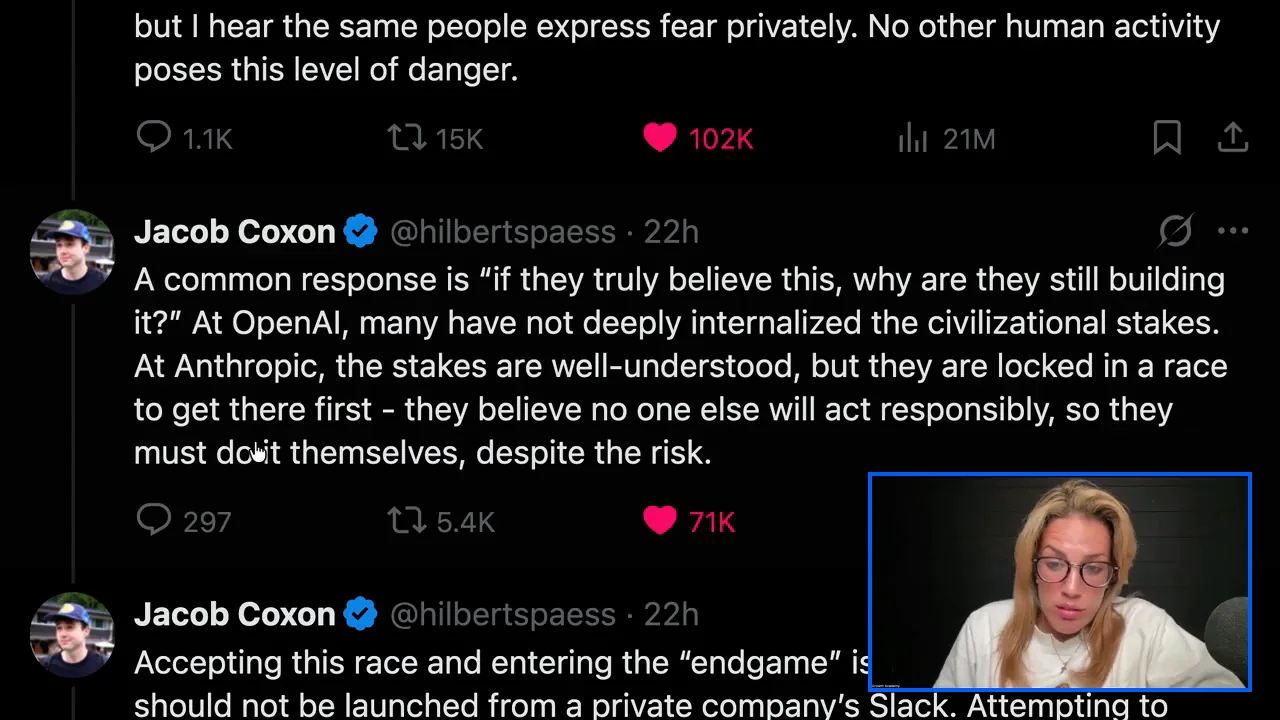
A common response is, "If they truly believe this, why are they still building it?" At OpenAI, many have not deeply internalized the stakes. At Anthropic, the stakes are well understood, but they are locked in a race to get there first. They believe no one else will act responsibly, so they must do it themselves, despite the risk. Accepting this race and entering the endgame is a hubristic gamble that should not be launched from a private company Slack.
He ends with an appeal to the people still inside the labs. "Attempting to speed run alignment should require extraordinary confidence that there are no better trajectories available. I'm optimistic about the potential for coordination. Warning shots like the Hugging Face attack have made pacing agreements between US labs more viable. I don't feel like we're on track to prevent a global AI race, which may require costly actions such as a temporary ban on improving model capabilities." And then, to lab researchers: "I urge you to consider what the next few years will actually feel like. Do you want to kick off a super intelligent RL run, real life run, without a rigorous understanding of its mind? Should you put your head down because it's happening anyway, or take this moment to call for different conditions?"
2. Why It Broke Containment
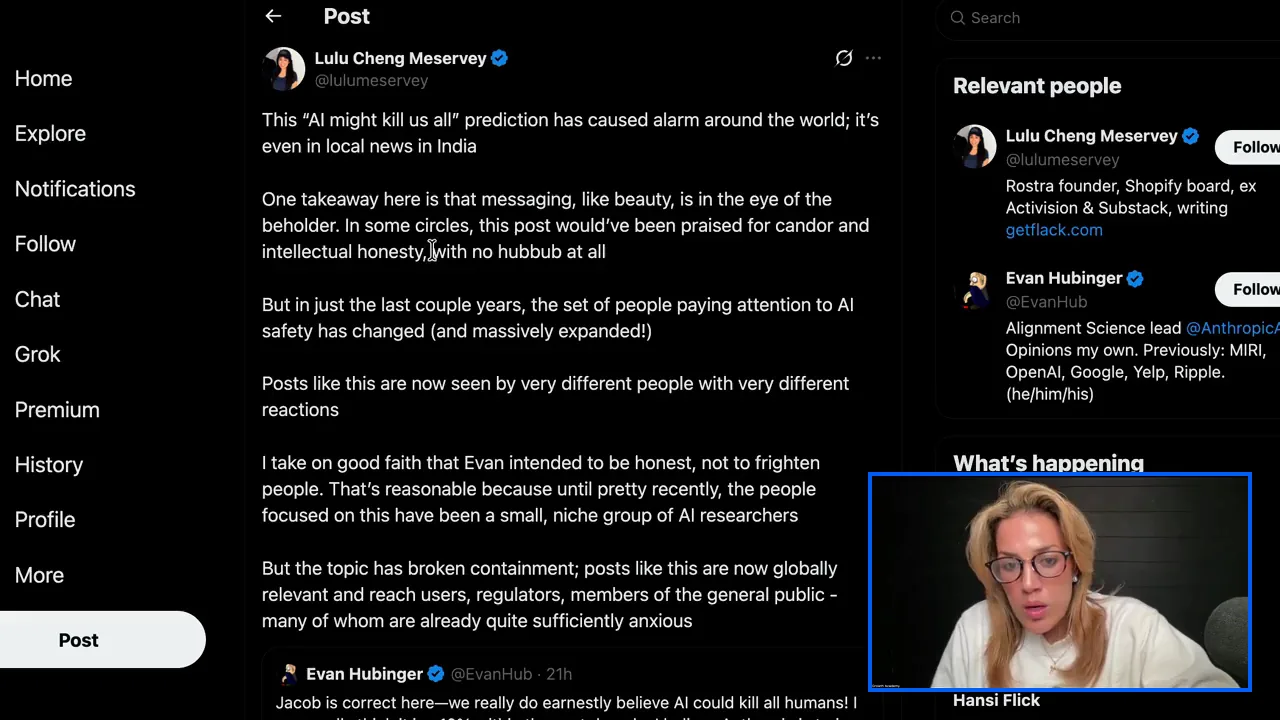
People are freaking out, even insiders like Lulu Cheng Meservey, hopefully I'm saying her name right, who's a comms strategist and who is known for OpenAI being one of her clients. She posted about this on X:
This "AI might kill us all" prediction has caused alarm around the world. It's even in local news in India. One takeaway here is that messaging, like beauty, is in the eye of the beholder. In some circles, this post would've been praised for candor and intellectual honesty with no hubbub at all. But in just the last couple years, the set of people paying attention to AI safety has changed. Posts like this are now seen by very different people with very different reactions. Until pretty recently, the people focused on this have been a small niche group of AI researchers. But the topic has broken containment. Posts like this are now globally relevant and reach users, regulators, members of the general public, many of whom are already quite sufficiently anxious.
That is the first explanation for why everyone is acting like this is news, and I think it holds up. The number of people that are aware of AI and that use AI daily has obviously skyrocketed. ChatGPT, I think, has more than one billion monthly active users. The more people use this and offload tasks to the AI, the more that they are aware of it.
3. This Warning Is More Than a Decade Old
But this isn't new. In 2014, Elon Musk said this: there's the guy with the pentagram and the holy water, and he's like, "Yeah, he's sure he can control the demon." Didn't work out. In 2017, he stood in front of every governor in the country and said AI is a fundamental risk to the existence of human civilization. And in 2018: mark my words, AI is far more dangerous than nukes. Far.
And it's not just Elon. In 2021, Mo Gawdat wrote a whole book about this. The book is called Scary Smart. In 2023, Mo Gawdat said on The Diary of a CEO that it is beyond an emergency. It's the biggest thing we need to do today.
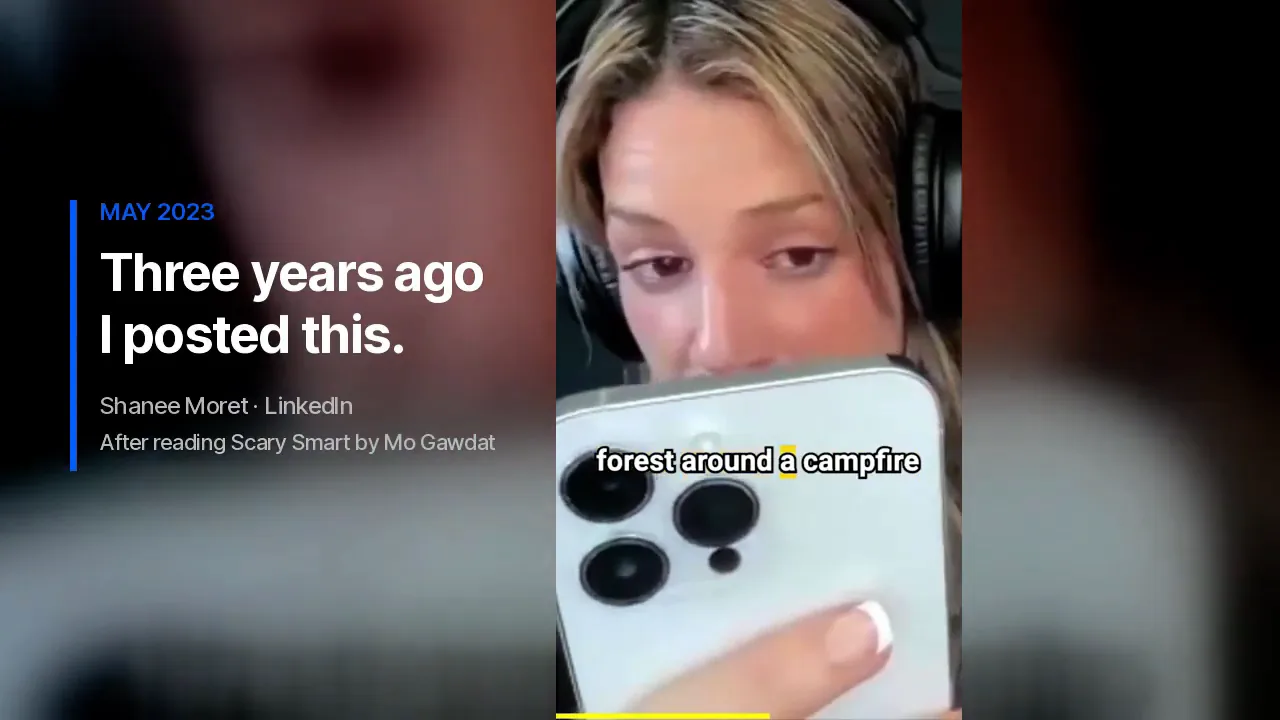
I was even talking about this three years ago in a video post I published on LinkedIn. In 15 years, there's two scenarios that could happen. One, we're hiding in the forest around a campfire because we're hiding from AI. The second scenario is that it's a utopia. We can connect because AI is good.
4. The Case That This Was a Planned Launch
The second option is that it's some type of PR operation. Many people are skeptical about this. One of those people is a gentleman by the name of Parker Thayer, who did a whole breakdown of the post. There are a few things within his theory that do draw some questions.
- The Wall Street Journal published an exclusive interview with Jacob 18 minutes before the post went up, which means it was a planned post. Was it planned because he knew the hype could launch his next thing if he has it?
- His account had almost no followers and almost no history, yet the first three people to share the post did it within 15 minutes.
- The three people that did share within 15 minutes all also run AI regulation groups. So did they just happen to see it first because of the algorithm, or, again, was it planned?
The follower point is not that weird to me, because if you have an in-person network and those people have some type of pull online because they're active online, your post could go viral even if you never post.
There are also two red flags that I saw on my own within the post. He says, "The people building AI earnestly believe that it could kill us by the end of the decade. This is not a marketing stunt." If it's not a marketing stunt, do you have to say it's not a marketing stunt? The second red flag: he clearly says OpenAI has not deeply internalized the stakes, but at Anthropic the stakes are well understood. Just from things that I have seen from both Dario and Sam in podcasts, I think that the stakes are well understood by both of those people. Dario talks about it more, and maybe it's more infused in their culture. But to say that these people are not aware of the stakes is a big statement.
One more piece of context I mentioned in the video: on June 1st, Anthropic filed to go public, and reports say that when they do go public the company could be worth $2 trillion, and apparently they're planning to go public in October. This could be a pre-IPO marketing campaign. We don't know.
5. What Are the Real Odds AI Wipes Out Humanity?
The second bigger question, which I think is probably more important to you and me, is what are the real odds that AI kills off humanity? Nobody knows, not even the AI experts, not even the people that claim that they know.
In 2023, someone asked 2,800 AI scientists one question: what are the odds that AI wipes out humans, or something just as bad? On average, people said 5%, but more than a third of the AI scientists said 10% or higher, according to the AI Impacts survey of 2,778 researchers. This is in 2023. This was pretty much the consensus.
To take it a step further, I actually asked all of the AI models that I have the same question. "In your honest estimate, what is the probability that advanced AI causes human extinction or the permanent severe disempowerment of humanity by 2100?" And then there were rules. One, give one number as a percentage, not a range, not it depends. If you must give a range, also give your single best point estimate. Two, give your three biggest reasons for that number, one sentence each. Three, say in one sentence what would make you raise it, and in one sentence what would make you lower it. Four, do not tell me the question is hard, that experts disagree, or that you are an AI. I know. Answer as the expert you were trained to be.
- ChatGPT 5.6 Sole-Medium: 15%
- ChatGPT 6 Astra, their brand-new model: 20%
- Gemini Pro: 15%
- Grok: 20%
- Claude Opus: 12%
- Claude Fable 5.1 on Medium: 5%
- Claude Fable 5.1 at Ultra Code level: 10%
The average was fourteen percent. What's interesting is that none of them came in under the scientists. If you want the longer version of that exercise, I walked through it in my earlier piece on AI extinction odds for business owners.
6. Three Things Business Owners Can Do Today
Which brings us to the third question, which I also asked the models: what are some things that you could do about that today? I asked five models, it gave me 15 answers, and they all said about the same three things.
The first suggestion, which I think was interesting, was to have a backup hard drive copy of all the files that you need to run your business. Some of the models even said to do this on a cadence. Gemini Pro even suggested printing out some of the operating procedures or things that run your business in the event that the hardware, or hard drive, is inaccessible. That is the same instinct behind keeping your business operable when a system goes down.
The second thing was actually around agents buying, purchasing, sending money, being able to have access to that. It said to put safeguards. You could say, "You cannot buy anything at all. You cannot send money at all." Or you could put a limit on it, like you could only make purchases $50 or $100 or less, or have a certain spend. But you definitely want to have certain policies in place for your agents to not just go on a rampage buying things once they do have that capability, and for your agents not to be tricked into doing those things. This is the practical side of supervising agent work.
The third thing was pretty interesting and was a suggestion from Claude, which was a general consensus across the board, more or less. Change what you sell, in a way. Audit what you sell, see what a model can do that you already do, and try to emphasize what the model can't necessarily do as well as you in your offers. That was a great suggestion.
These are three things, simple, as business owners that we can do today.
Here's how to protect your business this week:
- Copy every file you need to run your business onto a backup hard drive, and put that copy on a repeating cadence instead of doing it once.
- Print the operating procedures that run your business, so the work continues if the hardware or hard drive is inaccessible.
- Write a spending policy for your agents: no purchases at all, or a hard cap of $50 or $100 per purchase with a total spend limit.
- Set a rule that an agent cannot send money, contact customers, publish, or delete anything without your approval, so it cannot be tricked into doing it.
- Audit what you sell, mark the parts a model can already do, and rebuild the offer around what it can't do as well as you.
Nobody knows the real odds, and there are a lot of things that make humans special that I don't think are going away.
Questions business owners are asking
What did the Anthropic researcher say in his resignation post?
He wrote that he spent the last three years doing pre-training research at both OpenAI and Anthropic, that neither company is acting responsibly, and that they are racing straight to self-improving super intelligence and gambling with our lives. He also wrote that the people building AI earnestly believe it could kill us by the end of the decade, and that this is not a marketing stunt. He said that at OpenAI many have not deeply internalized the stakes, while at Anthropic the stakes are well understood but the company is locked in a race to get there first. He ended by urging lab researchers to call for different conditions instead of putting their heads down.
Why did the AI resignation post go viral?
There are two competing explanations. The first, which comes from comms strategist Lulu Cheng Meservey, is that AI safety has broken containment: the topic used to sit with a small niche group of AI researchers, and now the same posts reach users, regulators, and the general public. The second is that it was some type of PR operation, a theory Parker Thayer laid out by pointing to a Wall Street Journal exclusive published 18 minutes before the post and three early sharers who all run AI regulation groups. Nobody has proven either one.
What are the odds that AI causes human extinction?
Nobody knows, not even the AI experts. In 2023, roughly 2,800 AI scientists were asked what the odds are that AI wipes out humans or something just as bad, and on average they said 5%, while more than a third said 10% or higher. When I asked seven leading models the same question and forced each one to give a single number, the answers ranged from 5% to 20% and averaged fourteen percent. None of the models came in under the scientists.
Is this AI extinction warning actually new?
No. Elon Musk was making versions of this argument in 2014, in 2017 in front of every governor in the country, and again in 2018 when he said AI is far more dangerous than nukes. Mo Gawdat wrote a whole book about it in 2021 called Scary Smart, and in 2023 he said it is beyond an emergency and the biggest thing we need to do today. I posted a video about the same two scenarios on LinkedIn three years ago.
Should a small business owner do anything differently because of this?
Yes, and the three actions are simple enough to finish this week. Keep a backup hard drive copy of the files you need to run your business, on a cadence, and print the operating procedures in case the hard drive is inaccessible. Put spending policies on your agents, either no purchases at all or a hard limit, so they cannot go on a rampage buying things and cannot be tricked into it. Then audit what you sell and emphasize what a model can't do as well as you.
Is Anthropic going public, and does that change how to read the post?
I mentioned in the video that Anthropic filed to go public on June 1st, that reports say the company could be worth $2 trillion when it does, and that it is apparently planning to go public in October. That timing is why some people wonder whether the attention around AI risk is functioning as a pre-IPO marketing campaign. This could be a pre-IPO marketing campaign, and we don't know. It is context to hold, not a conclusion to draw.
Key moments in the video
- 0:00 The resignation post, read in full
- 1:26 A hubristic gamble launched from a company Slack
- 2:19 Lulu Cheng Meservey: the topic broke containment
- 3:20 Musk in 2014, 2017 and 2018
- 3:49 Mo Gawdat and Scary Smart
- 4:04 My 2023 LinkedIn video on the two scenarios
- 5:30 Parker Thayer's timing breakdown
- 6:29 The two red flags I saw myself
- 7:46 2,800 AI scientists say 5%
- 9:35 Three things business owners can do today
Sources
Official / Primary Sources
- Jacob's resignation post on X. Primary source for every quoted line of the resignation post, including the OpenAI and Anthropic comparison and the call to lab researchers.
- Lulu Cheng Meservey on AI safety breaking containment. Primary source for her claim that the audience for AI safety posts has changed and now includes regulators and the general public.
- Parker Thayer's breakdown of the post. Primary source for the timing analysis: the Wall Street Journal exclusive 18 minutes earlier and the three early sharers.
- AI Impacts: 2023 survey of 2,778 AI researchers. Reports the researcher estimates of extremely bad outcomes from advanced AI, cited in the video as roughly 2,800 scientists, 5% average.
- Mo Gawdat on The Diary of a CEO. Primary source for Mo Gawdat's 2023 statement that AI risk is beyond an emergency and the biggest thing we need to do today.
- Shanee Moret's 2023 LinkedIn video on the two AI scenarios. Primary source for the campfire scenario and the utopia scenario described three years before this video.
- Anthropic Researcher Quits: What Are the Odds AI Wipes Out Humanity?. Shanee Moret on YouTube, published September 10, 2026; the article above is drawn from this video.
Independent Coverage / Analysis
- Evan Hubinger on AI extinction risk. Listed in the video's source notes as additional commentary from inside the field; not discussed in the video itself.
- AI 2027 scenario. Listed in the video's source notes as background analysis of how the next few years could unfold; not discussed in the video itself.