The scariest version of an AI agent is not one that makes mistakes. It is one that makes mistakes quietly — where you cannot tell what it did, what it trusted, or what it changed until something downstream breaks.
That is why, when I compare agent platforms for business owners in the pillar guide, I weight something most reviews skip entirely: the visible work trail. Not whether the agent logs — they all log — but whether a nontechnical human can supervise from what it shows you.
The Test I Ran
I gave both major desktop agent environments the identical assignment: audit the growthacademy.global website. Same prompt, same site, and then I read the first page of what each delivered — not as a coder, but as the owner who has to trust or correct the work.
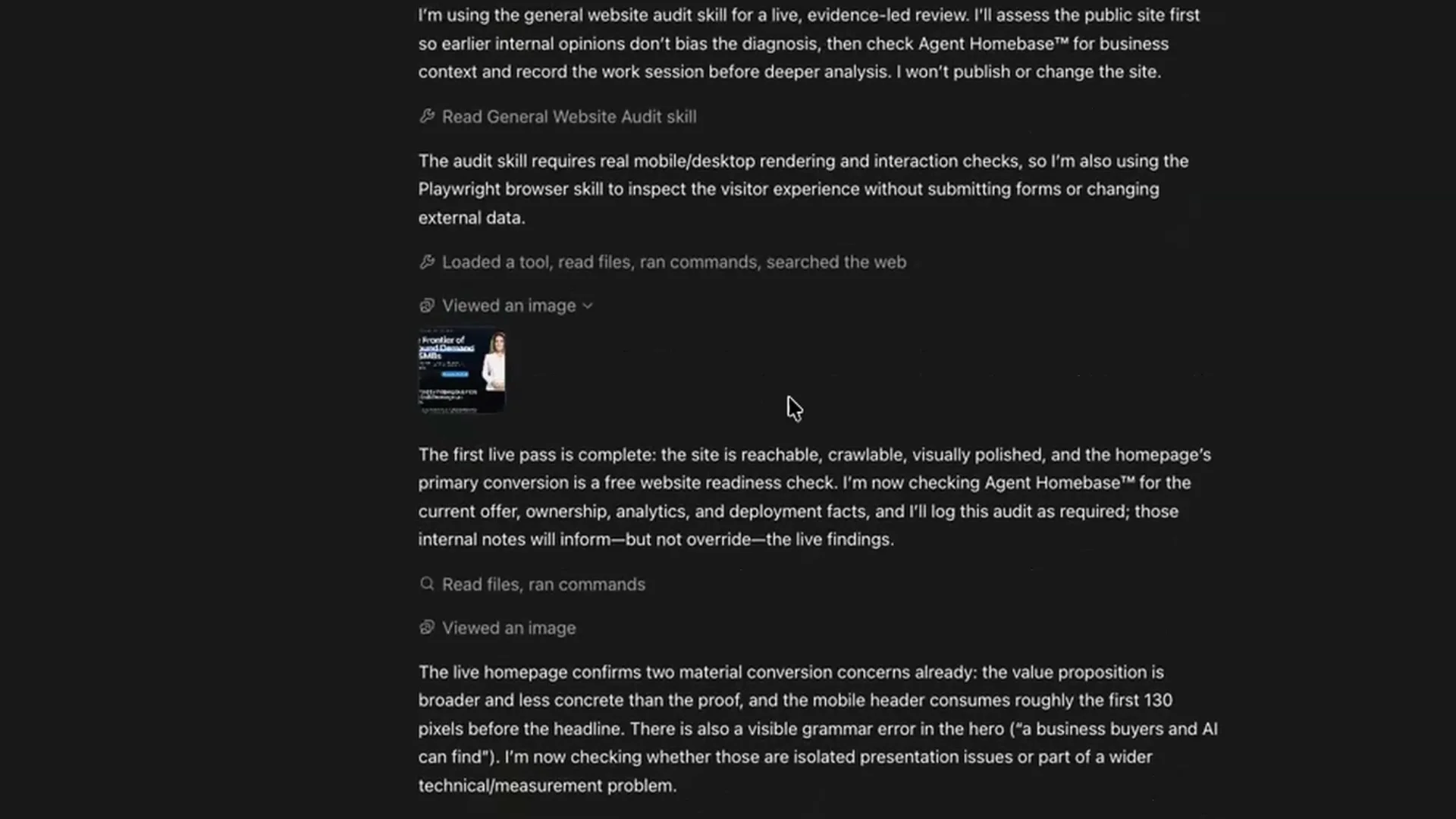
One environment narrated nearly every step in full sentences: it named the specific skill it selected ("I'm using the general website audit skill for a live, evidence-led review"), explained that the audit required a browser tool to inspect the visitor experience without submitting forms, and summarized the first pass in plain language — the site is reachable, crawlable, visually polished, and the homepage's primary conversion is a free readiness check.
The other environment worked in short fragments: "I'll audit the site." "The site is already heavily optimized." "Strong baseline, now digging into the anomalies." The work was happening — but to see which method it used, I had to go looking.
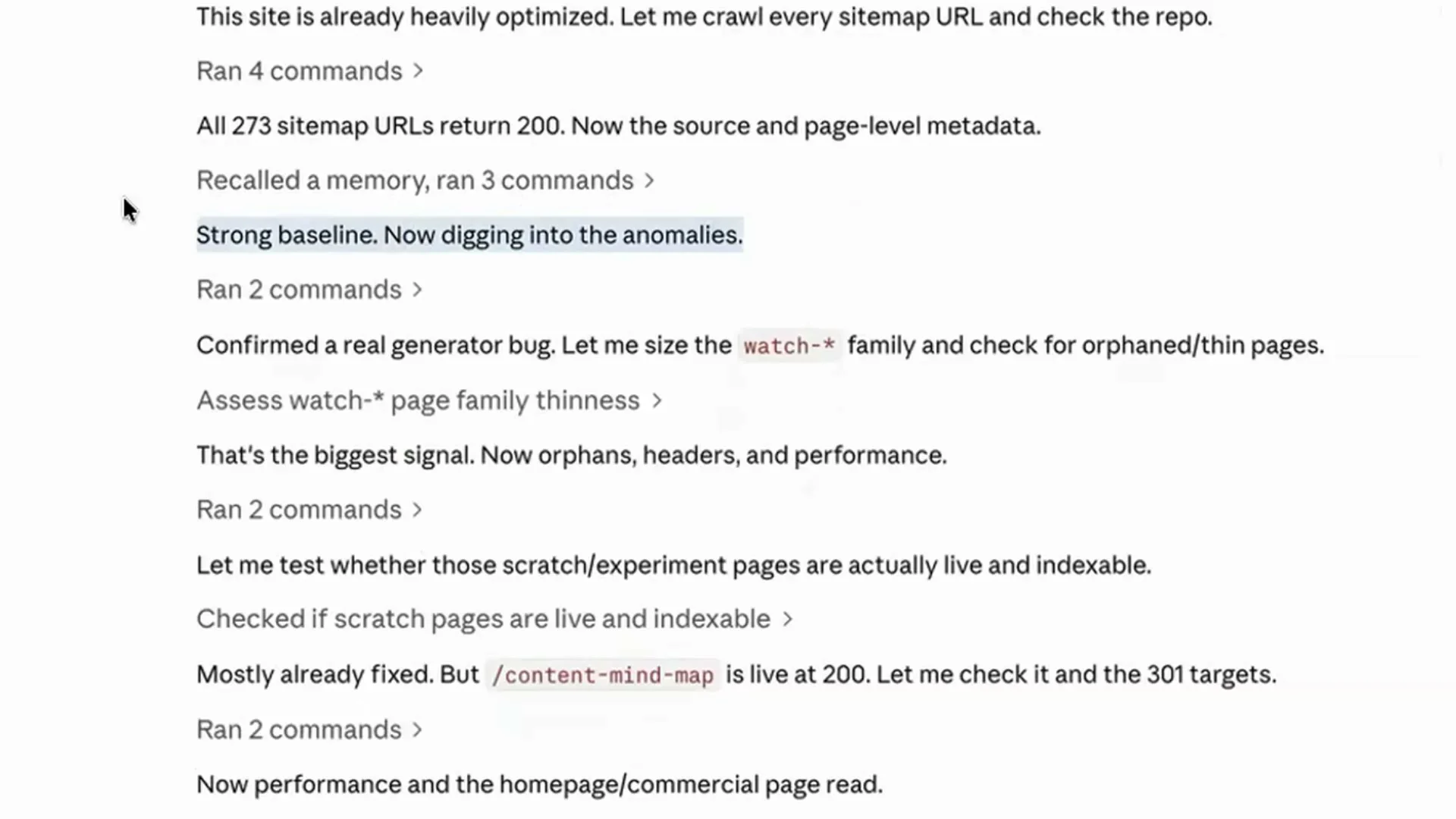
Both agents did the audit. Only one of them let me supervise it in real time without effort. The platform-level takeaway is in the pillar; this article is about the management skill underneath it, because it applies no matter which platform you run.
Why the Narration Is a Business Control, Not a Nicety
Here is the moment that makes this concrete. Suppose my company has built its own custom website-audit skill — our checklist, our standards, our voice. If the agent visibly announces "I'm using the general website audit skill," I can stop it in its tracks: "No — use our skill. And how do we make sure you never default to the general one again?"
If that same wrong choice happens invisibly, I don't catch it until I am reading a finished deliverable that feels slightly off — and by then I have paid for the wrong work twice: once to produce it and once to redo it.
A readable work trail turns supervision from an autopsy into a conversation.
The Five Questions Every Work Trail Must Answer
When you review an agent's log — during the work or after — you are looking for plain-language answers to exactly five questions:
- What method is the agent using? — which skill, tool, or approach it selected, named explicitly.
- What source did it trust? — the file, page, dataset, or system its conclusions rest on.
- What changed? — every file created, edited, sent, or deleted, stated as a list a human can scan.
- What remains unverified? — the claims or steps the agent did not confirm, admitted plainly.
- What requires my approval? — the consequential actions it stopped short of, and why.
If you can answer all five from the log without asking a technical person for a translation, you have a supervisable agent. If you cannot, you don't have an agent problem — you have an instructions problem, which is good news, because instructions are fixable.
Write the Logging Requirement Into the Agent's Instructions
You do not have to accept the default narration style of any platform. Every serious agent environment lets you set standing instructions — and logging behavior belongs there. Mine include, in substance:
- Before starting, state the method or skill you selected and why.
- Narrate each major step in full sentences a nontechnical reader can follow.
- After finishing, list what changed, what you did not verify, and what needs my approval.
- If a custom company skill exists for this task, use it, and say so by name.
On the Claude side, this lives naturally in the project's standing instruction file — see What Is CLAUDE.md? — and on the OpenAI side in your Codex custom instructions. The platform gives you a default personality; your instructions give you a management system.
Make "Catch One Mistake" a Milestone
When I onboard a team (full sequence here), I tell owners that the real graduation moment of month one is not the first completed deliverable. It is the first time someone on the team reads a work trail, catches the agent mid-mistake, and corrects it before the deliverable lands.
That moment proves three things at once: the logs are readable, the human is actually reading them, and the feedback loop works. From there, you can scale agents with confidence — because you are no longer hoping the work is right. You can check.
Supervision is also the discipline that keeps you portable. Logs, instructions, and standards that live in your files — not inside one vendor's interface — are a core part of owning your agent infrastructure.
Sources
Primary Source (author demonstration)
- Original YouTube video — the side-by-side audit demonstration (Shanee Moret, screen recording of both agents' output)