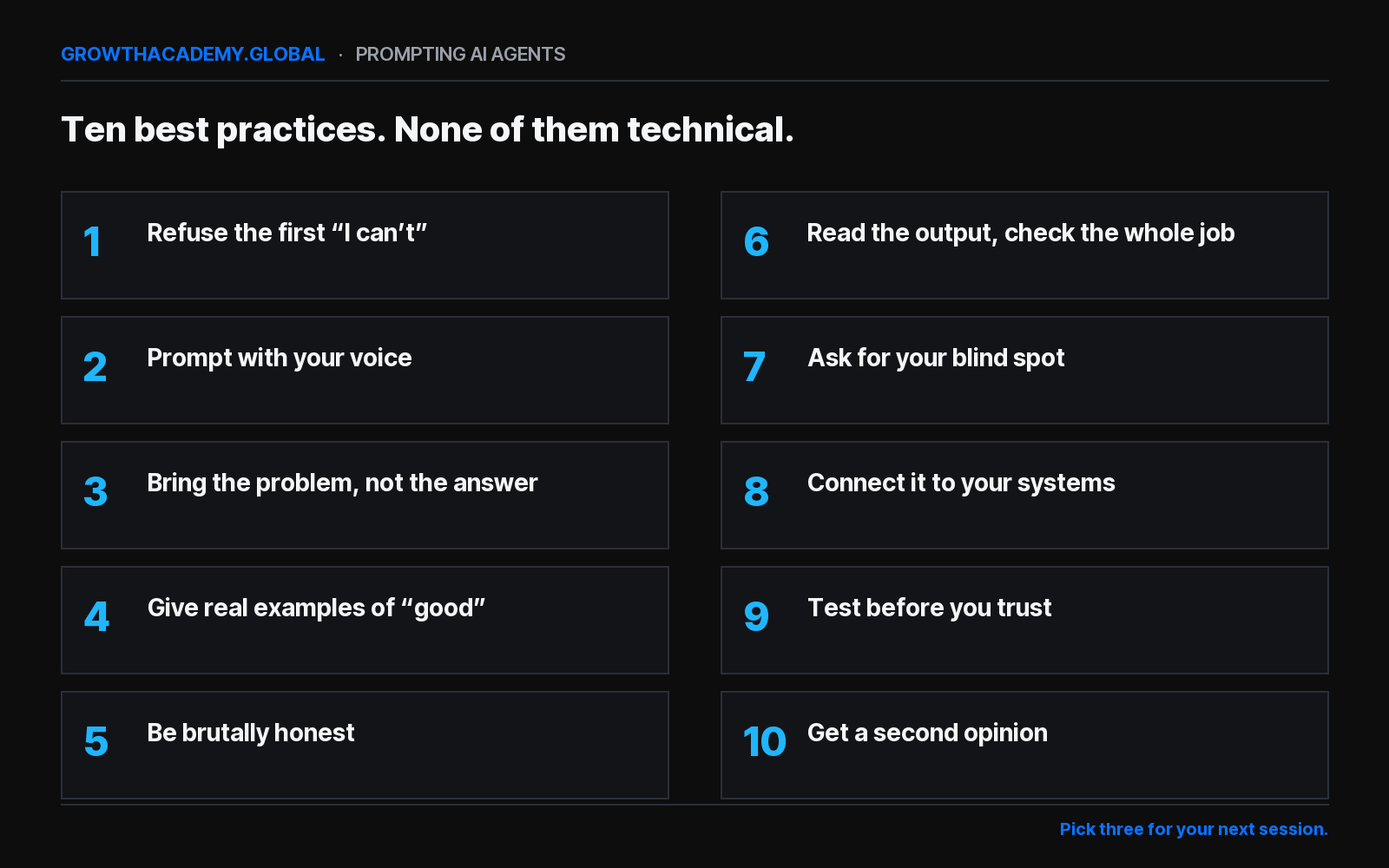
Short answer, the ten practices: 1) Refuse the first "I can't" and make it keep troubleshooting. 2) Prompt with your voice. 3) Bring the problem, not the answer. 4) Give it real examples of what good looks like. 5) Be brutally honest about what you do not know, and make it show you. 6) Read the output, and check it did the whole job. 7) Ask for your blind spot. 8) Connect it to your real systems before you decide it cannot help. 9) Test it before you trust it with anything that matters. 10) Get a second opinion from a different model when you are stuck. None of these are technical. All of them are decisions.
Everything below comes from doing this for real, sitting next to business owners while they work with their agents, not from a tutorial. The owners who win are rarely the most technical people in the room. They win because they built these ten habits. Pick three and use them in your next session.
1. Refuse the first "I can't." Make it keep troubleshooting.
This is the highest-leverage habit there is, and almost nobody does it. Agents reach for the path of least resistance, and when that route fails they often stop and report back rather than go hunting for a harder one. So "I can't" usually means "the easy way did not work and I gave up." Tell it plainly: that's not acceptable, try a different way, figure it out. Say it three to five times and watch it generate routes it never surfaced on the first pass. I gave one agent that exact push after it told me it could not finish a download, and it worked for seven minutes and solved what it had just called impossible.
The full breakdown, with the real screenshot, is here: when your AI agent says "I can't," make it keep troubleshooting.
2. Prompt with your voice.
Talk to it out loud. It is faster than typing, and it forces you to add the nuance and context the agent needs, the detail you would never sit down and type out. Knowing how to communicate with AI, how to hand it the specifics that get the job done right, is going to be one of the most valuable skills there is, and voice is how you practice it. Dictate the problem the way you would explain it to a sharp new hire sitting across the desk from you.
3. Bring the problem, not the answer.
Most people walk up to AI with the solution already decided and just ask it to type that out. That wastes the smartest part of the tool. State the problem and stay genuinely open to what it proposes. If you do have a fix in mind, say it, then add one line: I might be wrong, there could be a better way, tell me. That sentence gives it permission to improve on you instead of just obeying you.
4. Give it real examples of what good looks like.
When you want a specific kind of output, show it one. People starve the agent of examples and then wonder why the result misses. A single concrete example of the direction you are going moves it further than three paragraphs of description. Paste in the email that landed, the page you love, the format you want copied. Then ask it to match that.
5. Be brutally honest about what you don't know, and make it show you.
People are too polite with AI, because they are used to being careful with humans. That politeness is costing you. Say it in the plainest words: I have no idea where my settings are. I don't know what you're talking about. Bring it up on my screen. Where do I click? I'm still confused, make it easier for me. Just do it for me if you can, I give you full permission. That honesty is the fastest way to learn, because the agent stops assuming knowledge you do not have and starts meeting you where you actually are.
Say it: "I'm not technical. Walk me through it, or do it for me. I give you full permission."6. Read the output, and check it did the whole job.
Most people skip the explanation and react to the result. Read what it actually says, because that sentence is usually your next move. And ask, every single time: did you do all of it, or just the first part? Agents will quietly finish part of a task and stop. One of mine downloaded the first lesson of a course, hit a snag on the rest, and was honest that it had only staged the first one. The quiet half-finishes are the ones that cost you, because they look like wins until you check.
7. Ask for your blind spot.
When it hands you a plan, ask the question most people are afraid to ask: where am I wrong? What is my blind spot? What would you do differently? That question surfaces the expensive mistake before you make it. You spend your day being the one with the answers, so it takes real discipline to invite the disagreement. Invite it anyway.
Say it: "Where am I wrong here? What's my blind spot? What would you do differently?"8. Connect it to your real systems before you decide it can't help.
An agent can only work with what it can reach. If it has no access to your CRM, your email, your calendar, your files, it is guessing. A lot of "it did not really do much for me" is actually "I never connected it to anything." Give it real access to the systems your business runs on, with permission to act, and the quality of what it returns jumps immediately. If it stops to ask permission at every step, that is usually a settings fix, which I cover in why Codex asks permission for everything.
9. Test it before you trust it with anything that matters.
Never hand an agent your inbox, your clients, or your money on faith. Run it on twenty-five real past cases first, grade its decisions, turn the misses into written rules, then re-test to confirm the rules stuck. Only then do you let it run the lowest-stakes work on its own, with everything logged. Trust gets earned with scores, not granted with hope. The full method is here: the Test, Refine method.
10. Get a second opinion from a different model when you're stuck.
When one agent keeps circling the same failed path, copy the whole conversation and paste it into a different one, ChatGPT, Grok, or Claude. A fresh model often spots a route the first one could not, or confirms the wall is real so you stop wasting time. Treat your tools like a panel of advisors, not a single oracle. The one that is stuck is rarely the last word.
Common questions
What are the best practices for prompting AI agents?
Refuse the first "I can't" and make it keep troubleshooting, prompt with your voice, bring the problem instead of the answer, give it real examples of what you want, be brutally honest about what you do not know, read the output and check it did the whole job, ask for your blind spot, connect it to your real systems, test it before you trust it, and get a second opinion from a different model when you are stuck. None of these are technical.
How do I get better results from Codex or Claude Code?
Bring the problem rather than a pre-decided solution, give it a real example of the output you want, and use your voice so you naturally include the nuance it needs. Then read what it actually says, push it to keep troubleshooting when it stalls, and ask it where you are wrong. The quality of what you get back tracks the quality and honesty of what you put in.
Do I need to be technical to prompt AI agents well?
No. Every practice that matters is a decision, not a technical skill: refusing to accept the first no, telling the truth about what you do not understand, bringing the problem instead of the answer, and testing before you trust. Being honest that you are not technical, and asking the agent to show you or do it for you, is itself one of the highest-leverage habits.
What is the single most important habit when working with AI agents?
Refusing to accept the first "I can't." Agents take the path of least resistance and often quit before trying a harder route, so the owner who pushes it to keep troubleshooting gets far more out of the same tool than the owner who takes the first answer at face value.
Ten habits, zero of them technical. Pick three, use them in your next session, and watch how much more the agent does for you.
Go deeper on the big two: making the agent keep troubleshooting and testing an agent before you trust it. Then put it to work: turn your SOPs into agents.