I'm Shanee Moret, founder of GrowthAcademy.Global. I have been teaching business owners to use AI since January 2023, and I have built AI voice agents myself, including one that called my mom and my sister and held a real conversation. That is why the first thing I tell any established business to do is pick a team safe word. This could also apply to the family side.
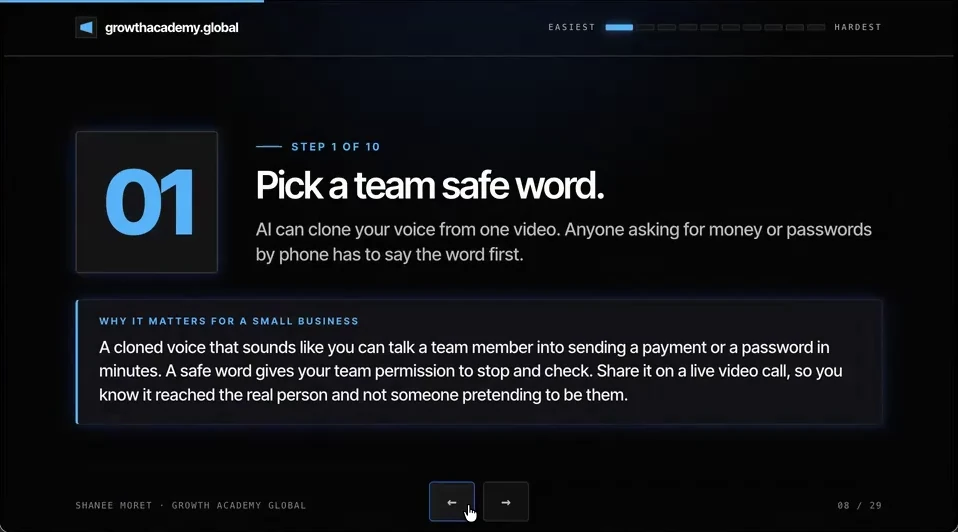
The reason is that AI can clone your voice from one video. Anyone asking for money or passwords by phone has to say the word first. This is very, very important, because that is how some of the biggest companies are getting scammed.
1. How the cloned-voice scam actually works
You work with Sally Jones. Sally Jones calls you, and you think it's coming from an internal number. Sally is like, "Oh, I forgot my password. Could you reset it, or could you just log me in?" You're like, "Sure, Sally, I trust you," and you give it to Sally. And that's not really Sally.
Usually what happens is they use a voice that is familiar to that person, through a number that is familiar to that person. Caller ID can be faked, which the FCC calls spoofing, so the screen can show a number you trust. And the models have gotten so much better that the voice can pause and sound extremely real. Beforehand you knew you were talking to me because of my voice. Now, probably within maybe 20 minutes, somebody could easily clone my voice.
This is not theoretical. The FBI's public warning on generative AI fraud describes criminals using AI-generated audio to impersonate a loved one or an executive and ask for money or access, and it recommends exactly this: a secret word or phrase that only the real person would know. And it is not only phone calls: in 2024 a multinational's Hong Kong office sent about US$25 million after a deepfake video call with people who looked and sounded like its own executives.
2. Set up your safe word this week
How to set up a team safe word
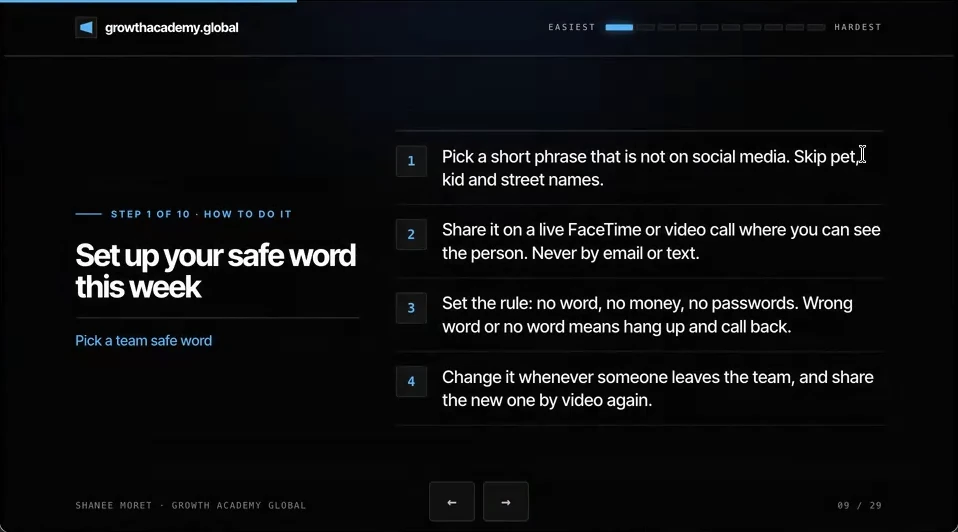
Step 1. Pick a short phrase that is not on social media. Skip pet, kid and street names. Pick a safe word that people are probably not going to easily guess. If it shows up anywhere in your posts, your bio or your podcast episodes, a scammer can find it the same way they found your voice.
Step 2. Share it on a live FaceTime or video call where you can see the person. Never by email or text. If it reaches the real person on a live call, you know it reached them and not someone pretending to be them. An email or a text can be read by anyone who gets into that inbox.
Step 3. Set the rule: no word, no money, no passwords. Wrong word or no word means hang up and call back. If they get the wrong passphrase, nothing happens. They don't get the password. They don't get the transfer.
Step 4. Change it whenever someone leaves the team, and share the new one by video again.
3. Make the rule about permission, not suspicion
A safe word only works if people actually ask for it, and the hardest part is asking someone who sounds exactly like your boss. Write the rule so it applies to everyone, including the owner. When the person calling is you, your team should still ask, and you should thank them for it.
Use it for three kinds of calls: anything that moves money, anything that shares or resets a password or login, and anything that changes account or payment details. Everything else can stay a normal conversation.
Pair it with step 2 of this series, hang up and call back on a number you already have. Between the two, the Sally Jones call has nowhere to go.
This could also apply to the family side. If a family member calls in a panic asking for money, the safe word is the fastest way to know it's really them.
Here's how to do this for yourself:
- Pick a short phrase with no pet, kid or street names in it, and search your own social media to confirm it is not there.
- Get the team on a live video call and say it out loud. Do not type it in the chat.
- Announce the rule: no word, no money, no passwords, and wrong word or no word means hang up and call back.
- Add 'change the safe word and share it by video' to your offboarding checklist.
- Do the same with your family this weekend.
Your voice is already on the internet. Your safe word should never be.
Questions business owners are asking
What is a safe word for AI voice cloning scams?
It is a short phrase your team or family agrees on in person or on a live video call, and that anyone asking for money or passwords by phone has to say first. AI can copy how you sound from a single video, but it cannot know a phrase that was never written down or posted anywhere. If the caller can't say it, you hang up and call back on a number you already have.
Can AI really clone a voice from one video?
Yes. The FBI warns that criminals use AI-generated audio to impersonate people their targets know, and current tools need only a short clip of someone talking. If you post videos, go on podcasts or run lives, there is enough of your voice online. That is why the defense is something a recording can't contain: a phrase only your team knows.
What makes a good safe word?
Short, easy to remember, and impossible to find online. Skip pet names, kids' names and street names, because those are the first things a scammer finds on social media. A random two-word phrase works well, for example an odd combination of a color and a food that means nothing to anyone outside your team.
How should I share the safe word with my team?
Say it on a live FaceTime or video call where you can see the person. Never send it by email or text, because anyone who gets into that inbox or phone would have it too. Seeing the person when you share it also proves the word reached the real team member and not someone pretending to be them.
When should I change the safe word?
Every time someone leaves the team, and any time you think it may have been shared outside the people who should know it. Share the new one the same way, on a live video call.
Key moments in the video
- 0:49 Voice cloning and multi-million dollar scams
- 1:43 Pick a team safe word
- 2:01 The Sally Jones password call
- 2:19 Pick a phrase that is not on social media
- 2:31 Share it only on a live video call
- 2:37 No word, no money, no passwords
- 2:48 Change it when someone leaves
Sources
Official / Primary Sources
- FCC: Caller ID Spoofing. Explains how scammers fake caller ID to show a number you trust, and advises calling back on the number from a statement or official website.
- FBI IC3: Criminals Use Generative Artificial Intelligence to Facilitate Financial Fraud. Public service announcement, December 3, 2024. Covers AI vocal cloning used to impersonate relatives and executives, and advises agreeing on a secret word or phrase.
- FTC: Scammers use AI to enhance their family emergency schemes. Consumer alert, March 20, 2023. Do not trust the voice; hang up and call the person on a number you know is theirs.
- 10 Ways to Protect Your Small Business Now That AI Can Call You. Shanee Moret on YouTube, published October 13, 2026; the article above is drawn from this video.
Independent Coverage / Analysis
- Hong Kong Free Press (AFP): Multinational loses HK$200 million to deepfake video conference scam, Hong Kong police say. February 5, 2024. Reports the Hong Kong police briefing on about HK$200 million (roughly US$25 million) sent in 15 transfers after a deepfake video call.
- CNN: Arup revealed as victim of $25 million deepfake scam involving Hong Kong employee. May 16, 2024. Reports Arup's confirmation that it was the company in the Hong Kong case. No statement from Arup or the police was available on their own sites.