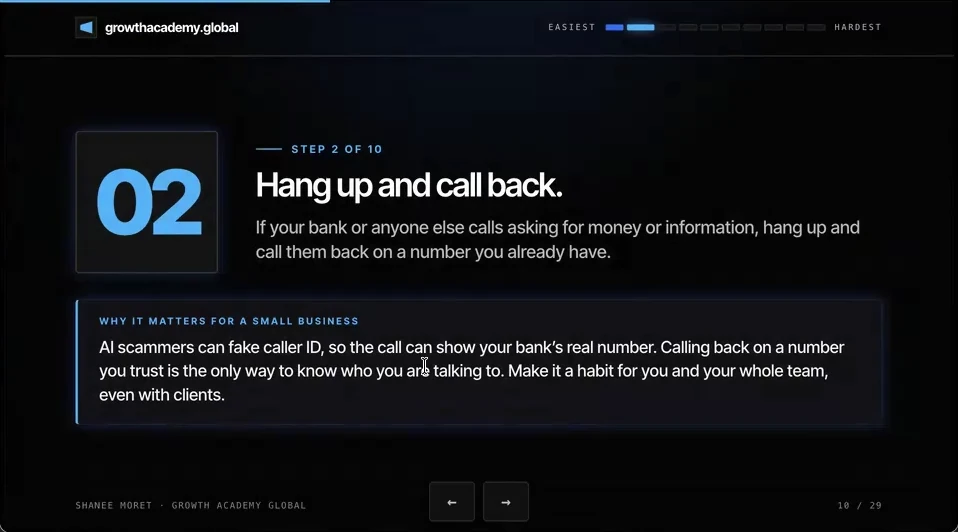
I'm Shanee Moret, founder of GrowthAcademy.Global. I have been teaching business owners to use AI since January 2023, and I build AI phone agents for my own business, so I know how real a call from software can sound. Step 2 of the 10 ways I protect a small business is simple: if your bank or anyone else calls for money or information, hang up and call them back on a number you already have.
AI scammers can fake caller ID, so the call can show your bank's real number. Calling back on a number you trust is the only way to know who you are talking to. Make it a habit for you and your whole team, even with clients.
1. Why the number on your screen proves nothing
Usually what happens in these scams is they use a voice that is familiar to the person, through a number that is familiar to the person. The voice can now be cloned. The number can be faked too: the FCC calls it caller ID spoofing, and its advice is the same as mine. Hang up, and call back on the number from your statement or the company's official website.
The FTC gives the same advice for the family version of this scam: don't trust the voice, call the person on a number you know is theirs. And for business payments, the FBI has told companies for years to verify any payment change by a phone number you already know, never one given to you in the request.
2. Set up your call-back habit this week
How to set up the call-back rule for your team
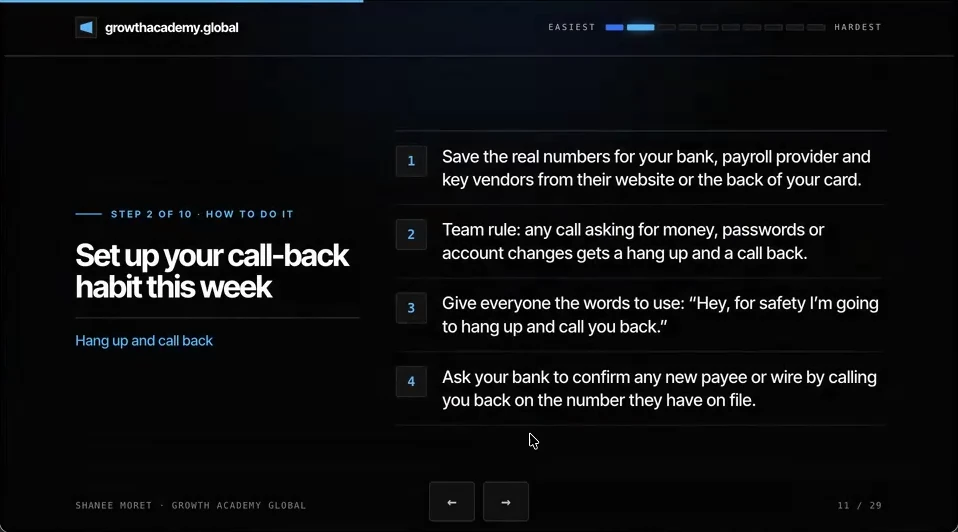
Step 1. Save the real numbers for your bank, payroll provider and key vendors from their website or the back of your card. Put them in your phone contacts and in your password manager, so everyone on the team dials the same verified numbers.
Step 2. Make it a team rule. Any call asking for money, passwords or account changes gets a hang up and a call back.
Step 3. Give everyone the words to use: "Hey, for safety, I'm going to hang up and call you back." You're making it easy so that no one on your team has to feel weird when they do that.
Step 4. Ask your bank to confirm any new payee or wire by calling you back on the number they have on file.
3. Use it with clients and vendors too
Make it a habit for you and your whole team, even with clients. Tell your key clients and vendors that this is how you operate, so a call-back from you never surprises them, and they know to expect one when they ask you to change where a payment goes.
It pairs with step 1, the team safe word, which covers the cloned voice while the call-back covers the faked number. If you want to hear how convincing a software caller already is, I recorded my own AI phone bot claiming to be human.
Here's how to do this for yourself:
- Look up your bank, payroll provider and top five vendors on their official websites and save those numbers today.
- Tell the team: any call about money, passwords or account changes gets a hang up and a call back.
- Share the exact sentence: Hey, for safety, I'm going to hang up and call you back.
- Call your bank and ask them to confirm every new payee or wire by calling you back on the number on file.
A scammer can pick the number that shows on your screen. They can't pick the number you dial.
Questions business owners are asking
Can scammers really make a call show my bank's real phone number?
Yes. It's called caller ID spoofing, and the FCC warns that scammers use it to show the number of a bank, a company or a government agency you trust. The name and number on your screen are just text the caller can set. That is why the only reliable check is to hang up and call the number printed on your card, your statement or the official website.
What should I say when I hang up on someone to call them back?
Keep it short and friendly: "Hey, for safety, I'm going to hang up and call you back." Giving the whole team the same sentence means nobody has to invent an excuse or feel rude. A real bank, vendor or colleague will understand, and a scammer usually pushes back or adds urgency, which is a signal on its own.
Which calls need a call-back?
Any call asking for money, a password or login code, or a change to account or payment details. That covers the three moves scammers need: getting paid, getting in, and redirecting future payments. Routine calls that don't ask for any of those can stay normal.
Does this apply when the caller sounds like my boss or a coworker?
Especially then. Voice cloning means a familiar voice is no longer proof of who is calling. If the person asks for money or a password, hang up and call them back on the number you already have for them, and use the team safe word as a second check.
Key moments in the video
- 2:53 Hang up and call back on a number you already have
- 2:59 Save the real numbers for your bank and vendors
- 3:04 The team rule for money, passwords and account changes
- 3:13 The exact words to use
- 3:21 Ask your bank to call back on new payees and wires
Sources
Official / Primary Sources
- FCC: Caller ID Spoofing. Explains how scammers fake caller ID to show a number you trust, and advises calling back on the number from a statement or official website.
- FTC: Scammers use AI to enhance their family emergency schemes. Consumer alert, March 20, 2023. Do not trust the voice; hang up and call the person on a number you know is theirs.
- FBI IC3: Cyber Criminals Conduct Business Email Compromise Through Exploitation of Cloud-Based Email Services. Public service announcement, April 6, 2020. Advises verifying payment changes in person or by a previously known phone number.
- 10 Ways to Protect Your Small Business Now That AI Can Call You. Shanee Moret on YouTube, published October 13, 2026; the article above is drawn from this video.