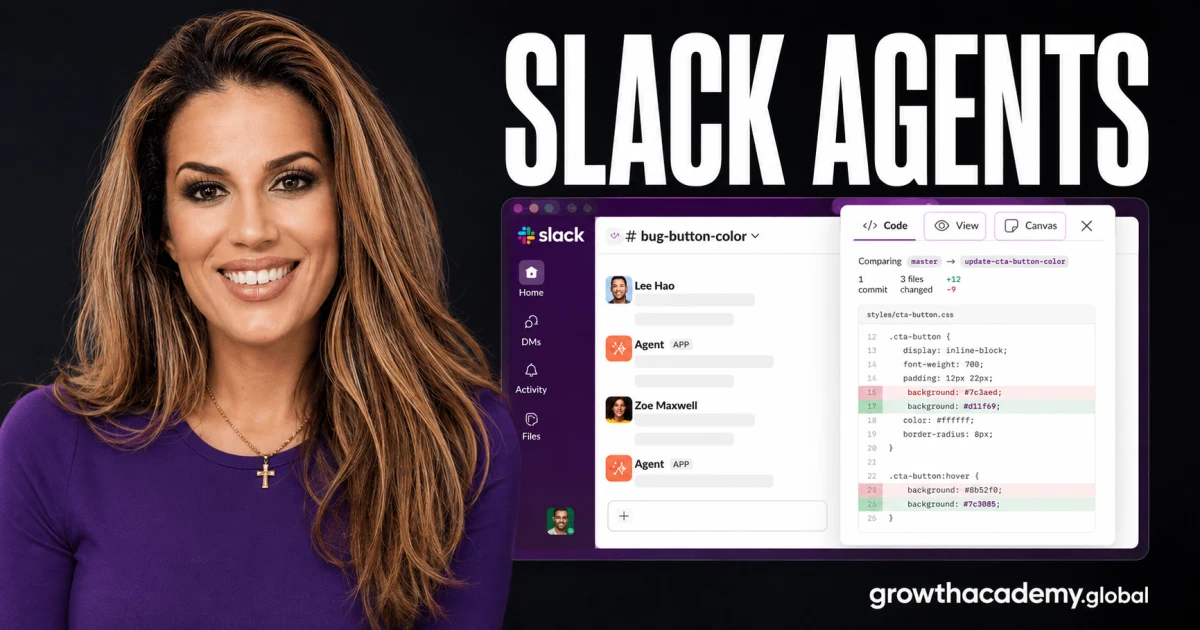
Where does agent work happen in your company right now? For most owners the honest answer is a private browser tab. One person assigns the task, watches the output, and decides alone whether it ships.
In late August, Salesforce moved that work somewhere your team can see it.
Between August 20 and 24, 2026, Salesforce launched Slack Code, a feature built into Slack that gives teams dedicated channels for working alongside AI coding agents. A team member tags a supported agent into a conversation, the agent opens a project-specific Code channel, the team follows the work in real time and leaves feedback, and the output ships only after someone approves it. It is available on any Slack plan.
What Shipped and How the Flow Works
The flow, as Slack's announcement and Salesforce's press release describe it, is simple. Salesforce pitches the launch as making AI software development "multiplayer."
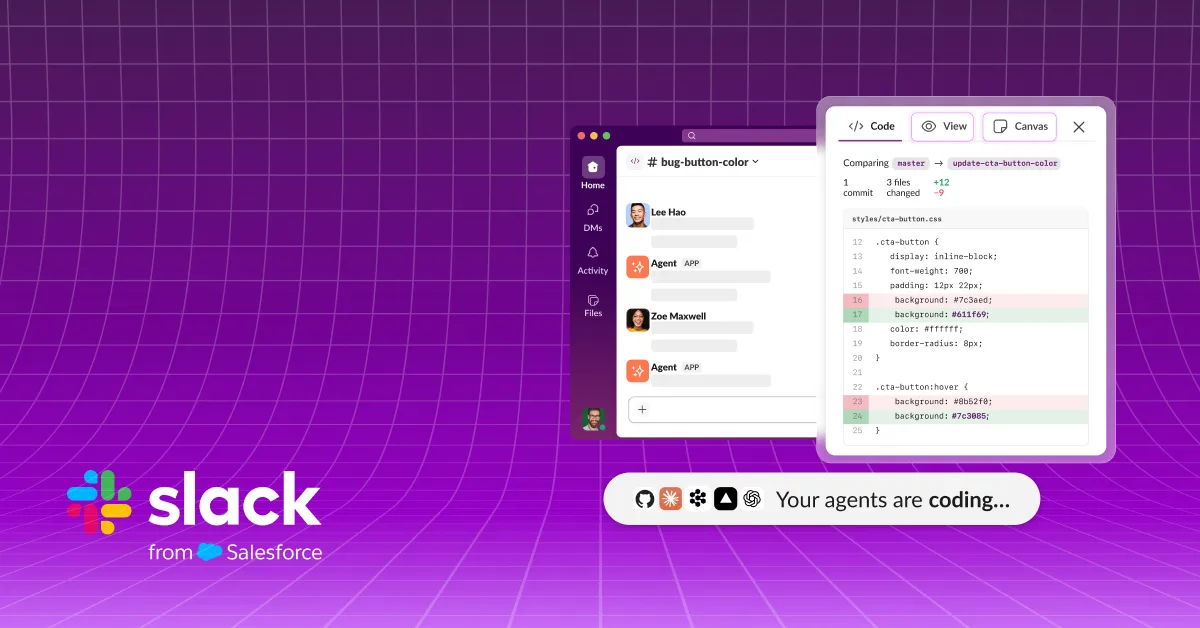
A team member tags a supported agent into a Slack conversation. Supported agents include ChatGPT, OpenAI Codex, GitHub Copilot, Cognition's Devin, and Vercel.
The agent opens a project-specific Code channel for the assignment. Everyone in it can follow the work in real time and review code diffs as they are produced, which in owner language means watching the changes appear while they are being made instead of receiving a finished bundle.
Team members leave feedback in the channel and the agent incorporates it. When the work is done, someone approves the finished output before it ships.
The channel keeps an audit log of the whole exchange, and it archives itself automatically when the assignment completes. The record survives after the channel closes.
Unite.AI's coverage frames it the same way: dedicated project channels for agent work, with the team in the room.
Why Visibility and Approval Are the Actual Story
Read past the word Code and look at the shape of the thing. This is the first mainstream template for agent work that is team-visible and approval-gated by default.
Today, most agent work in small companies happens the way freelance work happened before project management tools: in someone's private space, surfacing only when finished. That creates two problems you have probably felt.
The first is handoff. When the assignment lives in one person's browser tab, nobody else has the context, and the context leaves when that person does.
The second is accountability. When there is no formal approval step, things ship because the person running the agent decided they looked fine.
Slack Code answers both inside the tool your team already lives in. The task is visible in context from the moment it starts, and nothing ships until a person approves it.
Three Day-One Uses for a Small B2B Team
The contractor project you can finally watch
You hired a contractor to build an automation, and until now their agent worked out of your sight. Run the assignment through a Code channel and you watch the work as it happens, ask questions in the moment, and approve the result formally instead of discovering it in an invoice.
Internal tool fixes that get reviewed before deploy
Small teams ship internal scripts and fixes with no review step because review felt like ceremony. In a Code channel the diff is visible, feedback sits in the thread, and the approval is on the record before anything deploys.
The audit log as a client receipt
If you deliver technical work to clients, the archived channel is a timestamped record of what was asked, what changed, who commented, and who approved. That is a receipt you can stand behind when a client asks what they paid for.
What Adoption Actually Requires
Slack Code is available on any Slack plan, so the barrier is process rather than budget.
The decision that matters is governance, and it is yours to make: who in your company may assign work to an agent, and who approves the output before it ships. Two short lists. Write them before the first assignment so the approval step lands with the right person.
A reasonable rollout for a small team: pick one low-stakes internal project, run it through a Code channel end to end, and keep the archived channel as your reference for what good looks like.
The Honest Caveat
The supported agents are coding agents today, and "Code" is in the product's name for a reason. If your work is proposals and spreadsheets rather than software, the direct day-one value runs through whoever does technical work for you: your contractor, your fractional developer, your one technical hire.
The pattern is bigger than the launch, and it is fair to expect the team-visible, approval-gated shape to spread beyond code. Expecting is different from having. Buy the feature for what it does now and treat the rest as direction.
Frequently Asked Questions
Which agents does Slack Code support?
Supported agents at launch include ChatGPT, OpenAI Codex, GitHub Copilot, Cognition's Devin, and Vercel. A team member tags one of them into a conversation to open a Code channel for the assignment.
Do we need a paid Slack plan to use it?
Slack Code is available on any Slack plan. For a small team, the real setup work is deciding who may assign agent work and who approves the output.
Can non-technical team members participate?
The work the agents do today is coding work, but the channel itself is ordinary Slack. Following progress, leaving feedback, and giving the final approval all happen in the conversation, in plain view of the team.
What happens to the channel when the work is finished?
It archives itself automatically when the assignment completes, and the audit log of the exchange is preserved. The archived channel becomes the record of what was built, reviewed, and approved.
Sources
Official / Primary Sources
Independent Coverage / Analysis
Where This Goes
The private-tab era of agent work was a phase, the same way shadow IT was a phase. Useful tools arrive faster than the process for supervising them.
Slack Code is the first mainstream product to package the supervision: visible work, running feedback, a named approver, a permanent record. Whatever tools you use, that is the standard worth copying.
You can adopt the pattern before you adopt the product. Decide today that agent work at your company happens where the team can see it and ships only after someone approves it. The tooling is catching up to exactly that rule.