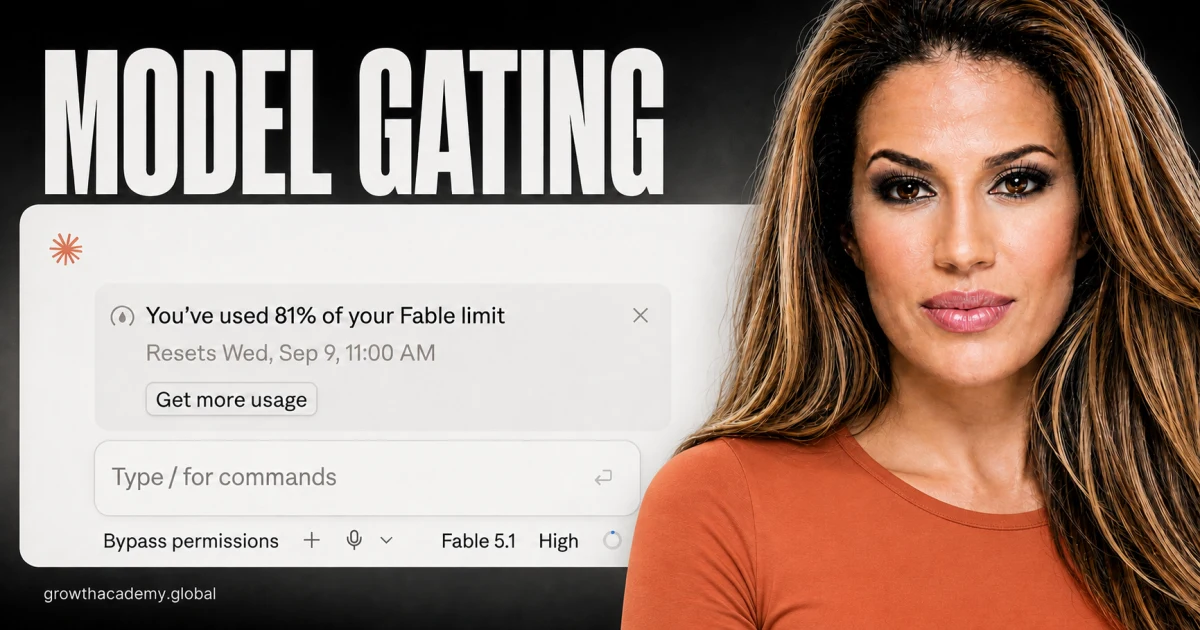
Here is a risk that never shows up in model benchmarks: you build your daily operations around a platform, the vendor ships its best model yet, and then you discover — through a policy page, not a conversation — how much of that model your subscription is actually allowed to use.
I call this model gating, and it is one of the reasons weighed in my platform comparison pillar. It deserves its own article because it is the least visible input to the platform decision and, for a business running agents on real work, one of the most consequential.
The Fable 5 Rollout, as Documented by Anthropic Itself
When Anthropic launched Claude Fable 5 — by many accounts its strongest model — the access rules for subscribers were revised repeatedly inside a single month. The sequence, from Anthropic's own pages and the coverage of each change:
- The announced plan: per Anthropic's redeployment announcement, Fable 5 became globally available July 1, included in paid plans up to 50% of weekly usage limits through July 7 only, with usage credits (metered, pay-beyond-your-subscription access) after that and requests falling back to Opus 4.8 when Fable 5 was blocked.
- What actually happened: the July 7 cutoff never landed. The inclusion window was extended twice — first to July 12, then to July 19 — with Anthropic's plan page stating the promotional inclusion ran through July 19 at 11:59 PM PT (Claude Fable models on your plan; extension reported by BleepingComputer).
- Where it settled: from July 20, access split by tier. Max and premium Team seats kept Fable 5 included — capped at 50% of weekly limits — while Pro and standard Team seats lost inclusion and moved to usage credits (with a one-time promotional credit), and standard Enterprise seats get credits only if the organization enables them (same support page; launch terms covered by Search Engine Journal).
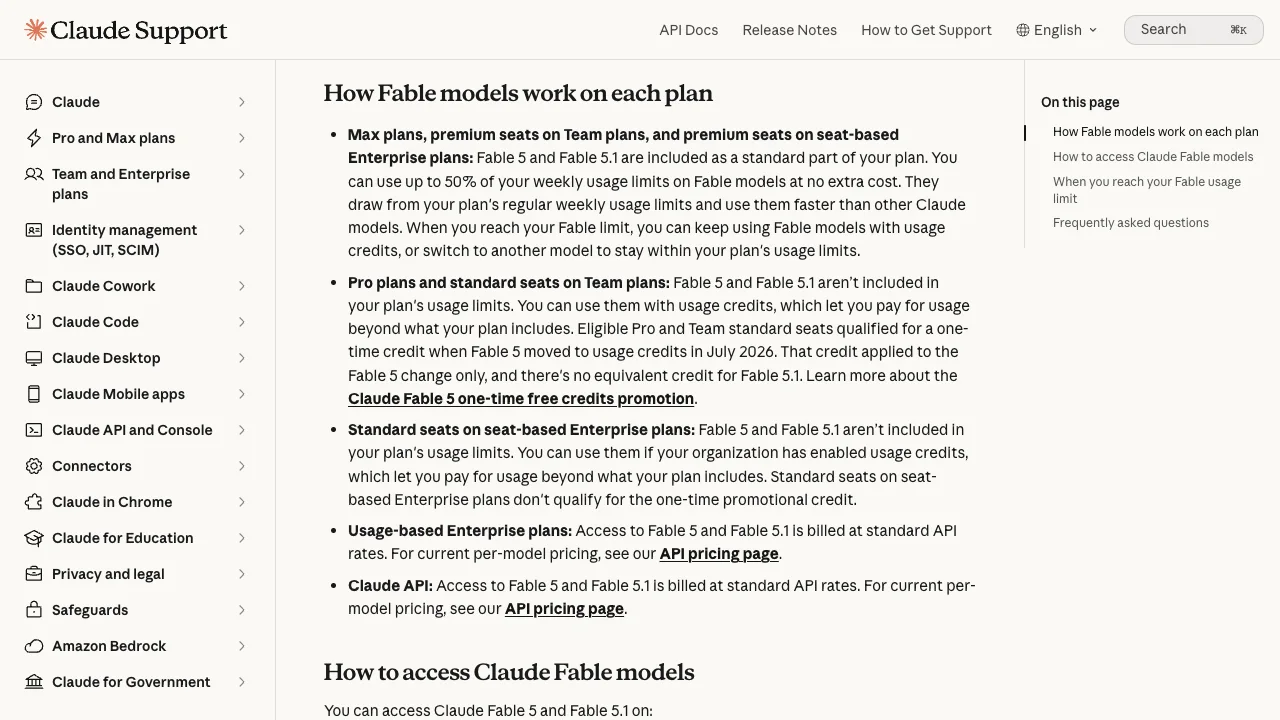
To Anthropic's credit, the current policy is published plainly. And each individual decision is defensible — extending a popular promotion twice is customer-friendly in isolation. If you have arguably the best model on the market, you can set terms like these; that is a rational business choice.
But look at it from inside a company whose operations were entrenched in that ecosystem during those weeks: the rules you were planning around changed at least three times in one month — announced cutoff, extension, extension, then a tier split in which some subscribers kept the model and others lost it. Your team finds the new model terrific, calibrates real workflows to it, and then your operating cost and your agents' capability are re-decided by someone else's announcement cycle. Whether each change was generous or restrictive is almost beside the point. None of the changes were your decision, and none of them were predictable.
The Contrast, Stated Carefully
Now the other side, stated no more strongly than the evidence allows — because OpenAI's launches have their own tiering. When GPT-5.6 shipped in July, higher tiers got the full model lineup at launch while Plus started with a subset, and ChatGPT Work rolled out to Pro, Enterprise, and Edu plans first (see OpenAI's release notes). "Who gets it first" gating exists on both sides of this comparison.
The distinction that survives scrutiny is narrower and, for operations, the one that matters: as of this writing, OpenAI has not metered a new model as a percentage of your plan's usage — no "you may only spend 50% of your subscription on the new model," no temporary-inclusion window that expires behind you mid-project. Once a model is in your tier, your allowance is your allowance. That has been my consistent experience as a heavy subscriber, and it is the track record to date. It is not a guarantee; any vendor can change access rules — which is precisely the point of this article.
For the adjacent-but-different question of raw capacity — how much total agent work each subscription tier buys — see Codex vs. Claude: Capacity in Q4 2026 and the Fable 5.1 pricing comparison. Gating is not about how much you get; it is about whether the rules of what you get hold still.
Why Predictability Beats Peak Capability for Operational Agents
A researcher wants the smartest model available today. A business running 25 dependable agents wants something different: the same capability, at the same cost, under the same rules, next month.
Operational agents are calibrated against a model's behavior — instructions tuned, workflows tested. When access rules shift mid-cycle, you don't just pay more; you re-test everything against whatever model your plan now favors. Multiply by every agent and every affected workflow. Release predictability is a capability for businesses, even though it never appears on a benchmark.
The Questions to Ask Any Vendor Before You Depend on Them
Put these in writing before you entrench:
- When you release a new flagship model, is it included in my current plan — fully, partially, or not at all?
- Have you ever capped a model at a percentage of plan usage? What is your stated policy for the next release?
- How much notice do you give before access or limit changes take effect?
- If a model my workflows depend on is deprecated or re-gated, what is the migration path?
No vendor will promise forever. What their answers — and their track record — tell you is how much rule risk you are carrying on top of the technology risk you already accepted.
The Real Answer Is Upstream of Any Vendor
I recommend most nontechnical teams start in the environment with the more predictable access story — but "start" is the operative word in the whole pillar. The durable protection against gating is not choosing the vendor who has never done it. It is building your operation so the model underneath is swappable: your business rules, instructions, credentials, and logs in your own hands, with any provider a plug-in rather than a foundation. That is the subject of Own Your Agent Infrastructure — the article I'd read next if this one made you uncomfortable.
Sources
Official / Primary Sources
- Redeploying Claude Fable 5 — Anthropic (announced launch terms)
- Claude Fable models on your plan — Anthropic Support (promotional end date and current plan matrix)
- ChatGPT release notes — OpenAI Help Center (GPT-5.6 launch tiering)