Short answer: Your SOPs, as written, are obsolete. Not the standards inside them, the instructions. Steps like "log into the CRM and check the field" stop existing the day an AI agent connects to that system. Status-report forms are worse: they capture a skeleton and lose the signals agents now mine. The replacement is not a better document for humans. It is the HASOP, the Human-Agent SOP: one procedure, two lanes, where the agent carries the motion and the human keeps the decisions. The standard never changes. Who carries it just did.
I watched this land on a CEO this week. He runs a process-improvement consulting firm, twenty-plus years in business, the kind of operator who teaches other companies discipline. We connected Claude Code to his systems and had it audit how his company actually runs. It told him his digital workspace failed his own standard. Thousands of files versioned by filename. Three documents competing to be the source of truth. And then it flagged the most valuable thing it found: his SOP library, years of refined procedures, every one of them written for human hands.
His own recurring frustration with his team, in his words: "Why are we not following the new SOPs?" The honest answer was never discipline. Humans skip steps when they get busy. The document was always going to lose to the calendar. The fix is not a better human. It is a procedure that runs itself and a human who supervises it.
Two kinds of dead steps
Open any SOP in your library and you will find two patterns, and both just expired.
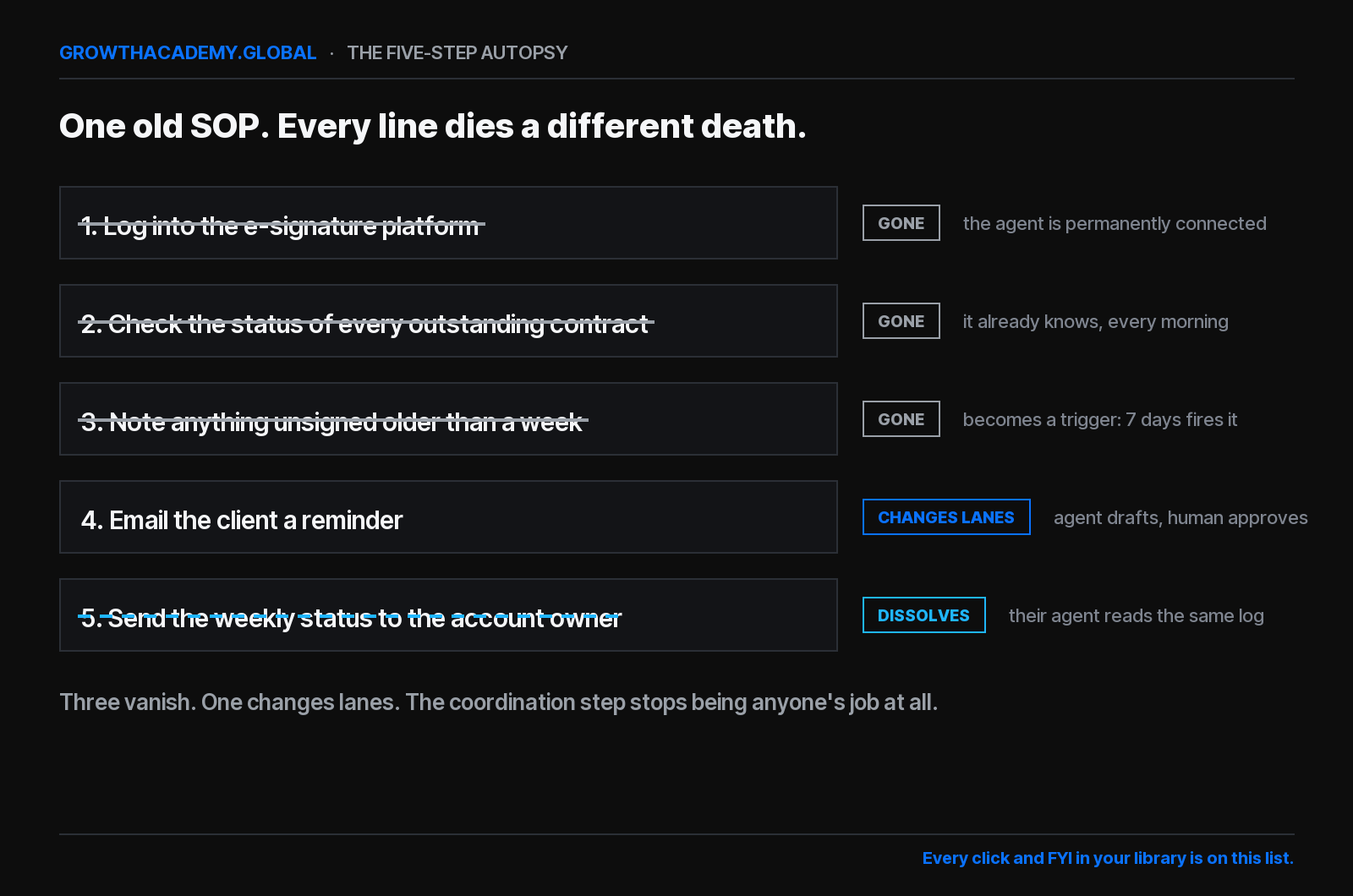
The click is dead. Here is a real procedure, the way it is written in a thousand operations manuals right now:
- Log into the e-signature platform.
- Check the status of every outstanding contract.
- Note anything unsigned older than a week.
- Email the client a reminder.
- Send the weekly status to the account owner so they know where things stand.
Not wrong. Obsolete, the way "rewind the tape" is obsolete. Walk it step by step, because every line dies a different death.
Step 1, "log in," is gone. Nobody logs in. The agent is connected to the platform the way your phone is connected to WiFi: permanently. There is no session to start, so there is no step one.
Step 2, "check the statuses," is gone. Checking was a ritual invented because seeing the data cost a human effort. The agent reads every envelope, every morning, across the whole business at once. It does not check. It already knows.
Step 3, "note anything older than a week," is gone. That sentence was always a rule pretending to be a chore. In the rebuilt procedure it becomes exactly what it wanted to be: a trigger. Seven days unsigned fires the escalation automatically, with the deal value and the signer's contact attached.
Step 4, "email the client a reminder," changes lanes. The agent drafts the reminder in your voice, referencing the engagement's own context. A human approves it with one reply, until the agent's track record earns it the routine sends.
Step 5, "send it to the account owner so they know," is the death nobody sees coming. You no longer inform the human. Their agent already knows. It read the same activity log the second the escalation fired, and it briefs its owner in their own morning summary, ranked against everything else on their plate. The FYI email, the weekly status, the "just looping you in": those steps exist because humans could not share state. Agents share state by default. The handoff does not get automated. It dissolves.
Five steps. Three vanish, one changes lanes, and the last one, the coordination step, stops being anyone's job at all. Every log-into, open, check, scroll, copy-paste, and FYI in your library is on that list.
The form is worse than dead. "After each client session, fill out the weekly status form." The form captures percent-complete and loses everything that mattered: the client's CFO asking about phase-two pricing twice, the sponsor sounding tired, the plant manager mentioning a second line. Those are continuation signals, upsell signals, risk signals, and no form field holds them. Forms exist because humans could not process nuance at scale. Agents can. The upgrade is not a better form. It is a two-minute voice memo with the nuance intact, mined by the agent the same hour.
That is the vetting test for every line of every procedure you own: is this step a click, a form, or a judgment? Clicks move to the agent. Forms become richer capture. Judgments stay human.
The word "standard" is the problem
SOP stands for standard operating procedure, and "standard" was the entire 20th-century ambition: do it the same way, every time, no matter who is doing it. Agents make consistency the floor. A procedure an agent runs is identical every single time by definition. So the ambition has to move, and the document has to change with it.
HASOP, the Human-Agent SOP
The rebuilt form of a standard operating procedure for the agent era: one procedure, two lanes. The agent's lane carries the motion: watching, checking, chasing, drafting, and logging through connected systems. The human's lane carries the decisions: approvals, exceptions, and the calls where a relationship needs a human voice. Classic SOPs described keystrokes. A HASOP describes responsibilities.
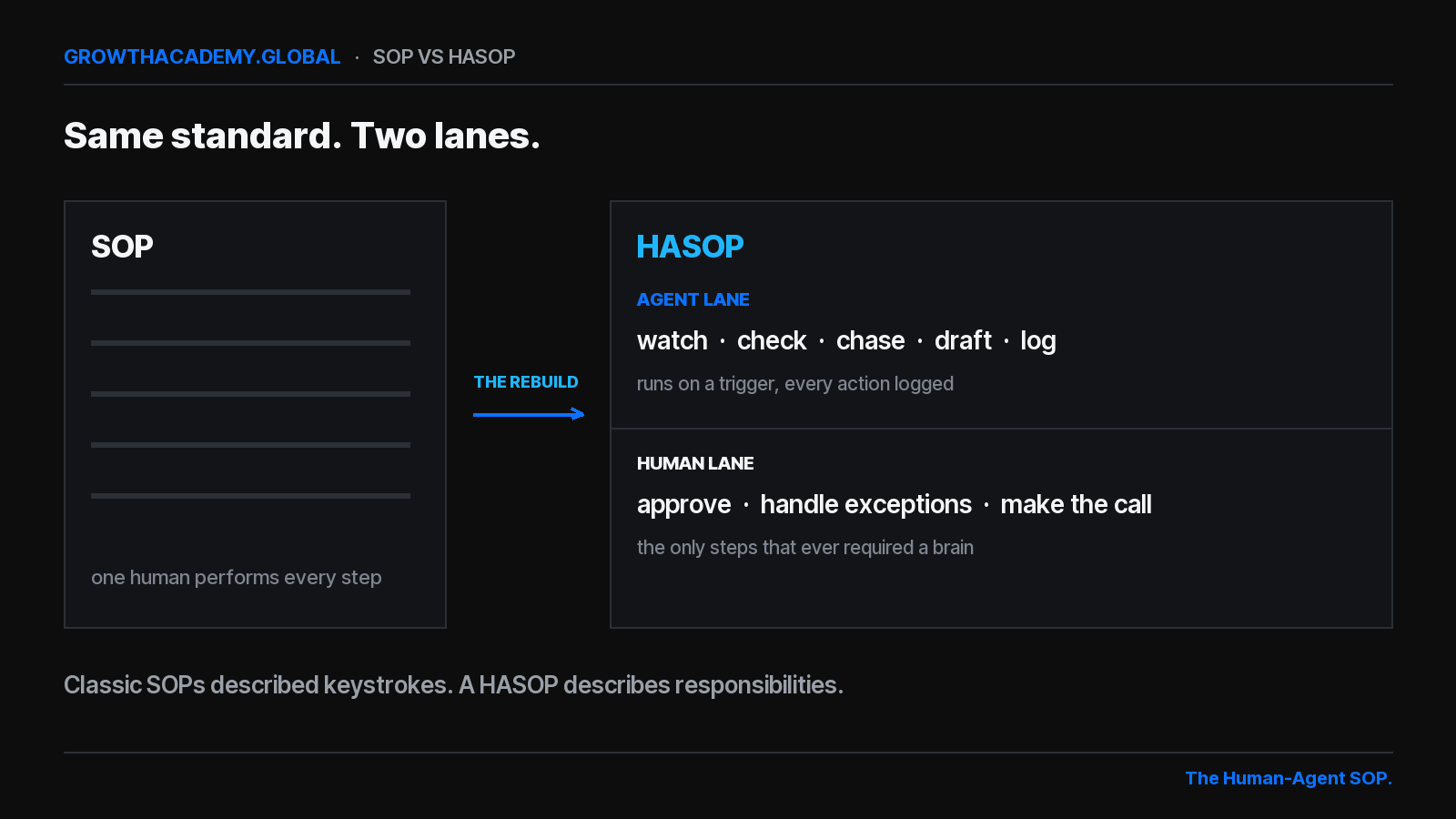
The trade inside a HASOP is always the same shape. In the contract-chasing procedure I rebuilt with that CEO, the agent's lane took five steps and the human's lane kept two, and the two that stayed human were the only two that ever required a brain: the approval, and the judgment call on when a phone call beats an email. Your team stops performing the standard and starts supervising it.
And the rebuild never finishes
Here is the part that should change how you think about documentation permanently. SOPs were written for a world where tools changed slowly, so a procedure stayed current for years and got revised at the annual ops review. That cadence is dead too. Connectors, capture methods, and agent capabilities now change monthly. A procedure written six months ago says "log into the CRM," which is already a dead step. The half-life of a keystroke instruction collapsed from years to weeks.
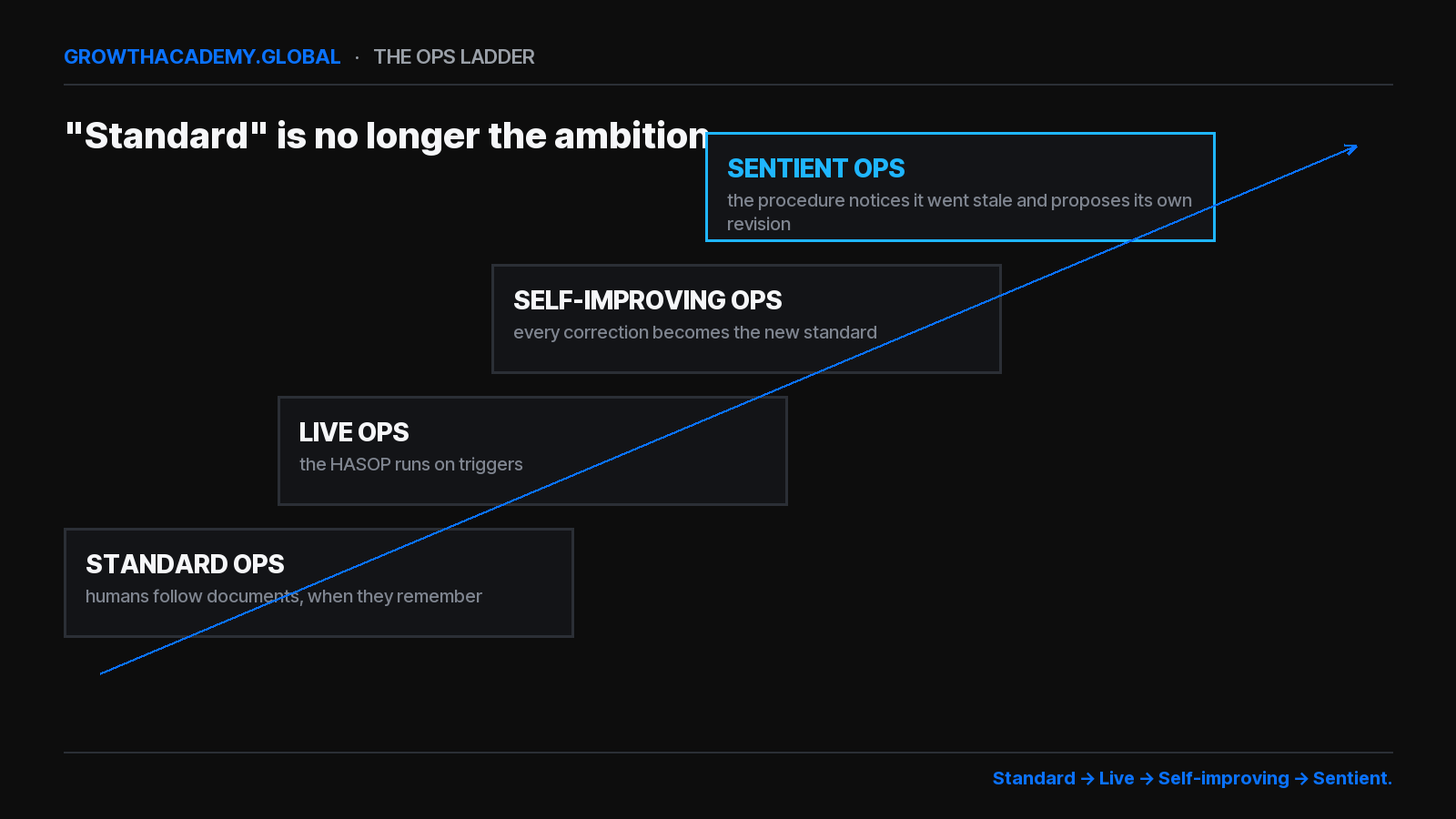
So the ambition climbs a ladder: standard ops (documents humans follow, when they remember), live ops (HASOPs that run on triggers whether anyone remembers or not), self-improving ops (every correction becomes the new standard automatically), and sentient ops (not conscious, aware of state, including its own: the procedure notices it has gone stale and proposes its own revision, and a human approves the change). At that last rung, re-vetting your procedures stops being a project someone gets assigned every few years and becomes a rhythm the operation runs on itself.
What to do with the library you already have
Do not throw it away. Your SOP library is the best conversion source in your company, and the firms that spent years documenting are sitting on a head start they do not realize they have. Here is the sequence:
- Make sure your agent has access. Codex or Claude Code, set up so it can actually act instead of stopping to ask at every step. This is the two-minute settings fix most people miss.
- Connect the rest of your core stack. CRM, email, calendar, meeting notetaker, e-signature, your files. The agent cannot vet procedures that touch systems it cannot see.
- Hand it the SOPs, or tell it to go find them. It can sweep your drives and folders, surface every procedure, checklist, and ops document you own, and rank them least to most valuable to convert.
- Give it this prompt so it strategizes the first five to build instead of you guessing:
Find every SOP, process document, checklist, and operations manual across my connected systems and folders. Rank them from least to most valuable to convert into an agent, scoring each on: how close it sits to revenue, how clear its trigger is, whether its inputs live in systems you can reach today, and how often the work repeats.
Then propose the first five agents I should build. For each one, show me: the trigger, the agent lane, the human lane including every client-facing approval that stays with us, any connection you are missing, and the one number we would watch to know it is working.
Do not build anything, change anything, or contact anyone. Rank, propose, and wait for my pick.
- Build the first one with the Test, Refine method. Baseline it on real past cases, refine the misses into written principles, re-test that the principles stick, then release the lowest tier and expand. The full method, with the real scores from a real client, is its own article.
- Put the library on a re-vet cadence of weeks, because the tools will keep moving and your procedures now age with them.
The full conversion playbook, with the worked examples, the Test, Refine method, and the exact document templates, is here: How to Turn Your SOPs Into AI Agents with Claude Code.
Common questions
Are SOPs obsolete?
As written, mostly yes. The thinking inside an SOP (the standard, the trigger, the escalation logic) is still the asset. The instructions are the problem: steps like log in, open, check the field were written for human hands, and AI agents connected to your systems make those steps obsolete. Status-report forms are worse, because they capture a skeleton and lose the nuance agents now mine. The procedure has to be rebuilt as a Human-Agent SOP.
What is a HASOP?
A HASOP, short for Human-Agent SOP, is the rebuilt form of a standard operating procedure for the agent era: one procedure, two lanes. The agent's lane carries the motion: watching, checking, chasing, drafting, and logging through connected systems. The human's lane carries the decisions: approvals, exceptions, and relationship calls. Classic SOPs described keystrokes. A HASOP describes responsibilities. The term was coined by Shanee Moret of Growth Academy Global in June 2026.
What is the difference between an SOP and a HASOP?
An SOP assumes a human performs every step, so it is written as keystrokes: log in, check, copy, send. A HASOP splits the same standard into two lanes, gives the motion to an AI agent that runs it on a trigger and logs every action, and keeps only the judgment steps human. The standard stays identical. Who carries it changes.
Should I throw away my SOP library?
No. Your SOP library is the raw material, and the firms that documented their processes for years are sitting on the best conversion source. Vet every procedure line by line: clicks move to the agent, forms become richer capture like voice, judgments stay human. Then rebuild each one as a HASOP and put it on a re-vet cadence of weeks, not years.
You did not waste the years you spent writing procedures. You were writing the spec for your agents before agents existed. Stop asking your team to follow the documents. Rebuild the documents so they run.
The how-to: turn your SOPs into AI agents, step by step. The context: what agents do to the admin layer and the 12 prompts that find money in your business.