One of the first questions I get from established business owners with enterprise clients is: "What if one or two of our clients has a no-AI policy?"
Until recently that was a contracts-and-honesty conversation. Now it is also a technical one, because Anthropic has taken a public stand: Claude marks the content it generates. If you serve clients with AI restrictions — or you are choosing your first agent platform with those clients in mind — you need to understand exactly what this does and does not mean before it surprises you inside a deliverable. It is reason seven in my platform comparison pillar, and it deserves its own full treatment.
What Anthropic Actually Announced
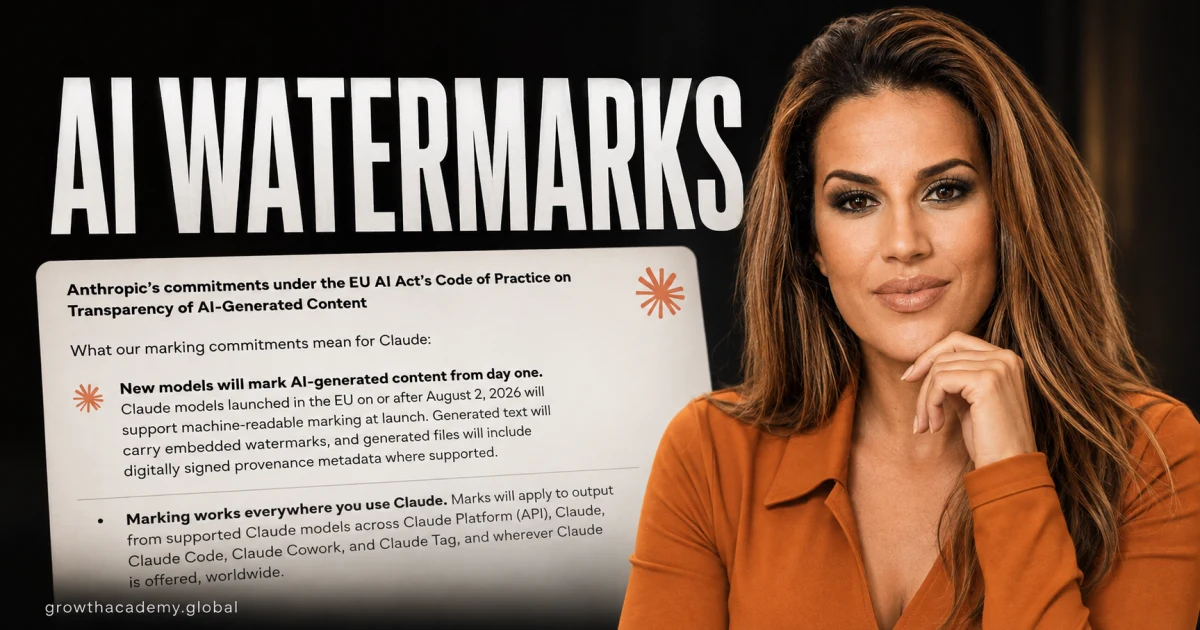
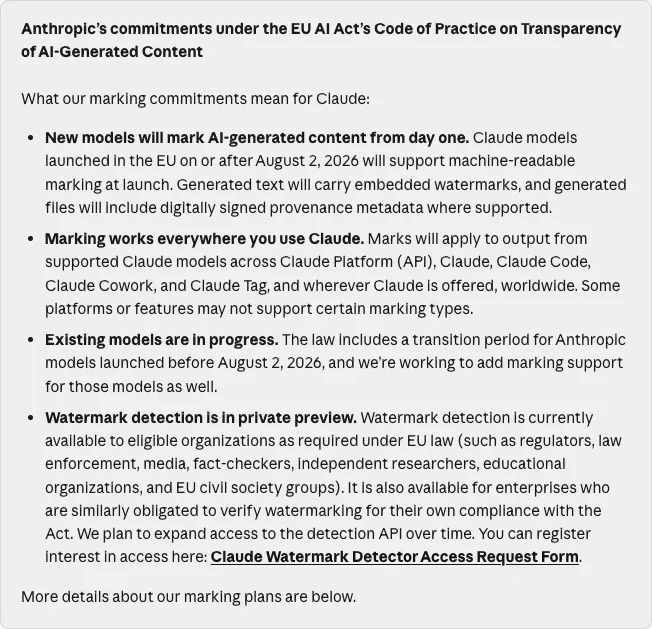
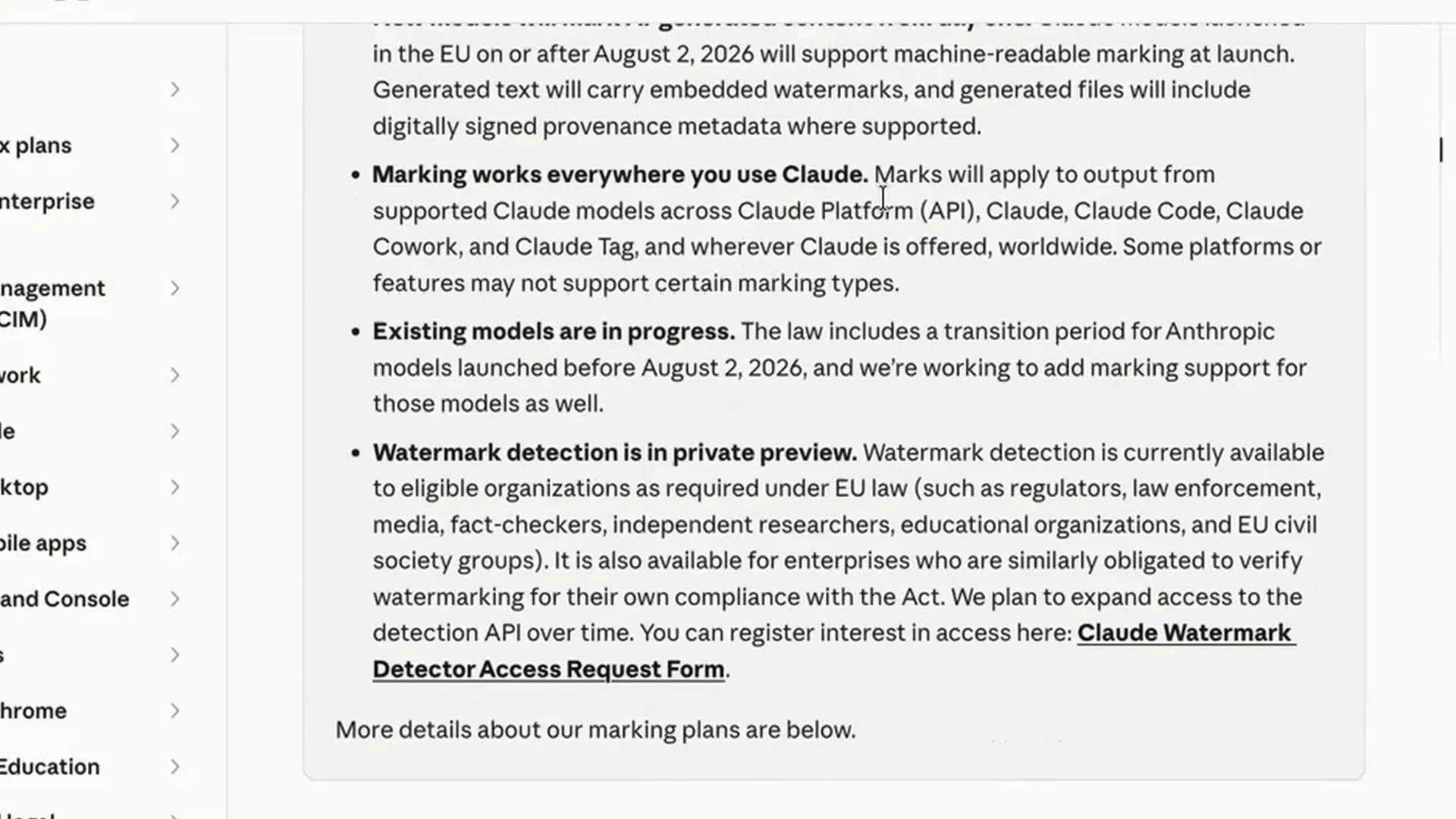
Anthropic's own policy page, How Claude marks AI-generated content, lays it out. The commitment is scoped by model generation: models launched in the EU on or after August 2, 2026 mark AI-generated content from day one, while older models are in a transition period — so marking is rolling across the lineup, not retroactively universal today. For supported models, it works in two ways:
- Embedded text watermarks. When a supported Claude model generates text, it weaves an imperceptible watermark directly into the text itself. You won't see it, and Anthropic says it does not change the meaning, quality, or readability of the response — but it is part of the text.
- Signed provenance metadata on files. When Claude generates a supported file type such as an SVG, PNG, or JPG, it attaches digitally signed provenance metadata.
Two scope details matter enormously for business owners:
- It applies everywhere, not just Europe. Anthropic states the marking applies to output from supported models wherever Claude is offered, worldwide — including the US, where I am and where my clients are. Independent reporting ties the timing to transparency requirements under the EU AI Act (The Register's coverage), but the implementation is global.
- It applies across the whole product family. Anthropic's policy page lists the marking surfaces: the Claude Platform (API), Claude on the web, Claude Code, Claude Cowork, Claude Tag, and the cloud platforms where Claude is offered — AWS, Google Cloud, and Microsoft Foundry. (The announcement post covers the watermarking methodology itself.)
Anthropic also ships the verification side: a free Claude Content Checker for testing whether text or files carry a supported mark, with a detection API in private preview.
What a Mark Proves — and What It Doesn't
This is where most of the online panic gets it wrong, in both directions. Anthropic's own limitations section is unusually candid:
- A detected mark is a signal, not a verdict. It tells you content may have been processed by Claude. It does not confirm the full provenance, and it does not mean Claude was the original author. People use Claude to proofread, translate, summarize, and convert files.
- No mark proves nothing either. The absence of a detected mark does not mean content wasn't AI-generated — by Claude before marking existed, or by any other model that doesn't mark at all.
Now play that forward into client work. You write an entire book yourself, run it through Claude for a spell check, and the text can carry the mark. That single scenario is why, in my corner of the business-owner world, I watched people cancel subscriptions when this rolled out — not because they were hiding AI ghostwriting, but because a proofreading pass can now make their own writing machine-flag as AI-processed, with no way for a third-party detector to tell the difference.
The Real Business Question: Who Controls the Provenance Story?
I want to be fair here, because this is a comparison-adjacent topic and fairness is the whole game: Anthropic marking its output is a legitimate transparency position, and in some industries — education, publishing, government work — verifiable provenance may become a selling point rather than a liability.
But as the owner of a business serving clients, the question is not whether watermarking is good for the ecosystem. It is: do you control which deliverables carry an AI provenance signal, or does your tooling decide for you?
If a client has a contractual no-AI clause and a Claude model touches their deliverable even once — because a guardrail wasn't configured, because a team member grabbed the wrong tool for a quick edit — the mark travels with the text. Your compliance posture is now set by an accident, not a policy.
How to Run This Cleanly: Per-Client AI Policy Flags
There are ways to deal with no-AI clients, and they are process, not heroics:
- Inventory the restrictions. Every client gets an explicit AI-policy flag in your client records: unrestricted, disclosure-required, or AI-prohibited. If you have never asked, ask — the awkward conversation is cheaper than the discovered breach.
- Route by flag, enforced by instructions. AI-prohibited client work runs only through tools and workflows you have verified for that policy — including which model families touch drafts, edits, and even file conversions. Your agents' standing instructions should name the restricted clients, and your work trails should let you prove after the fact what touched a deliverable.
- Match disclosure to the contract, not the vibes. For disclosure-required clients, marked output can actually make honesty easier — the provenance story and the paper trail agree.
- Decide platform exposure deliberately. If a meaningful share of your revenue is AI-restricted, that is a real input into which platform your team starts on — one input among several, which is exactly how I weight it in the pillar.
The Takeaway
Content marking is not a scandal, and it is not nothing. It is a vendor policy with real contractual consequences that arrived faster than most owners' client agreements did. Know which of your clients care, flag them, route their work deliberately, and keep the provenance decision where it belongs — with you.
Sources
Official / Primary Sources
- How Claude marks AI-generated content — Anthropic Support
- Anthropic announcement: Claude text watermarking