Short answer: As AI agents reach everyone, some of what you sell gets commoditized: work a client used to pay you for, an agent now does in minutes, either for them directly or for the competitor who figured it out first. You cannot tell which of your offers are exposed from the outside. You only see it once you are using the tools yourself. The owners who stay ahead are repositioning now: dropping the commoditized work, updating the format of the offers they keep (the same expertise that was once a prompt becomes a custom GPT, then an agent skill), moving up to judgment, outcomes, and relationships, and starting to build offers for the agents that will soon be buyers too. The exposure-audit prompt below tells you exactly where you stand.
What actually gets commoditized
Every service you sell has a price because it takes skill, time, or access your client does not have. As agents reach everyone, some of that gap closes. The routine analysis, the setup, the first draft, the report, the thing a client used to pay you a premium for, becomes something an agent does in minutes. That is commoditization up close: the same deliverable, a fraction of the price. It will not touch everything you do. It will touch more of it than you expect.
I watch this happen from the inside. In one working session this week, a CEO's agent read a decade-old proposal and flagged that it listed every cost without ever projecting the client's savings. In another, an owner's agent drafted a statement of work from fifteen minutes of spoken notes that used to take days. The work did not get worse. The market price of producing it collapsed. If that is the work you bill for, the collapse is coming to your invoices.
Why you cannot see it from the outside
Here is the uncomfortable part. You cannot tell which of your offers are exposed by reading an article about it, including this one. It does not become obvious until you are hands-on with the tools and can see what they actually do well. The owner who is in it knows which parts of the business to defend, which to reprice, and which to retire before the market decides for them. The owner who waits finds out when a client says they tried it themselves.
And I will say the quiet part: this is scary, and the fear is rational. Every owner I work with hits the moment where they realize some of what they charge for is now a commodity. The ones who do well are not the ones who feel nothing. They are the ones who let the fear send them toward the tools instead of away from them.
So do not guess. Ask. If your agent is connected to your business, paste this in:
Review every offer and service we sell, using my proposals, contracts, invoices, and client deliverables as the source. For each one, break the work into its parts and rank each part by how exposed it is to AI agents today: could an agent produce this deliverable now, soon, or not without human judgment?
Then give me three lists: what we should defend and double down on because it depends on judgment, relationships, or accountability; what we should reprice or repackage because parts of it are now automatable; and what we should retire or productize before clients can do it themselves.
Do not change anything, contact anyone, or rewrite any offer. Rank, explain your reasoning with examples from our own files, and wait for my decisions.
If your agent is not connected to your business yet, that is the real first step, and it is the boring one everyone skips: set the permissions, connect your core tools, then run the audit.
It does not take the whole market
People comfort themselves with "most of my competitors are not doing this." That is not the threat. The threat is the few who do it well. A handful of competitors who learn this and apply it better, and the playing field tilts. They quote faster, follow up sooner, deliver more for the same price, and carry more clients without adding headcount. That is leverage, and it compounds quietly while everyone else tells themselves there is still time.
The five moves smart owners are making
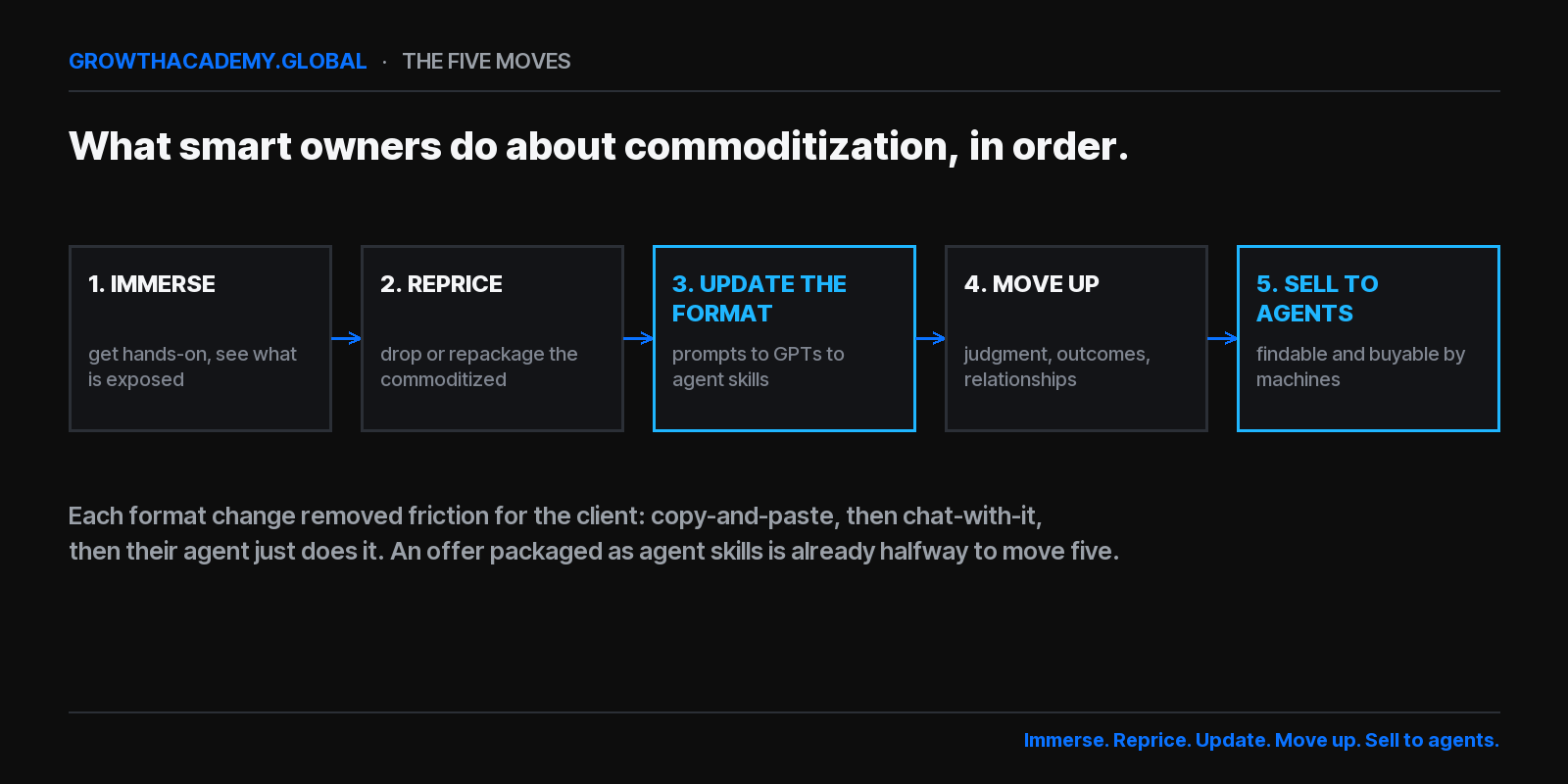
- Immerse, so you can actually see which of your offers are exposed. Not videos, not articles. Hands on the tools, on your own work, a few hours a week. The exposure audit above is the fastest start.
- Drop or reprice the commoditized work instead of defending it at the old price. Holding the old price on automatable work does not protect your margin. It hands a few fast competitors your client list.
- Update the format of the offers you keep, as the tools evolve. I have lived this one. I sold prompts. Then the same expertise became custom GPTs. Now it ships as agent skills, instructions a client's agent runs on its own. Same knowledge, three formats, and every step removed friction for the client: from copy-and-paste, to chat-with-it, to their agent just doing it. Whatever you sell, keep asking which format the buyer's tools can use with the least friction this quarter, because that format keeps changing.
- Move up the value chain to what agents cannot commoditize: judgment, taste, accountability, the relationship, the outcome you put your name on. That work gets more valuable as everything around it gets cheaper.
- Start building offers for agents, because your future customers will not all be human. There will be far more agents transacting on behalf of buyers than there are buyers, and the businesses that are findable and buyable by agents will win a market most owners do not know is opening. Notice where the format ladder in move three ends: an offer packaged as agent instructions is already halfway here. I wrote about that future in your next customer is a bot.
One more, for the operationally minded: the work you keep should be rebuilt to run with agents, not around them. That is the HASOP conversation, and the step-by-step version is the SOPs-into-agents playbook.
Common questions
Will AI make my business obsolete?
Not the whole business, but it will commoditize parts of it: the routine, repeatable work clients used to pay a premium for. The risk is staying still while that happens. Owners who reposition toward judgment, outcomes, and relationships stay valuable, and the ones who move early choose which parts to defend, reprice, or retire before the market decides for them.
How do I find out which of my services are exposed?
You cannot see it from the outside, and no article can tell you. Get hands-on with an AI agent, connect it to your business, and run the exposure audit: have it review your offers and deliverables against what agents can already do, and rank each one by how exposed it is. The owners who run this audit reposition first.
How do I stay competitive as AI spreads?
Five moves, in order: immerse yourself so you can see what is changing, drop or reprice the commoditized work instead of defending it at the old price, update the format of the offers you keep (prompts became custom GPTs, custom GPTs are becoming agent skills, and each step removes friction for the client), move up to the work agents cannot do (judgment, accountability, relationships, outcomes), and start making your business findable and buyable by agents, not just humans.
Which of my services are safe from AI?
The ones that depend on judgment, trust, accountability, and relationships rather than routine execution. Be careful with the word safe, though: you will only know which of yours qualify once you are using the tools on your own work, because the line between routine and judgment sits in a different place than most owners assume.
This is not a doom story. It is a timing story. The commoditization is coming either way. The only variable is whether you are the owner who saw it early and moved up, or the one who found out from a client.
Keep going: run the audit, then read why your SOPs are next, how to turn them into agents, and why the window is now.