OpenAI reports that its research organization used 3.1 agent-workdays for each human workday by mid-August. Its September 6 research acceleration report measures runtime using eight-hour days. It does not establish a threefold productivity gain.
For a small business owner, the useful question is where defined, reviewable assignments could free your team to spend more time with customers. Start with work you already understand well enough to judge.
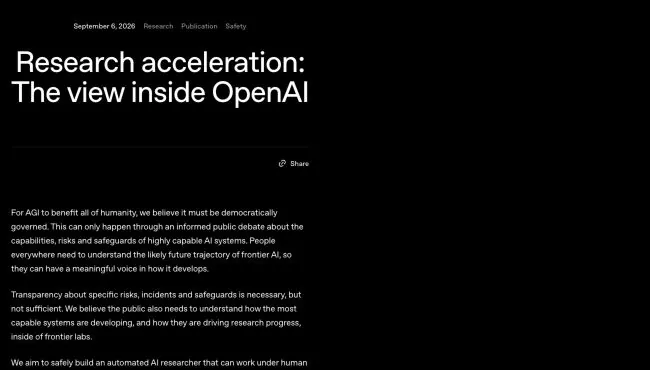
What OpenAI actually announced
OpenAI says it reached its automated research intern milestone: systems performing defined research assignments under human direction, including work that would take a skilled researcher days.
The same report values median daily researcher usage above $600 at API prices, with the 90th percentile above $7,000. These are inference valuations, not staff expenses or recommended SMB budgets.
There is a supervision caveat: over half of successful four-to-eight-hour tasks involved human intervention. This is OpenAI’s internal research evidence, not an independent study of small businesses.
Why this matters when you run a small business
Our interpretation: the opportunity is to move from asking for advice to assigning a deliverable. “How could we improve onboarding?” gives you ideas. “Use our approved onboarding checklist to prepare a welcome packet for review, and flag every missing input” gives you something your team can inspect and use.
That distinction matters when the owner is also the person gathering documents, chasing internal updates, checking proposals, and preparing meetings. Choose one of those bottlenecks. Define what a good result looks like before you judge the tool.
A busy agent is not automatically a useful agent. If your team spends longer correcting a packet than preparing it, that workflow has not earned a broader rollout. If the packet arrives accurate, complete, and easier to review, you have a practical reason to repeat the experiment.
Four assignments to test this week
These are proposed SMB pilots, not results reported by OpenAI. Use tools with access you have authorized, and test on copies or approved material first.
1. Prepare the next client meeting
Give the agent approved notes and project updates. Ask for a one-page brief containing the last agreed commitments, open questions, and decisions needed at the meeting. Require a source beside every claim. A useful result reduces preparation time without making you wonder where a detail came from.
2. Check a proposal before it leaves the business
Provide the current scope, your approved service descriptions, and the proposal draft. Ask the agent to flag missing deliverables, inconsistent dates, and promises outside the agreed scope. Have it produce a review list rather than silently rewriting commercial terms. Keep the final pricing and send decision with the responsible person.
3. Turn an approved recording into a content draft
Start with a recording or transcript you are allowed to reuse. Ask for an article outline, a complete draft, and the transcript passages supporting its central points. Require it to mark unsupported claims. The test is whether the draft preserves your expertise and saves editorial time, not how many posts it generates.
4. Prepare a weekly operations review
Use an exported copy of your project tracker. Ask for overdue work, missing owners, and conflicting completion dates, with a link or row reference for each finding. Keep proposed changes separate from the original records. Your team should be able to verify the list before updating any live system.
Write an assignment that has a finish line
Use this starting prompt, then replace the bracketed details with your own:
Using only [approved files], prepare [specific deliverable] for [business purpose]. A finished result must include [required sections] and a source for each factual claim. Flag missing or conflicting information. Save the result for review by [responsible person]. Do not send messages, change live records, or make purchases. Stop after [time or cost limit] and report what is complete, what remains, and what you need.
For a meeting brief, “done” might mean every outstanding commitment has an owner and supporting note, with unknowns clearly marked. For a content draft, it might mean the core argument matches the recording and every outside claim has an official reference.
Those criteria make review easier. They also help you distinguish a poor instruction from a task the tool cannot reliably handle.
Measure the result before expanding the workload
Run a small comparison on similar assignments. Record the normal preparation time, the time spent setting up and reviewing the agent’s work, any corrections, and the tool cost you can attribute to the task.
- Time returned: how much staff time remains after setup, review, and correction?
- Quality: is the deliverable usable, and did it miss anything consequential?
- Business usefulness: did it make a meeting better prepared, a proposal more complete, or a customer commitment easier to keep?
- Repeatability: can a colleague get a comparable result from the same documented process?
Set your own acceptable review time and cost before the pilot. Expand the assignments that meet those standards. Fix or stop the ones that create more work than they remove.
Questions business owners are asking
Should I use the 3.1 figure to plan staffing?
No. Make staffing decisions from your own workload, service commitments, quality requirements, and measured task results. A runtime ratio from a research lab is not a headcount formula for your company.
Does this mean my ChatGPT account can perform every task in the report?
The report does not establish that. Check the capabilities and permissions of the specific tool you are using. Start with a task whose inputs and finished result you can inspect.
What should I delegate first?
Choose recurring preparation work with clear source material and a low cost of correction. Keep a person accountable for reviewing the result and authorizing consequential actions.
Sources
Official / Primary Sources
- OpenAI: Research acceleration — The view inside OpenAI. Published September 6, 2026; checked September 8, 2026.
The suggested SMB assignments and measurement framework above are Growth Academy’s analysis, not OpenAI’s recommendations or measured SMB outcomes.