LinkedIn shipped a button in August 2026 that lets any reader report a post with one blunt label: "Seems like AI slop." LinkedIn says more than 1 million members used it within the first two weeks.
The distribution shift is concrete. LinkedIn says content it classifies as AI slop is now seeing roughly 40% fewer views than just a few weeks ago, per Social Media Today and Yahoo Tech. An individual report mainly shapes what that reporter sees; LinkedIn says patterns across many signals inform ranking, with safeguards so no single report decides a post’s fate.
Generic AI-generated posting on LinkedIn now carries a measurable cost: LinkedIn’s systems classify low-substance AI content, and that content is seeing roughly 40% fewer views platform-wide, per LinkedIn’s own announcement coverage. Keep AI in your process for research, structure, and editing. Make sure every claim, number, and story in the post could only have come from your operation.
One million reports in two weeks deserves a moment of respect. That is audience backlash at scale, recorded one clicked button at a time.
What LinkedIn Announced
Three facts matter from the announcement coverage.
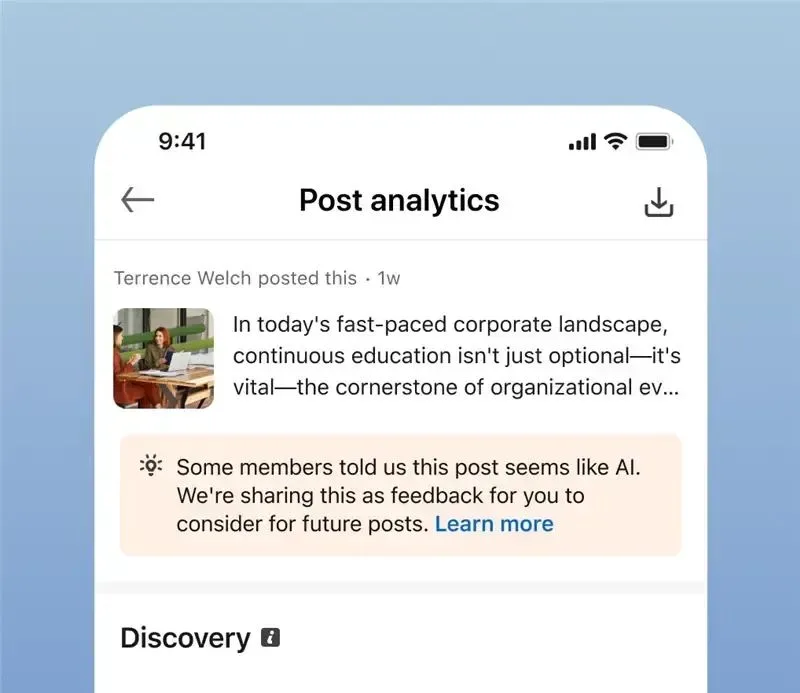
First, adoption. More than 1 million members used the reporting option inside two weeks, per Social Media Today. Readers found the button fast and used it heavily.
Second, the views are already gone. LinkedIn says content it defines as AI slop is seeing roughly 40% fewer views than a few weeks earlier, a platform-wide decline for that category.
Third, and most important for strategy: an individual report mainly personalizes the reporter’s own feed, and LinkedIn says no single piece of feedback determines distribution. Patterns across many reports, combined with LinkedIn’s other signals, are what move ranking. Human judgment about what reads as slop is now part of that mix.
The Math on Volume Strategies
For the past two years, a popular LinkedIn strategy has been daily AI-generated posting: pick topics, generate, publish, repeat. The pitch was that volume compounds.
The flag changes that math. Every generic post now competes in a feed where the slop category itself is being suppressed, and a million readers have shown they recognize the pattern on sight.
Volume built on generic output has turned negative-ROI on LinkedIn. The winners are posts carrying verifiable experience: specific numbers, real decisions, first-person operating detail that could only come from someone who did the work.
A Self-Audit: Does Your Content Pattern-Match Slop?
Readers flag pattern recognition. Before assuming your posts are safe, audit your last ten against the patterns they are reacting to.
- Interchangeable openers. If your first line could sit on top of any post in your industry, it reads as template output.
- Generic listicles. Five ways leaders build trust, with no example attached to any of the five.
- No specifics. No numbers, no dates, no named tools, no described decisions anywhere in the post.
- The anyone test. If a competitor could publish the post unchanged, it carries no evidence that you exist.
Passing the audit takes one thing: detail only your operation could produce. A price you changed, a process you killed, a week you measured.
If three or more of your last ten posts fail, pause the publishing queue instead of posting through it. LinkedIn has not published how its classifiers score individual accounts, so treat any account-level effects as unknown; the category-wide 40% decline alone is reason enough to stop and rework.
How to Use AI Without Triggering the Flag
The button punishes generic output, so keep AI in the parts of the process where it is genuinely strong and keep yourself in the part readers came for.
Use AI for research. Gathering context, checking coverage of a story, pulling together background you will verify.
Use AI for structure. Ordering an argument, tightening a draft, finding the buried lead and moving it to line one.
Use AI for editing. Cutting filler, shortening sentences, catching jargon.
Supply the substance yourself. The claim, the number, the story, and the decision come from your operation, stated in your words. That layer is the post.
Readers flag what feels manufactured. A post where the machine shaped genuinely lived material rarely feels that way, because the specifics anchor it to one identifiable business: yours.
A practical test before you publish: read the draft and mark every sentence a competitor could also truthfully post. If most of the draft is marked, it needs another pass through your operation before it goes out.
The Same Posts Get Cited by AI
The cleanup connects to a second late-August development. LinkedIn published an official guide on structuring posts for AI visibility, so they surface in AI search answers and chatbot citations.
Both systems reward the same artifact. The substantive, specific, well-structured post survives human flagging and becomes the material AI engines cite when your buyers ask them questions.
Write for the human holding the flag button and you are simultaneously writing for the machine assembling the answer. Our breakdown of LinkedIn's AI visibility playbook covers the structural half of that equation.
Frequently Asked Questions
Will using AI to write get my posts flagged?
The button asks readers to judge the finished post, so the risk sits in how generic the output reads. Posts built on your own numbers, decisions, and stories give readers nothing to pattern-match, even when AI helped with research, structure, and editing.
What happens when a post gets flagged as AI slop?
Per Social Media Today, an individual report mainly changes what that reporter sees, and LinkedIn says no single piece of feedback determines distribution. The measurable shift is category-wide: content LinkedIn classifies as AI slop is seeing roughly 40% fewer views than a few weeks earlier.
Is daily posting still a good LinkedIn strategy?
Daily generic posting now works against you, because the category it belongs to is being suppressed and readers recognize it instantly. A smaller number of substantive posts, each carrying verifiable experience, beats raw volume in a feed that is actively de-ranking the generic category.
Does the cleanup affect what AI engines cite?
The same substantive, specific posts the cleanup favors are the ones AI search tools tend to cite. LinkedIn published an official AI visibility guide in late August 2026 recommending exactly that kind of structured, durable content.