Short answer: GPT-5.5-Codex Medium means I am using the GPT-5.5-Codex model with Medium reasoning. Medium is the balanced setting. It gives Codex enough thinking room to do normal business work without forcing every task into the deepest, slowest, highest-token mode.
If you are a business owner using Codex and you click into the model settings, you may see a label like GPT-5.5-Codex with a reasoning setting such as Medium.
That label can feel technical if you are not a developer.
It is actually simpler than it looks.
The model name tells you which Codex model you are using. The reasoning setting tells Codex how much thinking room to use before it responds or acts.
If your dropdown says a slightly different GPT-5.x Codex label, the same concept still applies: the model is the engine, and the reasoning level controls the depth of thinking.
How to find the model settings in Codex
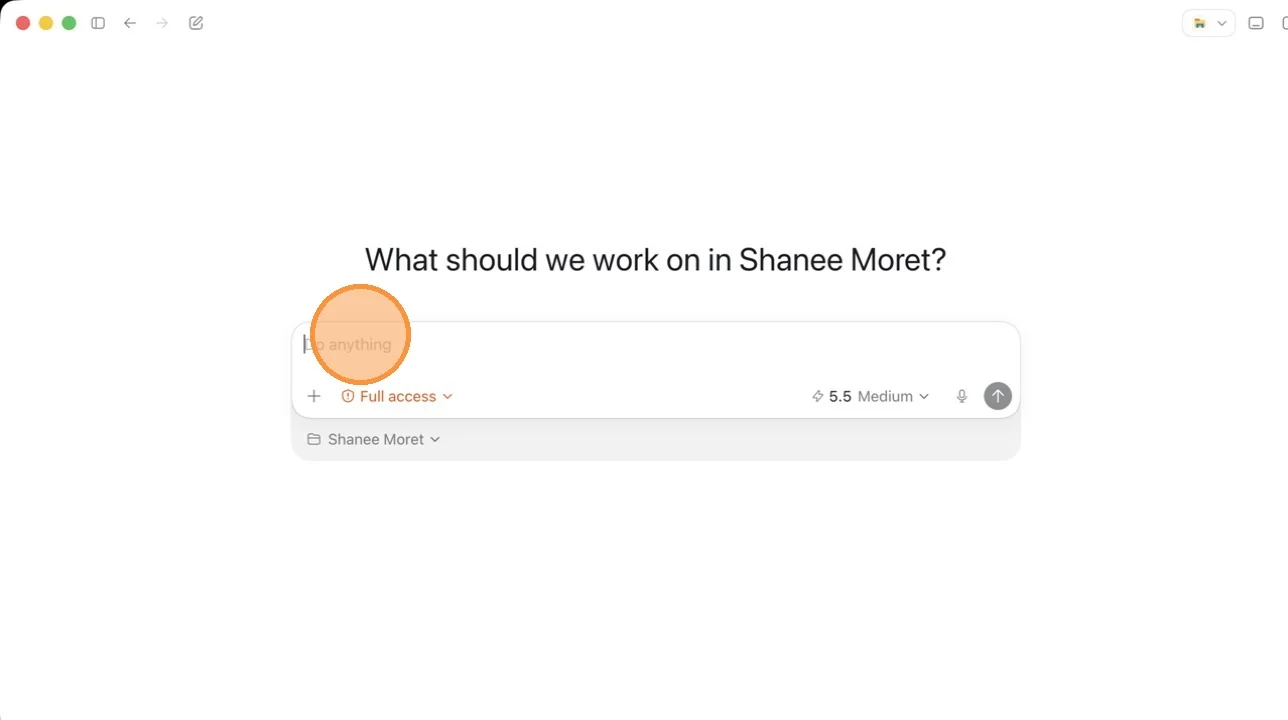
In my Scribe walkthrough, I start by clicking into the main Codex input field.
Then I open the model settings and select GPT-5.5-Codex.

What the dropdown actually means
People see the model label and the reasoning label together, then assume the whole thing is one complicated technical setting.
It is not.
Think of it this way:
- GPT-5.5-Codex is the model.
- Medium is the reasoning level.
- Reasoning level is how much thinking space Codex gets for the task.
What "Medium" actually does
Medium is the middle operating lane.
It is not the weakest setting. It is not the most intense setting. It is the default I would use for most normal business work.
OpenAI's Codex Prompting Guide explains that Medium reasoning is a good all-around interactive setting because it balances intelligence and speed. I like that explanation because it matches how I use Codex as a business owner: I want enough depth to avoid shallow work, but I do not need the heaviest setting for every single task.
Medium works well when I ask Codex to:
- Draft or revise a blog post.
- Read a few files and make a scoped change.
- Turn notes into an SOP.
- Explain what a setting means.
- Organize content or workflow notes.
- Fix a straightforward website issue.
- Create a checklist or implementation guide.
- Review a simple automation path.
Medium gives Codex room to think without treating every request like a complex engineering investigation.
Why Medium is usually the right default
Most business-owner tasks are not tiny, but they are also not high-risk infrastructure redesigns.
That is why Medium usually makes sense.
If I ask Codex to write a paragraph, Low may be enough. If I ask Codex to audit a full onboarding system, High or Extra High may be worth it. But if I ask Codex to help with ordinary business operations, Medium is usually the right starting point.
Examples:
- "Write a first draft of this blog in my voice."
- "Clean up this landing page copy."
- "Turn this transcript into a client-facing guide."
- "Review these notes and organize the action items."
- "Check this page and tell me what needs to be fixed before launch."
Those are real tasks. They deserve more than a quick shallow answer. But they do not always need the maximum reasoning level.
What token burn means
Token burn is the cost of using the model.
Every prompt, file, screenshot description, command result, draft, and answer uses tokens. Reasoning models can also use tokens while they think internally before they give you the visible response.
That hidden thinking is useful, but it is not free.
Here is the practical business-owner version:
- Low usually burns fewer reasoning tokens.
- Medium burns a balanced amount.
- High and Extra High can burn more because Codex is doing deeper thinking.
This is why I do not use the deepest setting for everything.
If I ask Codex to rename a button, I do not need a heavyweight reasoning run. If I ask Codex to audit a broken sales workflow, inspect files, check automations, and tell me exactly where the business process is failing, I probably want higher reasoning.
Medium protects me from both extremes. It keeps Codex thoughtful without making every task unnecessarily expensive or slow.
Medium does not mean "average"
This is the mistake I see business owners make.
They hear "Medium" and think it means average quality.
That is not what it means.
Medium means Codex gets a balanced reasoning budget. It can still produce strong work. It can still inspect context. It can still help me move a real task forward.
The setting is not a grade. It is a resource choice.
When I would not use Medium
I move away from Medium when the job clearly needs a different operating mode.
I use Low when the job is quick and low-risk:
- Rewrite this sentence.
- Summarize this paragraph.
- Format this list.
- Give me three headline options.
I use High or Extra High when the job is broad, risky, or operationally expensive to get wrong:
- Audit my entire onboarding workflow.
- Find why leads are not reaching sales.
- Fix a website issue across several files.
- Design an automation that affects customers.
- Review a live launch path before anything goes public.
OpenAI's Codex Prompting Guide points High and XHigh reasoning at the hardest tasks and long-running autonomy. That matches how I think about it: I save the deeper settings for the work where Codex needs to stay with the problem, reason across many steps, and avoid a bad assumption.
My simple rule
If you are new to Codex, start with Medium.
Use Medium for normal business work.
Use Low when the task is simple.
Use High or Extra High when the task has more risk, more files, more ambiguity, or more business consequences.
The goal is not to pick the most impressive setting. The goal is to pick the setting that matches the work.
FAQ
What does GPT-5.5-Codex Medium mean?
It means you are using the GPT-5.5-Codex model with Medium reasoning. The model is the engine. Medium is the reasoning level.
What if my dropdown says GPT-5.5 Medium instead?
The same concept applies. The GPT-5.x label is the model shown in your Codex interface. Medium is the reasoning level attached to that model.
Is Medium good for beginners?
Yes. Medium is usually the best starting point for nontechnical business owners because it balances depth, speed, and token use.
Does Medium mean Codex is less smart?
No. Medium does not mean Codex is low quality. It means Codex is using a medium reasoning budget.
Does Medium save tokens?
Medium can use fewer reasoning tokens than High or Extra High, but more than Low. It is the balanced setting, not the cheapest setting.
Should I leave Codex on Medium all day?
For normal business work, yes. I would only change it when the task is obviously simple, urgent, complex, risky, or long-running.
Sources
- Shanee Moret, Scribe walkthrough: How To Configure Model Settings In OpenAI Codex Agent
- OpenAI: Codex Prompting Guide
- OpenAI: Reasoning Models Guide
- OpenAI: GPT-5.2 Guide
- OpenAI: GPT-5.2-Codex Model Page