Ask a room of established business owners which AI vendor leads business adoption and most will answer OpenAI without checking.
The assumption is understandable. ChatGPT is the AI most people met first, and consumer familiarity travels with owners into buying decisions.
Ramp's August 2026 AI Index, published on or around August 20 and titled "Cracks in the AI Thesis," says the paying-business picture has looked different since spring. Quartz picked up the findings within the day.
Per Ramp's August 2026 AI Index, 43.5 percent of businesses on its platform pay for Anthropic products or tokens versus 39.7 percent for OpenAI, a lead Anthropic has held since May 2026. The data covers paying businesses on one expense platform, a real-spend proxy rather than total market share. Read it as a calibration signal: audit your own AI spend, and test the platform you ignore once a quarter.
Ramp is a corporate card and expense platform used by more than 70,000 US businesses, which makes its dataset a rare thing: actual spend, at scale, from companies rather than consumers.
The Numbers, Straight From the Index
Three findings matter for an owner, all per Ramp's data.
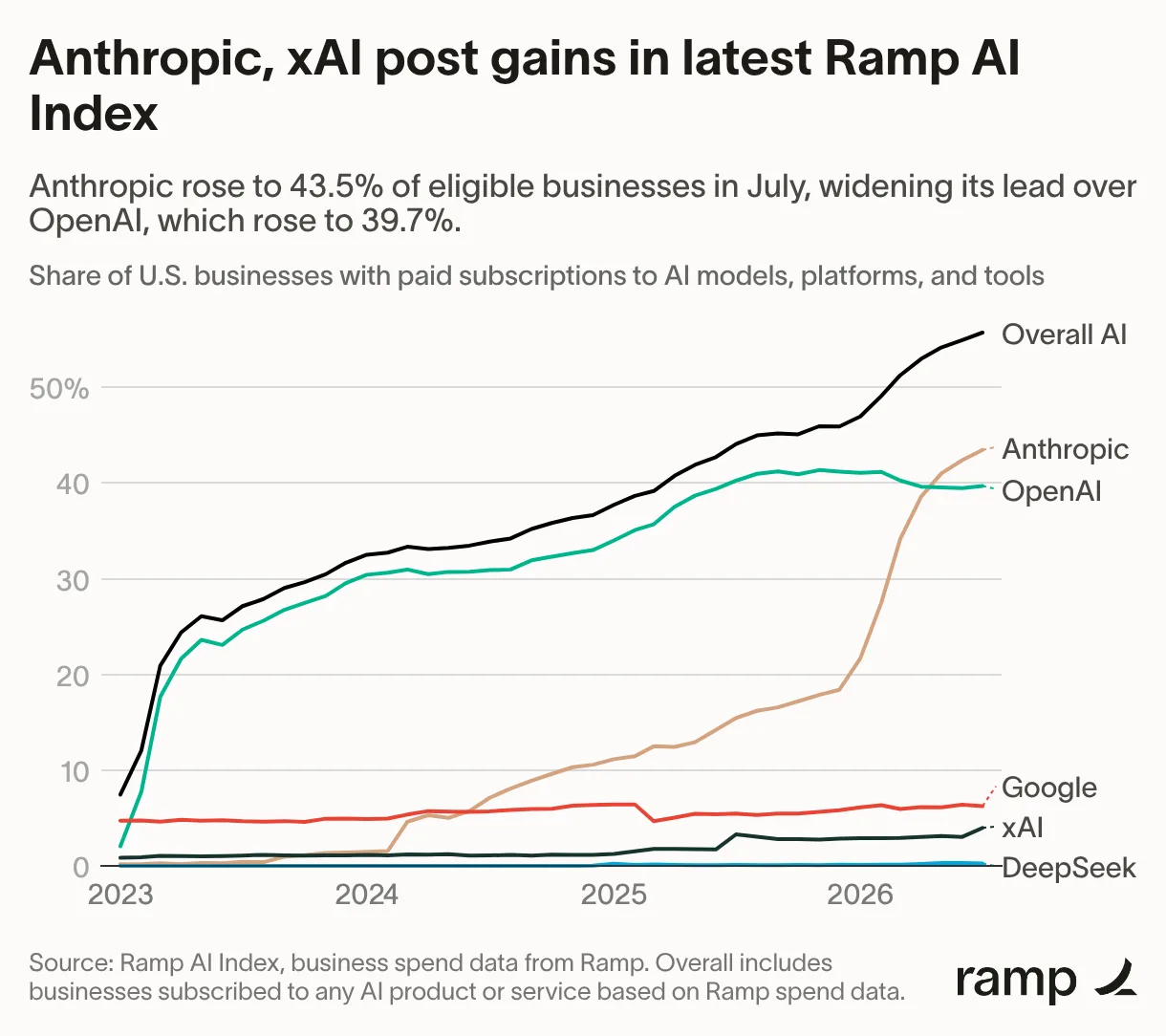
First, 43.5 percent of Ramp businesses pay for Anthropic products or tokens, versus 39.7 percent for OpenAI.
Second, the flip happened in May 2026, when Anthropic reached 41 percent against OpenAI's 39 percent. OpenAI has not regained the lead since.
Third, the race is still moving: OpenAI grew 0.23 percentage points month over month in July.
| Finding | Per Ramp's August 2026 AI Index |
|---|---|
| Businesses paying for Anthropic | 43.5% |
| Businesses paying for OpenAI | 39.7% |
| When the lead flipped | May 2026: Anthropic 41%, OpenAI 39% |
| OpenAI growth in July | +0.23 percentage points month over month |
| Fable 5 share of Anthropic token volume | 6% |
What This Data Actually Measures
Ramp counts businesses that pay Anthropic or OpenAI through its platform. That makes it a real-spend proxy: actual companies putting actual dollars through corporate cards and bills.
A spend proxy is narrower than market share of all usage. ChatGPT still dominates consumer usage, and free-tier behavior shows up in no expense dataset anywhere.
Ramp's customer base also skews the way any single platform's base does, toward the kinds of companies that choose Ramp. Treat the finding as a strong signal from a large sample rather than a census.
Paying for both vendors is common, too. A company can run ChatGPT seats for the team and buy Anthropic tokens behind a product, and that company counts in both columns.
The caveats size the claim without erasing it. Three straight months of a spending lead, across a base of more than 70,000 businesses, is a real pattern; the caution is only about which conclusions that pattern can carry.
The Second Finding Worth More Than the Headline
The horse race gets the coverage. The finding underneath it should change how you buy.
The index found weak uptake for Anthropic's newest flagship model, Fable 5, at 6 percent of token volume purchased from Anthropic, suggesting businesses do not automatically upgrade when a new model ships.
That validates the unfashionable stack. Teams standardize on what already works, run it until results slip, and treat each new release as something to test on their own workload first.
If you skipped a model upgrade this year and wondered whether you were falling behind, the spend data suggests you have plenty of company.
What to Do With This as an Owner
The data supports three moves, and switching on a headline is none of them.
- Audit what you actually pay for. Pull every AI subscription and API charge across the team into one list: seats, tokens, overlapping tools, forgotten trials. You want one page showing every AI dollar and who uses it.
- Check whether spend matches results. Mark where your measurable wins come from, then compare that against where the money goes. Fund what produces, question what does not.
- Run a quarterly calibration test. Once a quarter, take one real workflow and run it on the platform you do not use, keeping notes on quality and time. Switch when your own logged results say the other side wins on work you care about, and only then.
That habit costs a few hours a year, and it converts market noise like this report into a decision process you control.
It also keeps you honest in the other direction. If the platform you prefer stops earning its seat, your own notes will say so long before any index does.
Frequently Asked Questions
Does Ramp's data mean Claude is better than ChatGPT?
The index measures which vendors businesses pay through Ramp, within Ramp's customer base. Which tool performs better on your work is a separate question, and the quarterly calibration test answers it with your own evidence.
What exactly is the Ramp AI Index?
Ramp is a corporate card and expense platform used by more than 70,000 US businesses. Its AI Index reports what those businesses actually pay AI vendors, and the August 2026 edition is titled "Cracks in the AI Thesis."
Should I switch AI platforms because of this report?
Switching on a headline skips the only evidence that matters, which is your own results. Audit your spend, run the quarterly calibration test, and let logged outcomes drive any change.
Why does the Fable 5 finding matter?
Per Ramp's index, Fable 5 drew 6 percent of token volume purchased from Anthropic, suggesting businesses standardize on models that already work rather than chasing each release. That is permission to run a boring stack that produces.