Regulation headlines are easy to misunderstand. One headline makes it sound as though every company using ChatGPT just acquired a new EU compliance department. Another makes it sound as though the designation changes nothing outside Europe.
Neither is a useful explanation for an established business owner.
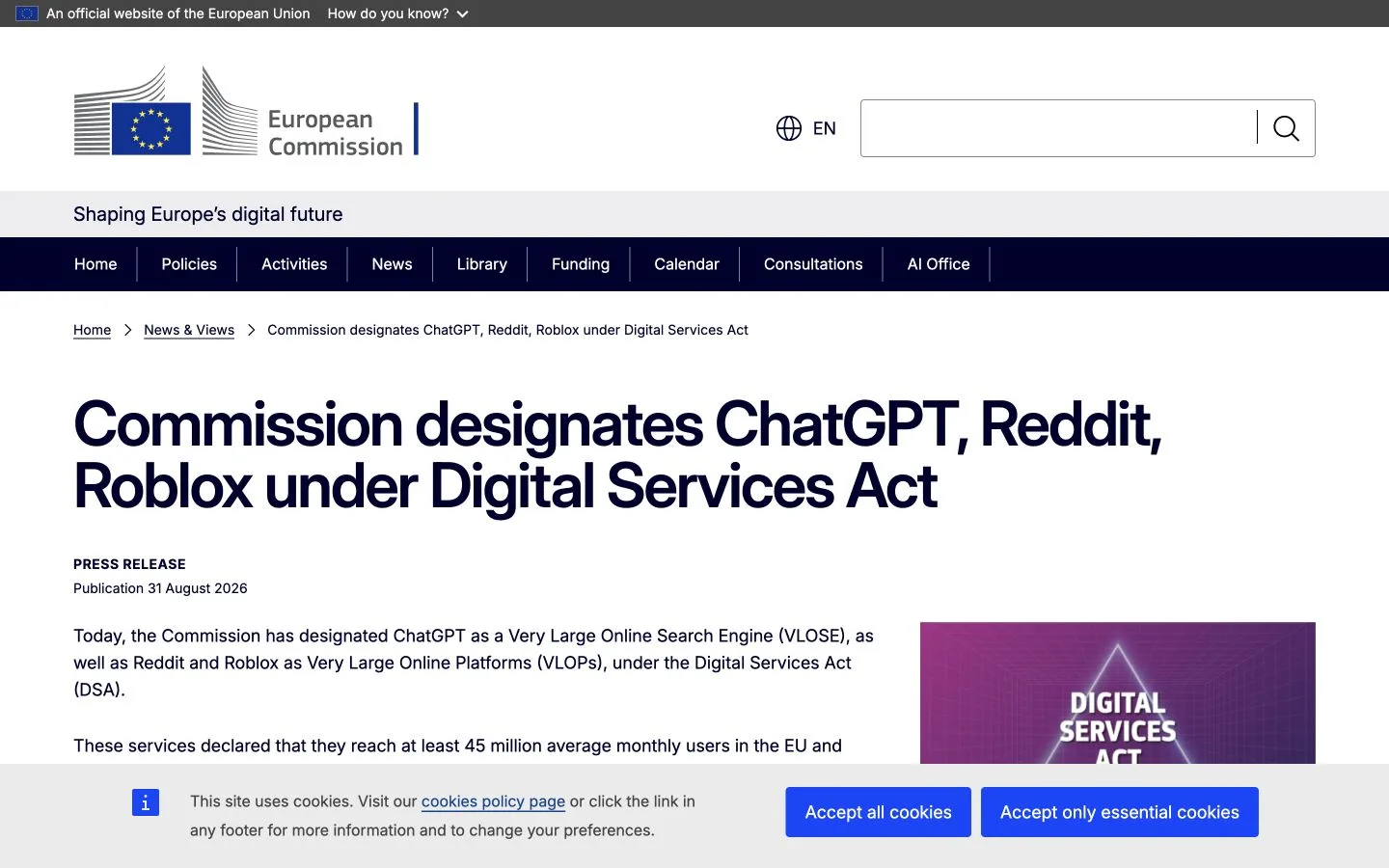
On August 30, 2026, the European Commission designated ChatGPT as a Very Large Online Search Engine, or VLOSE, under the Digital Services Act. ChatGPT reported enough average monthly users in the EU to cross the law's 45-million-user designation threshold.
The immediate legal obligations described in the designation are directed at the provider of ChatGPT in the EU. The designation does not, by itself, create a new filing, audit, or certification requirement for an ordinary US small business that uses ChatGPT.
What Actually Happened
The European Union has a law called the Digital Services Act. It divides online platforms into tiers based on how many people use them in Europe each month. The largest tier -- the one with the most obligations -- applies to platforms with more than 45 million monthly active users in the EU.
The Commission's designated-services list reports 159.1 million average monthly active users for ChatGPT in the EU.
That number put ChatGPT well into the highest-obligation category.
The important fact is narrower: for purposes of this EU law, ChatGPT is now supervised in the VLOSE category. That category carries additional duties for the service provider because of the system's reach and potential societal impact.
What the Designation Requires OpenAI to Do
The Commission's August 30 announcement says ChatGPT has four months—by January 2027—to comply with the additional DSA obligations that apply to VLOSEs.
The Commission specifically highlights risks involving illegal content, minors, physical and mental wellbeing, fundamental rights, elections, and public security. The wider DSA framework for VLOPs and VLOSEs also includes independent-audit and transparency duties. Those are provider-level responsibilities; they are not a new checklist that every ChatGPT customer must submit to the EU.
Why US Business Owners Should Pay Attention
You should pay attention for practical vendor-governance reasons, not because the headline automatically places your company under the DSA.
1. The service may change. OpenAI may introduce transparency, safety, reporting, or regional product changes as it implements the additional obligations. A US customer should watch confirmed product and policy updates instead of predicting them from the designation alone.
2. Client questions will become more specific. Procurement teams and clients may ask what AI service you use, what information enters it, who can access the output, and whether a human reviews important decisions. A clear answer is more valuable than saying either "AI is unregulated" or "the EU approved it." Neither statement is accurate.
3. Existing obligations still matter. Privacy law, contracts, professional duties, sector rules, client policies, and confidentiality requirements continue to govern how your company handles information. This DSA designation does not replace those rules or grant permission to put client data into ChatGPT.
4. Vendor concentration is an operating risk. A regulatory change, product limitation, permission change, or regional restriction can affect a workflow built entirely around one provider. Keep your core instructions, source records, approval rules, and evidence in company-controlled systems so a product change does not erase the operating process.
What Changes and When
Between now and January 2027, OpenAI's primary obligation is to complete and submit its risk assessment and audit to the EU Commission. Most of that process happens inside OpenAI, not visibly in the product.
Most of the immediate work happens inside OpenAI: assessing and mitigating systemic risks, meeting supervision requirements, and producing the required evidence. The Commission's announcement does not promise a specific new button, label, model behavior, or US product change by a particular date.
That is why businesses should follow confirmed OpenAI and European Commission updates rather than turning plausible future changes into facts.
The Bigger Signal for Business Owners
It is worth stepping back from the specific details to read the signal this sends.
The signal is that high-reach AI services are moving into established platform-supervision frameworks. That creates more accountability for providers and more questions for companies that depend on those providers.
This is not a reason to slow down your AI adoption.
It is a reason to make sure your AI adoption is thoughtful.
Business owners who understand the regulatory direction are better positioned to make decisions about which AI tools to build operations on, which data is appropriate to process through which tools, and how to communicate with clients about how you use AI in their work.
A professional response is not a stack of legal buzzwords. It is a clear account of what your company uses, what information is allowed into the system, what remains prohibited, who reviews the output, and where evidence is kept.
Three Things to Do Right Now
You do not need to launch a new compliance program based on this headline alone. You do need three operating basics.
Inventory the work, not just the tool. Record which teams use ChatGPT, which information classes may enter it, which connected apps it can reach, what decisions the output influences, and where human approval is required.
Check authority per client and engagement. Your internal AI policy does not override a client's contract, data restrictions, no-AI rule, or regulated-work requirements. Keep AI-authorized and AI-excluded work in separate operating lanes.
Monitor confirmed provider changes. Review official OpenAI release notes, product documentation, terms, privacy materials, and the European Commission's enforcement record. Update your process only when a change is real and relevant to the work you perform.
The question is not whether AI gets regulated. It is whether you are building your operations in a way that stays functional as regulation arrives. Regulation tends to favor structured, documented, intentional use over ad hoc, invisible use.
The business owners who will be in the best position as AI regulation matures are not the ones who avoided AI tools. They are the ones who used those tools thoughtfully, kept records of what they were doing, and built workflows with human oversight built in from the start.
If you are already running your Codex and ChatGPT agents with approval gates and documented guardrails, you are already building toward that posture.
If you are not, this is a good week to start.