On August 25, 2026, Amazon announced it will permanently close Mechanical Turk on September 30, 2026, along with SageMaker Ground Truth and Amazon Augmented AI.
Mechanical Turk ran for about 21 years. It was a marketplace where businesses paid humans small amounts for tasks that required human judgment: data labeling, transcription, survey completion, content review. At its peak it served more than 500,000 workers.
Amazon built the largest marketplace for paid human micro-judgment, watched AI models absorb the category, and chose to close it rather than compete. If you have been waiting for institutional proof that delegating this class of work to AI is economically real, a shutdown date on the calendar is that proof.
Set aside the hype cycle for a moment. This is a quiet, unglamorous infrastructure decision by one of the largest companies in the world, and those decisions carry more information than any keynote.
What Mechanical Turk Was
The premise was simple: some work needs a human eye, and software could route that human eye by the task. Post a batch of small jobs, set a price per task, and a distributed workforce completes them.
The task categories tell you what businesses actually bought. Label these images. Transcribe this audio. Complete this survey. Review this content against a policy.
Each task was small, priced in cents or dollars, and valuable only because a person applied judgment that software of the era could fake at best. That was the product for two decades.
Why Amazon Says It Is Closing
Amazon's official closure notice says the decision followed an internal assessment but does not attribute the closure to AI. CNBC reports declining usage as AI models replaced parts of the category.
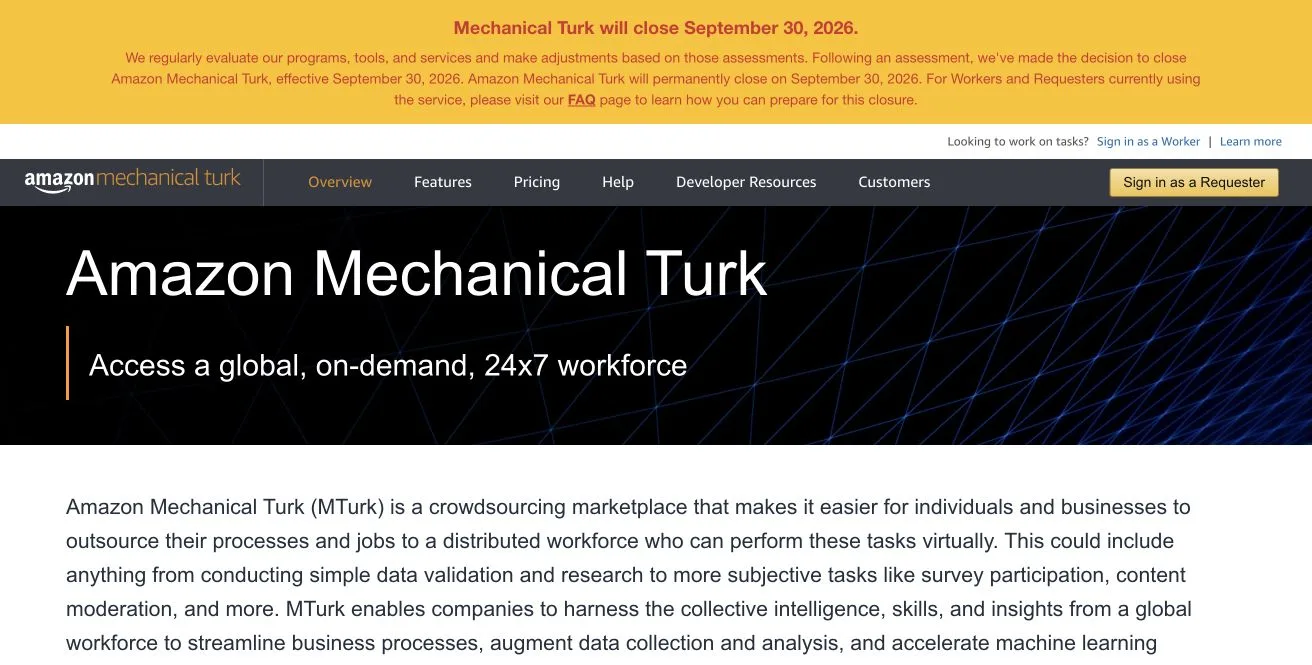
Sit with the mechanics of that. Amazon operated the buy side and the sell side of paid human micro-judgment, so it could watch demand migrate from human workers to models in its own usage data. It chose to retire the marketplace rather than compete with the models for the work.
Companies defend profitable infrastructure. They walk away from category funerals. The shutdown, alongside SageMaker Ground Truth and Amazon Augmented AI, reads as Amazon closing the book on the category itself.
The Task Map: MTurk Category to Agent Equivalent
Every task category MTurk handled has a direct agent equivalent an owner can run today. This is the practical part of the signal: the same work, moved in-house, on your own data.
Data Cleanup and Labeling
The MTurk version: pay workers to tag, categorize, and de-duplicate records.
The agent version: an agent working inside your spreadsheets standardizes categories, tags records, and flags inconsistencies across thousands of rows, following rules you write in plain language.
Transcription and Summarization
The MTurk version: pay workers to type out audio and condense it.
The agent version: recordings of calls, meetings, and trainings become transcripts and structured summaries with decisions, commitments, and open questions pulled out for you.
Review and Classification of Documents
The MTurk version: pay workers to sort and check content against criteria.
The agent version: an agent classifies invoices, contracts, and inbound files against criteria you define, extracts the fields you care about, and flags the exceptions for you.
Survey and Feedback Synthesis
The MTurk version: pay workers to complete surveys and process responses.
The agent version: free-text customer feedback becomes themes, counts, and representative quotes, so you read a one-page synthesis instead of four hundred raw responses.
What Still Deserves a Human
The shutdown marks where the floor moved, and the honest version of this article names what stays above it.
Judgment calls with real stakes. Pricing, hiring, firing a vendor, anything where a wrong call costs real money or a relationship. Agents prepare the analysis; you make the call.
Quality spot-checks. Sample the agent's output on a schedule, especially in the first weeks of any new delegated task. Trust grows from verified batches, never from vibes.
Anything client-facing. Drafts can come from agents. Sending, publishing, and promising stay with you, because your name absorbs the consequences.
The Decision Signal
If you have been waiting to see whether AI task delegation is a fad, September 30 is a concrete answer from one of the largest infrastructure companies in the world.
Amazon had 21 years of relationships, tooling, and market position in paid human micro-tasks, and it judged the category unwinnable against models. You need far less evidence than Amazon had to justify a small pilot.
The measured response: pick one category from the map above, run it with an agent for two weeks on real work, spot-check the output, and count the hours recovered. Expand only on evidence.
Frequently Asked Questions
When exactly does Mechanical Turk shut down?
September 30, 2026. Amazon announced the closure on August 25, 2026, and is retiring SageMaker Ground Truth and Amazon Augmented AI alongside it.
Why is Amazon closing Mechanical Turk?
Amazon's notice cites an internal assessment without naming AI as the cause. CNBC reports declining usage as AI models replaced parts of the category. The decision still makes the closure relevant to owners testing which micro-tasks agents can now absorb.
Does this mean human review work is obsolete?
The marketplace for paid micro-judgment is closing, and human judgment moves up the stack. Decisions with real stakes, quality spot-checks, and client-facing work still belong with people in your business.
What should a business owner do with this signal?
Pick one task category from the map in this article, run a two-week pilot with an agent on your own data, and spot-check the output. Measure the hours recovered before expanding anything.