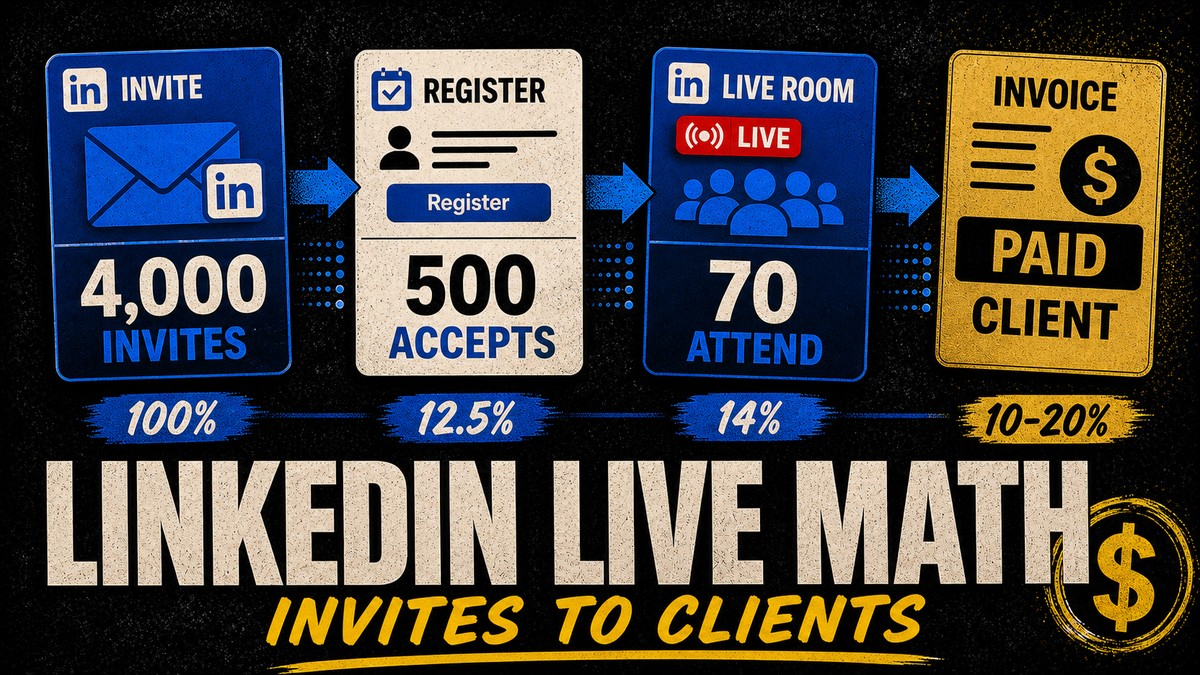
Short answer: A realistic LinkedIn Live funnel for an established B2B business owner starts with 4,000 invited first-degree connections, produces about 400 to 650 registrations, around 70 live attendees, roughly 3 consultation calls, and at least 1 close when the offer and network are aligned.
Day 3: LinkedIn Live Video Events
See the original replay this article is based on.
Watch the Replay →Most of the LinkedIn Live advice online skips the part that matters most to a business owner with a high-ticket offer: what do the funnel numbers actually look like?
Not follower growth. Not vanity engagement. The number of consultation calls generated, the number of clients closed, and the return on a single monthly event.
Shanee has hosted over 100 LinkedIn Live events and used this system across hundreds of clients. What follows is the practical funnel range, not a best-case projection.
For the complete framework, read the full guide.
In This Article
What are realistic LinkedIn Live event conversion rates?
For a business owner with a properly structured network, 4,000 plus relevant first-degree connections, a defined ICP, and a high-ticket B2B offer, the practical funnel looks like this:
| Funnel Stage | Number | What It Means |
|---|---|---|
| Invitations sent | 4,000 | First-degree connections, 1,000 per week across four weeks. |
| Expected registrations | 400–650 | Below 400 often signals a low-activity or weakly aligned network. |
| Live attendees | ~70 | Roughly 10 to 15 percent of registrants. |
| Inbound consultation calls | ~3 | From live attendees or immediate post-live action. |
| Expected closes (minimum) | 1+ | At any semi-competent ability to close. |
| Offer size context | $25,000–$100,000+ | One close per event compounds heavily over time. |
That is the system working as designed. The biggest mistake is not low performance. It is reading the wrong stage as the problem.
The 4,000 Invites: The Only Number You Actually Control
LinkedIn allows up to 1,000 first-degree connection invites per week per event. Over four weeks, that creates a practical 4,000-invite ceiling on a single event.
This is the only number in the funnel you fully control. Everything downstream is a ratio that follows from it.
Most business owners never get a fair test of the system because they schedule too late. Two weeks out means 2,000 potential invites. One week out means 1,000. Same-week scheduling means they cripple the funnel before the event even starts.
Go deeper: If You're Scheduling Your LinkedIn Live Less Than Four Weeks Out, You're Forfeiting Invites →
The second requirement here is relevance. A 4,000-connection network built around your old career, old niche, or old identity will not behave the same way as a current, relevant network aligned with the offer you sell today.
400 to 650 Registrations: The Range That Tells You Something About Your Network
When the system is working, roughly 10 to 16 percent of invited connections register. That creates the practical 400 to 650 registration range from a 4,000-invite pool.
The number Shanee watches closely is 400. If you are consistently below that level after using the full invite ladder, the issue is usually not your thumbnail or your title. It is more often that your network is not active on LinkedIn or is weakly aligned with your current business.
That is not failure. It is diagnostic information. Usually, the next move is to improve who you connect with going forward, tighten your topic specificity, and use your newsletter to reach second and third-degree people outside the invite pool.
70 Live Attendees: Where the Panic Usually Starts
Of 400 to 650 registrations, roughly 70 people may attend live. This is where first-time hosts often panic and assume something broke.
It usually did not.
Free live events always lose people between registration and attendance. The people who showed up are not average viewers. They registered, kept the calendar block, and showed up in real time. That is an unusually strong intent signal.
The people who did not attend are not lost either. They are still first-degree connections who raised their hand for the topic. They are still one message away. That is exactly why Shanee treats registrations as a second asset, not just a pre-attendance number.
Go deeper: LinkedIn Live Registrations Are Not Attendance Numbers →
3 Consultation Calls: What Conversion Actually Means Here
From a live room of roughly 70 people, about 3 may take the next inbound step and end up on a consultation call. That step might come through a form submission, a direct message, an event-page CTA, or a natural conversation opened by the live.
This is not a hard pitch environment. A strong LinkedIn Live is usually a 30-minute focused value session with a direct but low-pressure next step. That is why the conversion signal matters so much. The call came from trust, not from an aggressive close.
Shanee's observed range for live next-step action is meaningfully higher than what many business owners see from landing pages or standard uploaded video. LinkedIn has also published that Live videos can generate up to 7x more reactions and 24x more comments than native videos from the same broadcasters, which helps explain why the format behaves differently in practice.
The 1 Close: Why Even the Floor Is High-ROI
If 3 calls come from a single event, closing one of them is a realistic floor, not an aggressive fantasy.
At $25,000 to $100,000 per client, one close per monthly live creates a meaningful annual revenue stream from a single recurring channel. And that is before counting replay viewers, non-attending registrants, or comment-based follow-up conversations.
This is why the business owners who fit this model best are the ones with high-ticket, trust-heavy B2B offers. The economics work differently when one client meaningfully changes the month.
What These Numbers Require to Work
The funnel above assumes four things are in place:
- 4,000+ first-degree connections relevant to your current offer
- a defined ICP so the topic filters the right people in
- a high-ticket B2B offer where one close matters materially
- enough sales ability to close a qualified call
If one of those inputs is weak, the funnel still runs, but the ratios change. The useful question is not “does LinkedIn Live work?” It is “which input is weak in my version of the system?”
A Note on What These Numbers Are Not
These are not cherry-picked best days or inflated marketing claims. They are practical ranges pulled from Shanee's live events and client work.
Some events perform above this range. Some perform below it, usually because the network is misaligned, the event was scheduled too late, or the topic was too broad to attract the right people.
What matters is that even the floor of this system produces a business result that most other LinkedIn formats do not match. And once repeated monthly, the floor compounds.
If you skipped ahead, start with the full system here: The LinkedIn Live Video Framework for Established B2B Business Owners →
Frequently Asked Questions
Sources and references
- LinkedIn Help: Invitation limits for your LinkedIn Event
- LinkedIn Marketing: Live Event promotion references
- LinkedIn Virtual Events Activation Playbook
- Shanee Moret: Day 3 LinkedIn Growth Masterclass replay
- Observed funnel and conversion ranges from Shanee Moret's live events and client accounts.
Supporting article in the LinkedIn Live cluster. Start from the beginning →
Know who to follow up with after your LinkedIn Live.
If you have a LinkedIn Live replay, transcript, invite list, comment list, or upcoming topic, the $97 LinkedIn Live Follow-Up Kit gives you a simple tracker, message templates, and AI instructions so you know what to send next.
Buy the $97 Follow-Up Kit →