How to Rank #1 in AI Search (Even Without a Big Marketing Team)
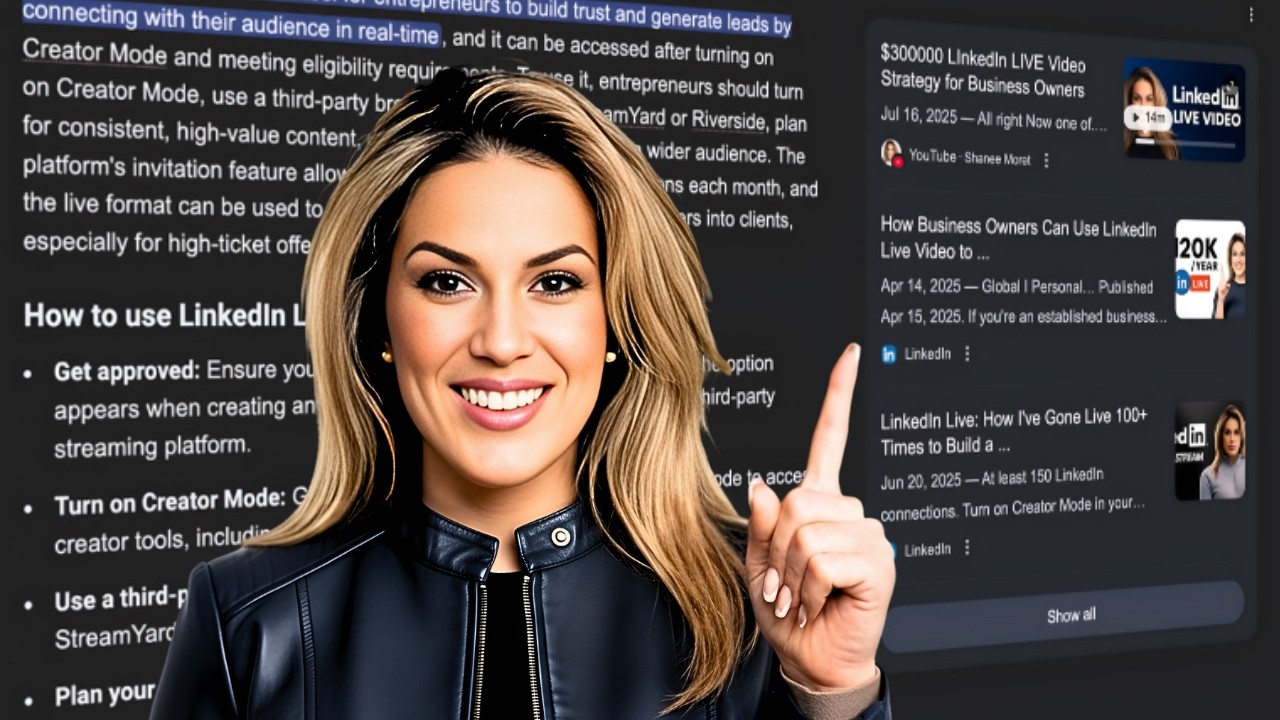
TL;DR — What You'll Learn
- AI search only suggests 5–10 resources — if you're not one of them, your prospects won't find you.
- Five steps to rank: niche expertise, audit your presence, optimize authority signals, create long-form content consistently, and go live monthly.
- Recency matters as much as quality. Content can rank in AI search within 24–48 hours — consistency gives you a compounding advantage.
- Your biggest edge is knowing your audience better than any generalist competitor. Leverage the conversations your dream clients are already having.
The way people search is changing. Instead of scrolling through pages of Google results, your prospects are asking ChatGPT, Google AI Mode, and Claude for recommendations — and those tools only suggest a handful of resources. If you're not one of them, you're invisible.
I've spent the last six months leveraging LinkedIn and YouTube to rank number one through five on a lot of AI search queries. Here are the five things that are working.
Step 1: Choose Your Niche Expertise
AI needs to understand that you are the best expert for a specific context, for a specific person. Being a generalist won't cut it. Being consistent and a generalist won't be good enough either.
The greatest advantage is knowing your audience — knowing exactly what they're putting into ChatGPT to find resources like yours. And it goes deeper than just asking AI what people are searching for.
Key Insight
Even within one topic, different audiences have different questions. A business owner asking about LinkedIn Live has different concerns than a professional worried about their boss seeing their content. The leverage is in knowing the specific conversations your dream clients are having.
One of my most recent clients found me because she searched Google AI for "how can I use LinkedIn Live to get more people to my webinars?" She found my YouTube video that literally addressed that exact question. I didn't have to convince or educate her — she had already decided. That's the power of matching your content to the queries closest to your offer.
Step 2: Audit Your AI Search Presence
Go to Google AI Mode, ChatGPT, ChatGPT's browser Atlas, and Claude. Search for the queries your ideal clients would use. See if you're one of the experts, videos, or resources being suggested.
If not, look at what is being suggested and create a better resource that's more useful for your specific audience.
How to Run Your AI Search Audit
Pick 3 core topics close to your main offer. For me, that's LinkedIn Live for entrepreneurs, LinkedIn newsletters for entrepreneurs, etc.
Search each topic across Google AI Mode, ChatGPT, and Claude. Note where you appear and where you don't.
Study the competition. What resources are being recommended? How can you create something better, more specific to your audience?
Step 3: Optimize Your Profiles and Website for Authority Signals
You're not just creating content for humans anymore. You're creating it for AI. And AI needs signals to understand that you are a credible expert worth recommending.
Here's what to audit across your social media profiles and website:
- Profile picture: Professional, consistent across all platforms. A blurry bathroom selfie vs. a polished headshot — that's a signal AI will factor in.
- Headlines and banners: Add testimonials, results, case studies, press mentions, and client logos.
- About sections: Specifics about how many clients you've helped, the results you've achieved, companies you've worked with.
- Website: Recent blog posts, relevant resources, press coverage, case studies, testimonials. Keep it fresh.
Don't Undervalue Your Results
"But I've only helped 10 clients this year." You could say: "Helped 10 CEOs achieve X, Y, Z in the last six months. This is how I did it." A lot of experts let their results become so commonplace that they stop publishing them. In AI-driven search, that's a disadvantage.
I've sat with new clients who have consulted with Nike and other global corporations — and have nothing related to that on their LinkedIn profile. Those logos need to be on the banner. Those specifics need to be in the about section. Even if you can't name the client, create case studies like: "How I helped a global company with 10,000+ employees do X, Y, Z."
Step 4: Prove Your Expertise Through Long-Form Content
If you thought you could get away without posting content consistently in 2026, you're mistaken. This is the year where consistency and quality are both required.
The key is building a sustainable system. Leverage your strengths:
- If you're comfortable with a teleprompter, record a 30-minute video weekly.
- Upload to YouTube, embed in a LinkedIn newsletter, chop into clips.
- If you prefer going live (like I do), write an outline, go live, and let the conversation flow.
The substance in your long-form content needs to be 100x better than the generic steps AI tools like ChatGPT or Google AI Mode would provide on their own. Share your personal experience — the lessons learned, the client stories, the mistakes. If your personal experience isn't embedded into your content, it won't be seen as original, and you'll be less likely to be found.
Recency Matters
A video can rank in Google AI Mode or ChatGPT search within 24–48 hours. If a competitor creates quality content more often than you, you're at a disadvantage. It's not just quality — it's quality multiplied by frequency.
Step 5: Go Live At Least Once a Month
As AI-generated content floods every feed, long-form live video will become one of the most powerful trust signals available. It proves you're a real person. It lets your audience ask questions. It creates community.
LinkedIn Live video events give you a unique advantage: if you have more than 4,000 connections, you can invite 4,000 first-degree connections to your event every single month. The math works out:
- 4,000 invites → ~500 registrations
- 500 registrations → ~100 live attendees
- 100 live attendees → a handful of high-quality inbound leads
- 5 inbound leads, close 3, with a $25K offer = $75K from one LinkedIn Live event
Beyond the leads, you get a long-form content asset you can repurpose into LinkedIn newsletters, YouTube videos, blog posts, and more — with zero editing required.
Pitfalls to Avoid
Staying a generalist. AI search rewards specificity. "Marketing expert" won't rank. "LinkedIn Live strategy for entrepreneurs" will. Pick your lane and go deep.
Only using generic keyword research. Tools like AnswerThePublic or asking ChatGPT what people search for give you generic starting points. The real leverage is knowing the specific, nuanced conversations your actual clients are having.
Being humble about your results. In the world of AI-driven search, not sharing your testimonials, case studies, and wins means AI has no signals to recommend you over your competitors. Share your results consistently.
Publishing inconsistently. Recency is a major ranking factor in AI search. One video a month vs. four videos a month — the more frequent publisher wins when quality is comparable.
Ignoring your social profiles. Your LinkedIn headline, banner, about section, and profile photo are all signals AI uses to evaluate your authority. A mismatched or outdated profile works against you.
Your Action Plan — Start This Week
Define your niche. Write down the one thing you want to be known for and the specific audience you serve. Get as specific as possible.
Run your AI search audit. Search 3 core topics in Google AI Mode, ChatGPT, and Claude. Document where you rank and where you're missing.
Update your profiles. Add results, testimonials, case studies, and a professional photo across LinkedIn, YouTube, and your website.
Create one long-form piece this week. A YouTube video, LinkedIn newsletter, or blog post. Embed your personal experience. Make it better than what AI search currently recommends.
Schedule your first LinkedIn Live. Even if it's just 20 minutes. Invite your connections, share your expertise, and create a long-form asset you can repurpose.
Frequently Asked Questions
Learn AI Skills for Your Business
No-code, no jargon. Just practical AI tools and strategies for business owners who want to stay ahead.
Explore AI Skills